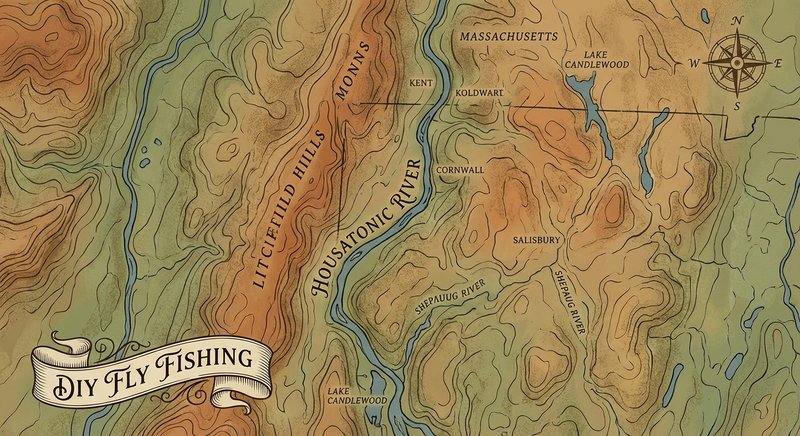
Housatonic River
Fly fishing in Connecticut · Intermediate · Best seasons: Spring, Summer, Fall, Winter
Target Species
Brown Trout, Rainbow Trout
About This Water
Western Connecticut river with trophy brown trout. TMA section offers year-round fishing.
Fishing Recommendations
The Housatonic River—affectionately known by locals as "The Housy"—is widely considered the premier fly fishing destination in Connecticut and one of the finest "big water" experiences in the Northeast. Flowing through the scenic Litchfield Hills, it offers a Western-style river experience right in New England.
🎣 Location Overview
The Housatonic is a large, freestone-style river, though its flows are influenced by several dams. What makes it special is its sheer scale; in the Trout Management Area (TMA)—which runs roughly 9 miles from the Falls Village dam down to the Cornwall Bridge—the river is wide, powerful, and filled with classic pocket water, deep pools, and long, glassy glides.
Unlike the intimate mountain brooks elsewhere in the state, the Housy demands respect. It is famous for its prolific aquatic insect life and its ability to produce "holdover" fish that grow to impressive sizes, taking on the colors and strength of wild trout.
🐟 Target Species & Behavior
- Brown Trout: The kings of the river. The Housy holds a mix of stocked fish and wary holdovers. These fish are notorious for hiding under the river's massive boulders or in deep undercut banks. During hatches, they move into the tail-outs of pools or "the seams" to sip dries.
- Rainbow Trout: Generally found in the faster, highly oxygenated water. They are known for their aerial acrobatics and tend to be less "picky" than the browns but are just as strong given the river's heavy current.
Behavior Note: Because the river is wide, trout are spread out. Look for "seams" (where fast and slow water meet) and "bubbles lines." In the heat of summer, trout congregate near cold-water tributaries (thermal refuges); fishing for them at this time is highly discouraged to prevent fish mortality.
📅 Best Times to Fish
- Spring (April – June): The Golden Era. This is prime time. Water levels stabilize, and the major hatches begin. The Hendrickson hatch in late April/early May is legendary.
- Summer (July – August): Trout fishing slows down as water temperatures rise. If the water hits 70°F, stop trout fishing. This is the time to switch to the river's world-class Smallmouth Bass fishing in the lower stretches.
- Fall (September – November): As temperatures drop, trout become aggressive again. This is the best time for streamer fishing for large, pre-spawn Browns. The Isonychia (Iso) hatch provides excellent dry fly action.
- Winter (December – March): Fishing is tough but rewarding. Focus on the deeper, slower pools. Midges and small stoneflies are the primary food sources.
🪰 Recommended Flies & Techniques
Dry Flies
- Hendrickson (Light & Dark): Sizes 12-14. Essential for May.
- March Brown: Sizes 10-12. Large, visible, and very effective in late May.
- White Fly (Ephron leukon): Sizes 12-14. This is the "Blizzard Hatch" in late August/early September.
- Isonychia: Sizes 10-12. A staple from June through October.
Nymphs
- Pat’s Rubber Legs: Sizes 6-10. The Housy has a massive population of Golden Stoneflies.
- Frenchie or Pheasant Tail: Sizes 14-18. Generalist patterns that mimic many nymphs in the river.
- Zebra Midge: Sizes 18-22. Essential for winter and technical summer tail-water periods.
Streamers
- Wooly Buggers (Black/Olive): A classic that never fails.
- Kelly Galloup’s Sex Dungeon: For when you are hunting the 20-inch trophy Browns in the fall.
Techniques
- Nymphing: European Style (Perdigons) or indicator nymphing is the most consistent way to catch fish here. Weight is key; you must get the fly down through the heavy surface currents.
- Swinging Wets: A traditional Housy technique. Swinging soft hackles through the riffles is deadly during a caddis or Hendrickson emergence.
💡 Pro Tips & Local Knowledge
- Wading Safety: The Housy is notorious for its "greasy" rocks and powerful current. Studded boots and a wading staff are non-negotiable. Do not underestimate the "push" of this river.
- The "Push-em-up" Spot: Located near the covered bridge in West Cornwall, this is one of the most famous pools. It holds a high concentration of fish but gets pressured.
- The Evening Rise: During the summer and fall, the river may look dead at 2:00 PM. Stay until the sun dips below the ridge; the river often "comes alive" with rising fish in the last 45 minutes of light.
- Observe the Flow: Check the USGS gauge at Falls Village. Ideal wading flows are between 400 and 700 cfs. Anything over 1,000 cfs becomes difficult and dangerous to wade.
⚠️ Important Information
- Regulations: The 9-mile stretch from Falls Village to Cornwall Bridge is a Trout Management Area (TMA). It is Catch and Release Only and restricted to Barbless Hooks.
- Permits: A Connecticut Fishing License and a "Trout & Salmon Stamp" are required. You can purchase these online via the CT DEEP website.
- Clean Your Gear: To prevent the spread of invasive Didymo (Rock Snot), ensure you dry your boots and gear completely between trips or wash them with a mild bleach solution.
- Thermal Refuges: From June through September, certain areas near tributary mouths are closed to fishing to protect heat-stressed trout. Pay close attention to posted signs.
Guide's Final Word: The Housatonic is a moody river. It can be frustrating one day and world-class the next. Be patient, watch the water, and respect the power of the current. Tight lines!
Bug Hatches & Matching Flies
| Hatch | Type | Peak months | Time of day | Hook sizes | Matching flies |
|---|---|---|---|---|---|
| Hendrickson Ephemerella subvaria | mayfly | April, May | Afternoon | #12-14 | Red Quill #12-14, Hendrickson Emerger #12-14, Pheasant Tail Nymph #12-14 |
| White Fly Ephoron leukon | mayfly | August, September | Evening/Night | #12-14 | White Wulff #10-12, Ephoron Spinner #12-14, White Sparkle Dun #12-14 |
| Isonychia Isonychia bicolor | mayfly | June, September, October | Late Afternoon/Evening | #10-12 | Iso Parachute #10-12, Prince Nymph #10-14, Zug Bug #10-12 |
| Grannom Caddis Brachycentrus | caddis | April, May | Morning/Afternoon | #14-16 | Elk Hair Caddis (Olive) #14-16, LaFontaine's Deep Sparkle Pupa #14-16, Peacock Caddis #14-18 |
| March Brown Maccaffertium vicarium | mayfly | May, June | Afternoon | #10-12 | March Brown American #10-12, Hare's Ear Nymph #10-14, Gray Fox #12-14 |
| Blue-Winged Olive Baetis | mayfly | April, May, September, October | Late Morning/Afternoon | #18-24 | BWO Parachute #18-22, RS2 #20-22, WD-40 #18-22 |
| Giant Stonefly Pteronarcys dorsata | stonefly | May, June | Night/Evening | #4-8 | Pat's Rubber Legs #4-8, Golden Stone Nymph #6-10, Stimulator (Orange) #6-10 |
| Light Cahill Stenacron interpunctatum | mayfly | June, July | Evening | #12-14 | Light Cahill #12-14, Cream Usual #12-16, Gold Ribbed Hare's Ear #12-14 |