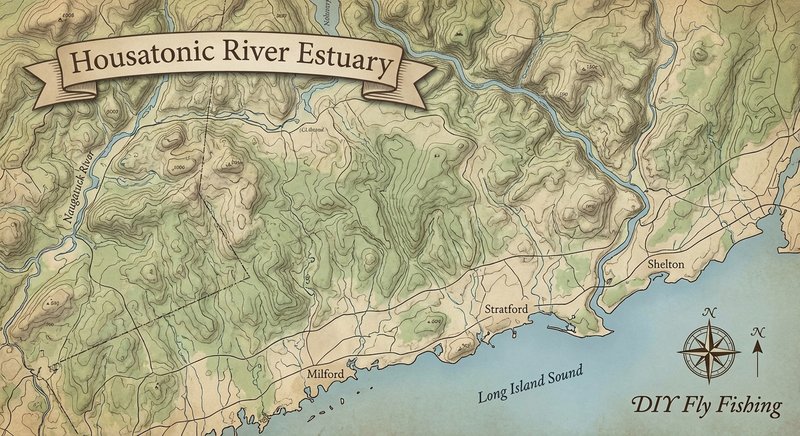
Housatonic River Estuary
Fly fishing in Connecticut · Intermediate · Best seasons: Spring, Summer, Fall
Target Species
Striped Bass, Bluefish, White Perch
About This Water
Stratford area estuary with striped bass. Spring migration spot.
Fishing Recommendations
The "Housy" is a legendary name in Northeast angling circles. While many know it for the trout water in Cornwall, the Housatonic River Estuary—where the river meets Long Island Sound between Stratford and Milford—is one of the most productive tidal fisheries in New England.
As your guide, here is the comprehensive breakdown for fly fishing the lower Housatonic.
🎣 Location Overview
The Housatonic Estuary is a dynamic, nutrient-rich environment that serves as a massive "fish highway." It transitions from the deep, rocky channels of the upper estuary (near Derby and Shelton) to sprawling salt marshes, mudflats, and sandbars as it reaches the Sound.
What makes it special is its holdover population. Unlike many rivers that go dormant, the Housy hosts one of the largest wintering populations of Striped Bass in the country. When the migratory fish arrive in the spring to join the residents, the biomass is staggering. It is a place of contrast: you’ll find yourself casting under massive industrial bridges one moment and stalking quiet, grassy banks the next.
🐟 Target Species & Behavior
Striped Bass
- Behavior: The undisputed kings of the river. In the spring, they are focused on the river’s massive herring run. In the fall, they key in on "peanut" (juvenile) menhaden.
- Holding Spots: They love structure. Look for bridge pilings, submerged rock piles, and the "seams" where fast current meets slower water. During high tide, they move onto the flats to forage; during low tide, they retreat into the deep 20–40 foot channels.
Bluefish
- Behavior: These are the "yellow-eyed demons" of the estuary. They usually arrive in late May or June. They are aggressive, fast, and will destroy flies.
- Holding Spots: Bluefish often patrol the mouth of the river near Short Beach and the breakwaters. They follow the schools of adult bunker (menhaden).
White Perch
- Behavior: Often overlooked but a blast on light fly tackle. They are semi-anadromous and travel in large schools.
- Holding Spots: They prefer the brackish sections, particularly around the mouth of small creeks or near the Sunnyside area in Shelton. They feed heavily on grass shrimp and small minnows.
📅 Best Times to Fish
- Spring (April – June): This is the "Main Event." As water temperatures hit 50°F, the river explodes with life. The river herring run brings in the biggest bass of the year.
- Summer (July – August): Best at night or during the "grey light" of dawn/dusk. The water can get warm, pushing fish toward the mouth of the river where the oxygenated Sound water pushes in.
- Fall (September – November): The "Fall Run." Cooling temperatures trigger massive schools of bait to move out of the marshes, leading to explosive surface blitzes.
The Golden Rule: In the estuary, tide is more important than time of day. The best fishing usually occurs during the "middle" three hours of a tide (rising or falling) when the water is moving fastest.
🪰 Recommended Flies & Techniques
Top Fly Patterns
- Hollow Fleyes / Beast Fleyes: (8–10 inches) In white/chartreuse or grey/white to mimic river herring in the spring.
- Clouser Minnow: (Chartreuse/White or Tan/White) The "universal" fly for the Housy. Use these to get deep in the current.
- Gurglers & Bob’s Bangers: High-floating topwater flies for early morning or when fish are blitzing on the surface.
- Ray’s Fly: A slim, local favorite that mimics silversides perfectly.
- Grass Shrimp Patterns: Small (Size 6-8) orange or pink flies for White Perch.
Techniques & Presentation
- The "Swing": Cast 45 degrees downstream with a fast-sinking line. Let the current pull the fly across the seam. This is deadly for Striped Bass holding behind bridge pilings.
- Intermediate Lines: An intermediate (slow-sink) line is the workhorse here. It stays below the surface chop but won't snag the bottom in the shallows.
- The Two-Handed Strip: When Bluefish are around, retrieve as fast as physically possible. You cannot outswim a Bluefish.
💡 Pro Tips & Local Knowledge
- The Bridge Strategy: The I-95 (Moses Wheeler) Bridge and the Washington Bridge (Route 1) create massive shadow lines at night. Stripers sit just inside the dark water and ambush bait passing through the light. Cast into the light and strip your fly into the darkness.
- Find the "Peanuts": In the fall, look for "shimmering" water or hovering terns. This indicates peanut bunker. Use a wide-profile fly (like a Mushmouth) but keep it short (3–4 inches).
- The "Housy Drift": If you are in a boat or kayak, don't use your motor. The fish in the estuary can be very "engine shy" in shallow water. Drift with the tide and use a stealthy approach.
- White Perch Secret: Use a 3-weight or 4-weight rod and a tandem rig (two small shrimp flies). It’s common to get "doubles" when you find a school.
⚠️ Important Information
Access Points
- Bond's Dock (Stratford): Excellent for shore access and night fishing near the bridges.
- Short Beach (Stratford): Best for fishing the mouth of the river and the sandbars.
- Sunnyside Recreation Area (Shelton): Great for targeting White Perch and holdover Stripers in the upper estuary.
- Wooster Island: Accessible only by boat/kayak, this is a prime spot for finding fish away from the crowds.
Regulations & Permits
- License: A Connecticut Marine Waters Fishing License is required for everyone 16 and older.
- Striped Bass: Check current DEEP regulations. Currently, CT uses a "Slot Limit" (typically 28" to less than 31"). Circle hooks are required when using natural bait, but for fly anglers, ensure you are using barbless hooks for easier releases.
- Safety: The Housy has very strong tidal currents and significant boat traffic. If wading, be extremely careful of the "muck" and the rapidly rising tide, which can trap you on a sandbar.
Gear Recommendation
- 9-foot 8-weight or 9-weight rod is the standard for Bass and Blues.
- Reels with sealed drags are highly recommended due to the brackish/salt environment. Rinse your gear thoroughly with fresh water after every outing!
Bug Hatches & Matching Flies
| Hatch | Type | Peak months | Time of day | Hook sizes | Matching flies |
|---|---|---|---|---|---|
| Hendrickson Ephemerella subvaria | mayfly | April, May | Afternoon | #12-14 | Red Quill #12-14, Hendrickson Emerger #14, Pheasant Tail #12-16 |
| White Fly Ephoron leukon | mayfly | August, September | Evening/Night | #12-14 | White Wulff #12, Snowshoe White Fly #12-14, White Gloved Howdy #12 |
| Tan Caddis Hydropsyche | caddis | May, June, July | Late Afternoon/Evening | #14-18 | Elk Hair Caddis #14-18, LaFontaine's Deep Sparkle Pupa #14-16, Holy Grail #14-18 |
| Blue Winged Olive Baetis | mayfly | April, May, September, October | Afternoon | #18-22 | RS2 #18-22, BWO Parachute #18-20, Barr's BWO Emerger #20 |
| Isonychia Isonychia bicolor | mayfly | June, August, September | Late Afternoon | #10-12 | Iso Parachute #10-12, Zug Bug #10-14, Prince Nymph #10-12 |
| March Brown Maccaffertium vicarium | mayfly | May, June | Afternoon | #10-12 | March Brown American #10-12, Gold Ribbed Hare's Ear #10-12 |
| Giant Stonefly Pteronarcys dorsata | stonefly | May, June | Evening/Night | #4-8 | Pat's Rubber Legs #6-8, Stimulator #8-10 |
| Chironomids Midge | midge | March, April, October, November | Anytime | #20-26 | Zebra Midge #20-24, Griffith's Gnat #20-22 |
| Ants/Beetles Formicidae/Coleoptera | terrestrial | July, August, September | Mid-day | #12-18 | Black Foam Ant #14-18, Chernobyl Ant #10-12, Crowe Beetle #14-16 |