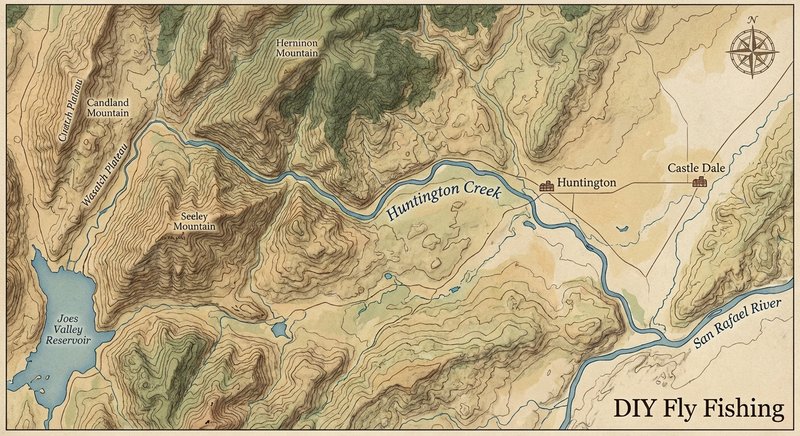
Huntington Creek
Fly fishing in Utah · Beginner · Best seasons: Summer, Fall
Target Species
Cutthroat Trout, Brown Trout
About This Water
Central Utah stream with wild cutthroat. Less pressured mountain fishing.
Fishing Recommendations
Huntington Creek is one of Utah’s premier "Blue Ribbon" fisheries, offering a quintessential high-mountain fly fishing experience. Tucked away in the Manti-La Sal National Forest, it is a place of rugged beauty, featuring steep canyon walls, boulder-strewn pockets, and some of the most beautiful trout in the Intermountain West.
🎣 Location Overview
Huntington Creek is a high-altitude drainage located in Emery County, Central Utah. It is primarily known for two distinct sections: the Right Fork (a tailwater section below Electric Lake) and the Left Fork (a more traditional freestone mountain stream).
What makes Huntington special is its diversity. You can spend the morning technical nymphing in deep canyon pools and the afternoon twitching terrestrials against undercut banks. The "Right Fork" is the crown jewel—a catch-and-release trophy section that feels much larger than it is due to the size of the fish it holds. The water is crystal clear, cold, and highly productive, making it a favorite for anglers who prefer sight-fishing and mountain scenery over the crowds of the Provo or Green Rivers.
🐟 Target Species & Behavior
- Brown Trout: These are the apex predators of the Right Fork. They are wild, buttery-gold, and can reach impressive sizes (18-22 inches) for such a small stream. They are wary and love structure—look for them under overhanging willows, deep in the "dark water" of boulder pockets, and tucked into undercut banks.
- Bonneville Cutthroat Trout: The native stars of the drainage. They are generally more opportunistic than the Browns and will often rise to a dry fly even when there isn't a visible hatch. They hold in the swifter riffles and the heads of pools.
- Behavior: Because the water is clear, these fish are "spooky." In the summer, they transition to a diet of terrestrials. In the fall, the Browns become highly aggressive as they prepare for the spawn.
📅 Best Times to Fish
- Summer (Late June – August): This is the prime window. Once the high-altitude snowpack melts and runoff subsides (usually by late June), the dry fly action explodes. July is peak season for Stoneflies and PMDs.
- Fall (September – October): My personal favorite time. The canyon turns gold and orange, and the Brown Trout become territorial. Blue Winged Olive (BWO) hatches occur on overcast days, providing some of the best dry fly fishing of the year.
- Prime Time of Day:
- Summer: 9:00 AM to 11:00 AM (nymphing) and 4:00 PM to dusk (dry fly).
- Fall: 11:00 AM to 4:00 PM. The water needs to warm slightly to trigger insect activity.
🪰 Recommended Flies & Techniques
Dry Flies
- Terrestrials: Fat Albert (Size 10-14), Parachute Ants (Size 16-18), and Chernobyl Ants.
- Mayflies: Parachute Adams (Size 14-18), Light Cahill (Size 16), and BWO Sparkle Duns (Size 18-20).
- Attractors: Royal Wulff or Stimulators (Size 12-16).
Nymphs
- The "Bread and Butter": Gold-Ribbed Hare’s Ear (Size 14-16) and Pheasant Tails (Size 16-20).
- Attractor Nymphs: Rainbow Warriors or Copper Johns (Red/Copper, Size 16).
- Midges: Zebra Midges (Black or Olive, Size 18-22) for the deeper holes.
Techniques
- Dry-Dropper: This is the most effective way to cover Huntington Creek. Use a buoyant hopper or Stimulator as your indicator and hang a Zebra Midge or Pheasant Tail 18–24 inches below it.
- Tight-Line Nymphing: Because the creek has many "pockets" created by boulders, a traditional indicator often gets caught in conflicting currents. High-sticking or Euro-style nymphing through the fast pockets is deadly.
- Stealth Approach: The water is often low and clear. Wade upstream, stay low, and avoid casting your shadow over the pools.
💡 Pro Tips & Local Knowledge
- The "Dam" Stretch: The first mile below the Electric Lake Dam is the most productive for large Browns. However, it is also the most technical. Use long, fine leaders (5x or 6x) to avoid spooking fish.
- Look for the Seeps: In the canyon sections, look for where small springs or seeps enter the creek. These spots provide consistent water temperatures and often hold a concentration of fish.
- The Left Fork Mystery: If the Right Fork feels too crowded, head to the Left Fork. The fish are smaller, but they are incredibly eager to take a dry fly, and you will often have miles of water to yourself.
- Twitch the Fly: When fishing terrestrials (ants/hoppers) in late August, don't be afraid to give the fly a tiny "skitter" or twitch. It often triggers a reflex strike from a Brown Trout hiding in the shadows.
⚠️ Important Information
- Access: Access is excellent via Utah Highway 31 (The Energy Loop). There are numerous pull-offs and forest service parking areas.
- Regulations:
- Right Fork (from Electric Lake dam downstream to the forks): This is Catch and Release only. Artificial flies and lures only. No bait is allowed.
- Always check the current Utah Fishing Guidebook before your trip, as regulations can change.
- Safety: This is high-country bear and cougar territory. While encounters are rare, keep your wits about you. Cell service is non-existent in the depths of the canyon—download your maps beforehand.
- Gear: A 8'6" or 9' 4-weight rod is the perfect tool for this water. It has enough backbone for the wind but is delicate enough for the small dries.
Huntington Creek is a gem of the Wasatch Plateau. Treat it with respect, practice barbless catch-and-release, and you'll find it to be one of the most rewarding technical small streams in the country.
Bug Hatches & Matching Flies
| Hatch | Type | Peak months | Time of day | Hook sizes | Matching flies |
|---|---|---|---|---|---|
| Blue Winged Olive Baetis | mayfly | March, April, October, November | Mid-day | #18-22 | Parachute Adams #18-22, RS2 #20-22, Pheasant Tail Nymph #18-20 |
| Pale Morning Dun Ephemerella excrucians | mayfly | June, July | Late Morning/Afternoon | #16-18 | PMD Sparkle Dun #16-18, Quill Gordon #16, Split Case PMD #16-18 |
| Western Green Drake Drunella doddsi | mayfly | July | Afternoon | #10-12 | Green Drake Hairwing #10-12, Hares Ear Nymph #10-12 |
| American Grannom Brachycentrus occidentalis | caddis | May | Afternoon/Evening | #14-16 | Elk Hair Caddis (Olive) #14-16, Peacock Caddis #16, LaFontaine Sparkle Pupa #14-16 |
| Golden Stonefly Hesperoperla pacifica | stonefly | June, July | All Day | #8-12 | Chubby Chernobyl #8-12, Pat's Rubber Leg #8-12 |
| Spotted Sedge Hydropsyche | caddis | July, August, September | Evening | #14-18 | Elk Hair Caddis (Tan) #14-18, Z-Wing Caddis #16 |
| Grasshoppers Orthoptera | terrestrial | August, September | Mid-day/Afternoon | #8-14 | Parachute Hopper #10-12, Morrish Hopper #8-14 |
| Midges Chironomidae | midge | February, March, October | Morning | #20-24 | Zebra Midge #20-22, Griffith's Gnat #20-22 |