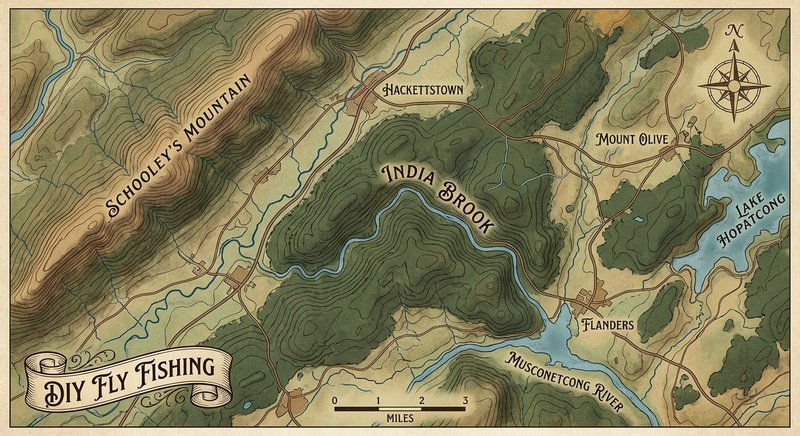
India Brook
Fly fishing in New Jersey · beginner · Best seasons: spring
Target Species
Rainbow Trout, Brown Trout
About This Water
Somerset County tributary with stocked trout. Spring fishing in wooded setting.
Fishing Recommendations
India Brook, located in the heart of Morris County, New Jersey, is one of the state’s finest examples of a "small water" success story. Tucked away in the Mendham and Randolph area, it offers a surprisingly rugged and scenic fly fishing experience that feels miles away from the suburban sprawl of Northern New Jersey.
As your guide, here is the comprehensive breakdown for fishing India Brook.
🎣 Location Overview
India Brook is a primary tributary to the North Branch of the Raritan River. It is characterized by its high gradient, rocky freestone bottom, and impressive cooling canopy. The stream is divided into two distinct experiences: the Wild Trout Stream section (upstream) and the Stocked section (downstream).
Anglers love India Brook because it offers "pocket water" fishing—a technical style of fishing where you target small eddies and soft spots behind boulders. The centerpiece of the area is India Brook Park and Mountainside Park, where the stream carves through a deep ravine, creating beautiful cascades and the notable Buttermilk Falls.
🐟 Target Species & Behavior
- Wild Brown Trout: The upper reaches of India Brook hold a self-sustaining population of wild Browns. These fish are beautiful but notoriously "spooky." They hold in tight undercut banks, beneath overhanging rhododendrons, and in the deepest shadows of the ravine.
- Stocked Rainbow Trout: In the lower sections and easily accessible park entries, the NJ Division of Fish and Wildlife stocks Rainbows during the spring. These fish tend to congregate in the larger pools and at the base of the falls before spreading out into the faster runs.
- Behavior: Because the water is clear and the stream is relatively narrow (10–20 feet in most spots), the fish are highly sensitive to vibration and shadows. Approach every pool as if you are hunting.
📅 Best Times to Fish
Spring (The Prime Window)
- April: This is the peak of the stocking season and the beginning of the early hatches. Water levels are usually high, so heavy nymphs are required.
- May: The "Golden Month." Water temperatures stabilize between 55°F and 62°F. This is when the insect life is most active and dry fly fishing becomes consistent.
- Early June: Great fishing continues, though water levels begin to drop. This is the best time to target wild fish in the upper reaches before the summer heat.
Best Times of Day
- Early Spring: 10:00 AM – 3:00 PM (Wait for the sun to warm the water slightly).
- Late Spring: Dawn and Dusk. The "Evening Rise" on India Brook can be magical during a Caddis hatch.
🪰 Recommended Flies & Techniques
Top Fly Patterns
- Nymphs: Bead-head Pheasant Tails (#14–18), Gold-ribbed Hare’s Ears (#12–16), and Zebra Midges (#18–22). For the stocked Rainbows, a "Mop Fly" or a "Squirmy Wormy" in pink or chartreuse works wonders after a rain.
- Dry Flies: Blue Winged Olives (BWO) (#18–20) for cloudy April days. Adams (#14–18) is the perfect generalist. Tan or Olive Elk Hair Caddis (#14–16) are essential for May evenings.
- Streamers: Small Woolly Buggers (#10–12) in black or olive. Strip these through the deeper pools near the falls to entice larger resident Browns.
Effective Techniques
- High-Sticking/Tight-Line Nymphing: Because the currents are complex and multi-directional, using a float (indicator) can be frustrating. Keeping a tight line with minimal fly line on the water allows for a more natural drift in the pockets.
- The "Dapping" Approach: In the overgrown wild sections, you often won't have room for a backcast. Creep up to the bank and simply drop your fly onto the water surface using the rod tip.
💡 Pro Tips & Local Knowledge
- Stealth is Mandatory: Wear earth tones (greens and browns). Avoid shiny watches or forceps that might catch the sun. If you can see the fish, they have likely already seen you.
- Fish the "Micro-Pockets": Most anglers walk past the small 1-foot deep pockets behind rocks. On India Brook, a wild Brown Trout will often live in a pocket no bigger than a dinner plate.
- The Buttermilk Falls Area: This is the most popular spot, but also the most pressured. For a better experience, hike at least a half-mile upstream or downstream away from the main parking lot trailheads to find unpressured fish.
- Gear Selection: A 7’6” or 8’0” 3-weight or 4-weight rod is ideal. Anything longer will get tangled in the overhanging trees; anything heavier will spook the fish upon the line hitting the water.
⚠️ Important Information
- Regulations: India Brook contains a "Wild Trout Stream" designation in certain stretches. This means special regulations apply:
- Artificial Lures Only: No bait (worms, powerbait) is permitted in these sections.
- Size Limits: There is often a 9-inch minimum for keeping trout (though catch-and-release is highly encouraged to protect the wild genetics).
- Always check the current NJ Freshwater Fishing Digest for exact boundary markers.
- Access: Use the parking lots at India Brook Park (Mendham) or Mountainside Park (Randolph). The trails are well-maintained but can be steep and slippery near the ravine.
- Permits: You must have a valid New Jersey Fishing License and a Trout Stamp. These can be purchased easily online via the NJ Fish & Wildlife website.
- Safety: The rocks in the ravine are notoriously slick. Studded wading boots or felt soles (where legal) are highly recommended. Watch out for Poison Ivy along the trail banks in late spring.
Bug Hatches & Matching Flies
| Hatch | Type | Peak months | Time of day | Hook sizes | Matching flies |
|---|---|---|---|---|---|
| Blue-Winged Olive Baetis / Pseudocloeon | mayfly | April, May, September, October | Mid-day/Afternoon | #18-22 | RS2 #20-22, Parachute BWO #18-20, BWO Emerger #18-22 |
| Hendrickson Ephemerella subvaria | mayfly | April, May | Afternoon | #12-14 | Red Quill #12-14, Hendrickson Nymph #12-14, Pheasant Tail #14 |
| Tan Caddis Hydropsyche | caddis | May, June | Morning/Evening | #14-18 | Elk Hair Caddis #14-16, LaFontaine's Deep Sparkle Pupa #14-18, Holy Grail #16 |
| Sulfur Ephemerella invaria / dorothea | mayfly | May, June | Evening | #14-18 | Sulfur Parachute #16-18, CDC Sulfur Emerger #16-18, Sulfur Cripple #16 |
| Little Black Stonefly Taeniopteryx / Allocapnia | stonefly | February, March | Mid-day | #16-20 | Early Black Stone #16-18, Zebra Midge #18-20, Copper John (Black) #16-18 |
| Light Cahill Stenacron / Stenonema | mayfly | June, July | Evening | #12-16 | Light Cahill #14-16, Gold Ribbed Hare's Ear #14-16 |
| Ants and Beetles Formicidae / Coleoptera | terrestrial | July, August, September | All Day | #14-22 | Black Foam Ant #16-20, Cinnamon Ant #18-22, Crowe Beetle #14-16 |
| Green Drake Ephemera guttulata | mayfly | May, June | Evening | #8-12 | Green Drake #10-12, Coffin Fly #10-12 |
| Midges Chironomidae | midge | January, February, March, December | All Day | #18-24 | Griffith's Gnat #20-22, Zebra Midge (Red/Black) #20-24, Mercury Midge #20 |