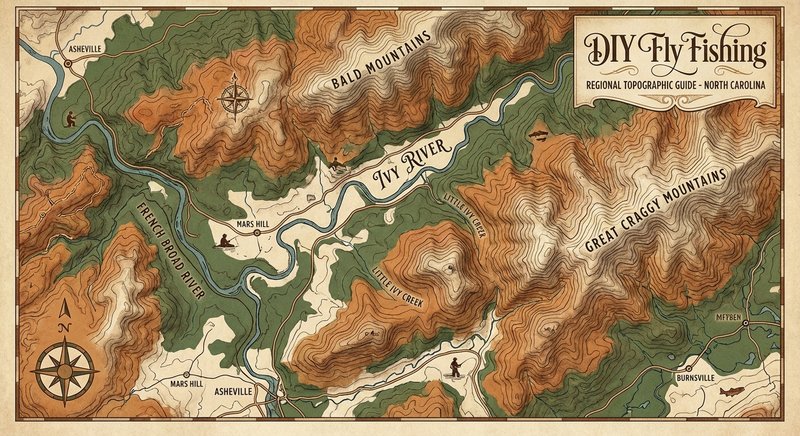
Ivy River
Fly fishing in North Carolina · Beginner · Best seasons: Spring, Summer, Fall
Target Species
Brown Trout, Rainbow Trout
About This Water
Mountain stream north of Asheville with wild trout. Less pressured waters.
Fishing Recommendations
The Ivy River (specifically the section known as the Big Ivy) is a gem of Western North Carolina. Located just north of Asheville near the town of Barnardsville, it offers a classic Appalachian freestone fishing experience. While the lower sections can get warm and sluggish, the upper reaches flowing out of the Pisgah National Forest provide some of the most scenic and productive trout water in the Blue Ridge Mountains.
🎣 Location Overview
The Ivy River is a tributary of the French Broad River. For the fly angler, the "Big Ivy" is the primary focus. It begins high in the Coleman Boundary area of the Pisgah National Forest, a high-elevation cove surrounded by some of the tallest peaks in the East (including the Craggy Gardens area).
The river is characterized by its "stair-step" nature: a series of plunge pools, tight pocket water, and large boulders. The water is crystal clear in the upper reaches, requiring a stealthy approach. As it flows downstream toward Barnardsville, it widens and transitions into a "Hatchery Supported" mountain stream, offering a mix of accessible roadside fishing and rugged backcountry trekking.
🐟 Target Species & Behavior
The Ivy River holds a mix of Rainbow and Brown Trout.
- Rainbow Trout: These are the primary residents in the mid-to-lower sections. They are often stocked by the NCWRC, meaning they can be aggressive and less "picky" about fly choice, usually holding in the faster riffles and at the heads of pools.
- Brown Trout: The prize of the Ivy. You will find wild browns in the upper high-elevation reaches and some "holdover" browns in the deeper, darker holes of the lower river. They are notoriously wary, preferring undercut banks, the shadows of large boulders, and deep "tail-outs" at dusk.
- Behavior: In the summer, fish move into the highly oxygenated "bubble curtains" at the base of waterfalls. In the spring and fall, they spread out into the flatter runs to feed on active hatches.
📅 Best Times to Fish
Optimal Seasons
- Spring (March – May): The peak of the season. Water temperatures rise into the 50s, triggering massive hatches of Quill Gordons, March Browns, and Hendrickson mayflies.
- Summer (June – August): Focus on the upper Coleman Boundary area where the canopy provides shade and higher elevation keeps the water cool. Terrestrial fishing (ants/beetles) is spectacular here.
- Fall (September – November): The most beautiful time to be on the water. Brown trout become aggressive as they prepare to spawn. Blue Winged Olives (BWO) are the dominant hatch.
Prime Windows
- Time of Day: During the heat of summer, fish the "bookends"—dawn and dusk. In the spring and fall, the 11:00 AM to 3:00 PM window is often most productive as the sun warms the water enough to trigger insect activity.
🪰 Recommended Flies & Techniques
Top Fly Patterns
- Dry Flies: Parachute Adams (size 14-18), Elk Hair Caddis (tan/yellow, size 14-16), Yellow Sally Stonefly (size 14-16), and Stimulators (orange/yellow, size 12-14).
- Nymphs: Bead-head Pheasant Tail (size 16-18), Gold Ribbed Hare’s Ear (size 14-16), and the "Sexy Walt's" worm. Don't forget the Pat's Rubber Legs (black/brown) for high-water days.
- Terrestrials: Black Foam Ants, Beetles, and Dave’s Hopper (size 10-14).
- Streamers: Wooly Buggers (olive or black, size 8-10) are effective in the deeper holes after a rain.
Effective Techniques
- Dry-Dropper: This is the "bread and butter" on the Ivy. Use a buoyant Stimulator or Parachute Adams as your "indicator" and hang a small Pheasant Tail nymph 18–24 inches below it.
- High-Sticking: Because the river is rocky, traditional long-line nymphing often leads to snags. Use a short line and keep your rod tip high to "guide" your nymph through the pocket water.
- Stealth: The water is clear. Wear drab clothing (earth tones), stay low, and cast upstream to avoid spooking fish.
💡 Pro Tips & Local Knowledge
- The Coleman Boundary Secret: Drive all the way to the end of Forest Service Road 74. The further you hike upstream from the last parking area, the more "wild" the fish become. You will trade size for beauty and solitude.
- Watch the Gauge: The Ivy is a freestone river, meaning it reacts quickly to rain. If the French Broad (nearby) is chocolate milk, the Ivy might be fishable in 24 hours, whereas larger rivers take days to clear.
- The "Green" Stage: The best fishing occurs when the water is slightly tinted "green" after a rain but is still clear enough to see the bottom in three feet of water. This gives the fish confidence to leave their hiding spots.
- Wading Safety: The rocks in the Ivy are notoriously slick. Felt-soled boots or rubber soles with studs are highly recommended.
⚠️ Important Information
Access
- Public Access: Much of the upper river is within the Pisgah National Forest (public). The lower sections along Barnardsville Hwy (NC-197) often pass through private land; look for the NCWRC "Public Mountain Trout Water" signs (green/white or red/white) to ensure you are in a legal fishing zone.
Regulations
- Hatchery Supported (Green Signs): These sections are closed in March and open the first Saturday in April. There are no lure restrictions, and you can keep up to 7 fish.
- Wild Trout (Blue Signs): In the higher elevations, you may encounter Wild Trout designations. These are catch-and-release or highly restricted, requiring single-hook artificial lures only.
- Always check the current NCWRC Trout Map before heading out.
Safety & Gear
- Bear Country: The Coleman Boundary is prime bear habitat. Carry bear spray if you are hiking deep into the headwaters.
- Tackle: A 7.5 to 8.5-foot 3-weight or 4-weight rod is perfect for this water. A 9-foot rod can be cumbersome in the tighter, rhododendron-choked sections.
Bug Hatches & Matching Flies
| Hatch | Type | Peak months | Time of day | Hook sizes | Matching flies |
|---|---|---|---|---|---|
| Quill Gordon Epeorus pleuralis | mayfly | March, April | Midday | #12-14 | Quill Gordon Dry #12-14, Quill Gordon Wet Fly #12-14, Gold Ribbed Hare's Ear #12-14 |
| Blue Winged Olive Baetis spp. | mayfly | March, April, October, November | Afternoon | #18-22 | RS2 #20-22, Parachute Adams #18-22, Pheasant Tail #18-20 |
| Yellow Sally Isoperla spp. | stonefly | May, June, July | Late Afternoon/Evening | #14-16 | Yellow Sally Stone #14-16, Little Yellow Sloan #14-16, Pat's Rubber Leg (Yellow) #14-16 |
| Light Cahill Stenacron interpunctatum | mayfly | June, July | Evening | #12-16 | Light Cahill Dry #12-16, Cream Usual #14-16 |
| Cinnamon Caddis Hydropsyche spp. | caddis | May, June, September | Evening | #14-18 | Elk Hair Caddis (Tan) #14-16, Holy Grail #14-16, Soft Hackle Hare's Ear #14-18 |
| March Brown Maccaffertium vicarium | mayfly | April, May | Afternoon | #10-14 | March Brown Dry #12-14, Gold Ribbed Hare's Ear #10-12 |
| Giant Black Stonefly Pteronarcys dorsata | stonefly | April, May | Morning/Evening | #4-8 | Girdle Bug #6-10, Black Stimulator #8-12 |
| Zebra Midge Chironomidae | midge | January, February, December | Midday | #18-24 | Zebra Midge (Black/Silver) #18-22, Griffith's Gnat #20-22 |