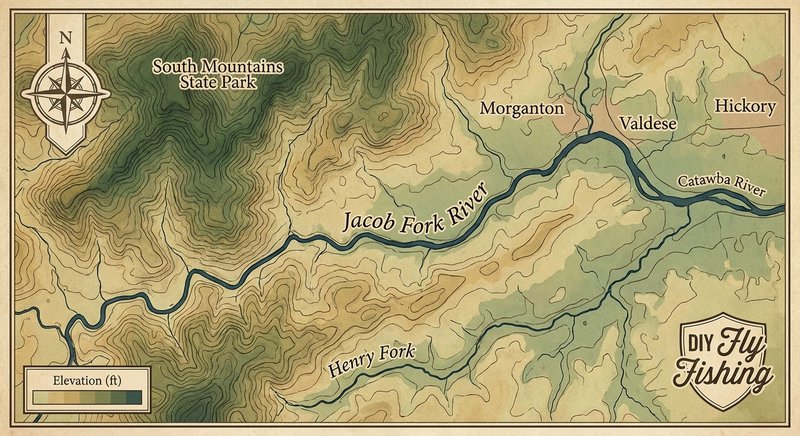
Jacob Fork River
Fly fishing in North Carolina · Intermediate · Best seasons: Spring, Fall
Target Species
Brown Trout, Rainbow Trout
About This Water
Piedmont stream in South Mountains State Park. Wild trout and waterfalls.
Fishing Recommendations
The Jacob Fork River, nestled within the rugged South Mountains State Park near Connelly Springs, North Carolina, is a gem of the Piedmont-foothills transition. It is one of the southernmost "Delayed Harvest" (DH) trout waters in the state, offering a unique mountain fishing experience surprisingly close to Charlotte and Hickory.
Here is your comprehensive guide to fly fishing the Jacob Fork.
🎣 Location Overview
The Jacob Fork is a classic freestone stream characterized by its high-gradient descent through the South Mountains. The most popular and productive section is located within South Mountains State Park.
What makes it special is the dramatic scenery—specifically the 80-foot High Shoals Falls—and the diversity of the water. You will find everything from plunging pocket water and massive boulders to long, slow-moving pools and technical riffles. Because it is a "Delayed Harvest" stream, the state heavily stocks it with high densities of trout, making it an excellent destination for both beginners looking for high catch rates and experts practicing technical presentations.
🐟 Target Species & Behavior
The Jacob Fork is primarily a Rainbow and Brown Trout fishery.
- Rainbow Trout: These are the "acrobats" of the river. They tend to hold in faster water, often sitting in the "heavy" part of the riffles or the bubbly oxygenated water at the heads of pools. They are aggressive feeders and will often move a significant distance to grab a fly.
- Brown Trout: The Browns here prefer structure and stealth. Look for them in the "giddy-ups" (the slow water right next to fast current), under overhanging rhododendrons, or tucked tightly against the large granite boulders.
- Behavior: In the early DH season (October/November), the fish are aggressive and less "leader shy." As the season progresses into Spring, these fish become highly educated due to heavy pressure. They will move from the deep wintering holes into shallower riffles as water temperatures rise in April and May.
📅 Best Times to Fish
While you can fish here through the winter, the "Prime" windows are:
- Spring (March – May): This is the crown jewel of the season. Rising water temperatures trigger insect hatches, and the fish become very active. April is often the best month for dry fly action.
- Fall (October – November): The Delayed Harvest season begins October 1st. The river is freshly stocked, the foliage is stunning, and the fish are hungry after being moved from the hatchery.
- Time of Day:
- Late Fall/Winter: Wait for the sun to hit the water (10:00 AM – 3:00 PM). A 2-degree rise in temp can turn the bite on.
- Spring: Early morning for nymphing; late afternoon/evening for caddis and mayfly hatches.
🪰 Recommended Flies & Techniques
Nymphing (The High-Percentage Play)
Since the Jacob Fork has a lot of pocket water, "High-Sticking" or European Nymphing is incredibly effective here.
- Attractor Nymphs: Mop Flies (Chartreuse/Tan), Squirmy Wormies (Red/Pink), and Egg patterns (Oregon Cheese). These work best in Oct/Nov.
- Natural Nymphs: Pheasant Tails (#14-18), Hare’s Ears (#12-16), and Sexy Walt’s Worms.
- Stoneflies: Large Pat’s Rubber Legs (#8-12) in black or coffee are great as a "lead" fly to get your rig deep.
Dry Flies
- Spring Hatches: Blue Quills, Quill Gordons, and Maryland Hendricksons.
- Generalists: Elk Hair Caddis (Tan/Olive #14-16) and Yellow Stimulators. The Jacob Fork has a lot of yellow sallies in late spring.
- Terrestrials: In early October or late May, don't be afraid to throw a Beetle or Ant pattern near the banks.
Streamers
- Patterns: Black or Olive Woolly Buggers, or a Sparkle Minnow.
- Technique: Strip them through the deep pools or "swing" them through the tail-outs of the larger runs. This is the best way to target the larger "holdover" Brown trout.
💡 Pro Tips & Local Knowledge
- The "Hike-In" Rule: The parking lot near the picnic area gets crowded. Most anglers fish within 200 yards of their cars. If you hike 15–20 minutes upstream toward the falls, the fishing pressure drops significantly, and the fish are less spooky.
- Watch the Gauge: The Jacob Fork is rain-dependent. If there has been a heavy downpour, the river can turn "chocolate milk" quickly. Check the USGS gauge for "Jacob Fork at Ramsey." You want a steady or falling flow.
- The Stealth Factor: Because the water is often crystal clear, wear earth-toned clothing (greens/browns) and avoid "lining" the fish. Use long leaders (9-12ft) ending in 5x or 6x fluorocarbon tippet when the water is low.
- The "Hidden" Water: Don't ignore the tiny pockets. A pocket the size of a hula-hoop behind a rock can hold a 14-inch Rainbow.
⚠️ Important Information
Access
- Primary Access: South Mountains State Park (3001 South Mountain Park Ave, Connelly Springs, NC).
- Follow the High Shoals Falls Loop Trail; the river parallels the trail for a significant distance.
Regulations
- Delayed Harvest (DH): From October 1st until the first Saturday in June, the river is Catch and Release Only and restricted to Single-Hook Artificial Lures only. No bait or multiple hooks allowed.
- License: You must have a valid North Carolina Fishing License with a "Trout Privilege" (Trout Stamp).
Special Considerations
- Cell Service: It is virtually non-existent in the gorge. Download your maps or let someone know your plan before you enter the park.
- Wading Safety: The rocks in the Jacob Fork are notoriously "greasy" and slick. Aluminum-barred boots or felt soles with studs are highly recommended. A wading staff is a smart move if you plan to navigate the boulder fields near the falls.
Bug Hatches & Matching Flies
| Hatch | Type | Peak months | Time of day | Hook sizes | Matching flies |
|---|---|---|---|---|---|
| Blue Winged Olive Baetis | mayfly | February, March, October, November | Late Morning/Afternoon | #18-22 | RS2 #18-22, Parachute Adams #18-22, Pheasant Tail Nymph #18-20 |
| Quill Gordon Epeorus pleuralis | mayfly | March, April | Mid-day | #12-14 | Quill Gordon Dry #12-14, Iron Blue Dun #14, Hare's Ear Nymph #12-14 |
| Grannom Caddis Brachycentrus | caddis | April | All Day | #14-16 | Elk Hair Caddis (Dark) #14-16, Holy Grail Caddis #14-16, Peacock Caddis #16 |
| Sulfur Ephemerella invaria | mayfly | May, June | Evening | #14-18 | Sulfur Parachute #14-18, Sulfur Emerger #16-18, Frenchie #16 |
| Yellow Sally Isoperla | stonefly | May, June, July | Afternoon/Evening | #14-16 | Yellow Stimulator #14-16, Little Yellow Sloan #16, Iron Lotus #16 |
| Light Cahill Stenonema | mayfly | June, July | Evening | #12-14 | Light Cahill #12-14, Cream Usual #14, Gold Ribbed Hare's Ear #14 |
| Midges Chironomidae | midge | January, February, December | All Day | #20-26 | Zebra Midge #18-22, Griffith's Gnat #20-24, Mercury Midge #20-22 |
| Terrestrials Formicidae/Coleoptera | terrestrial | July, August, September | All Day | #12-18 | Black Foam Beetle #14-16, Cinnamon Ant #16-18, Green Weenie #12-14 |