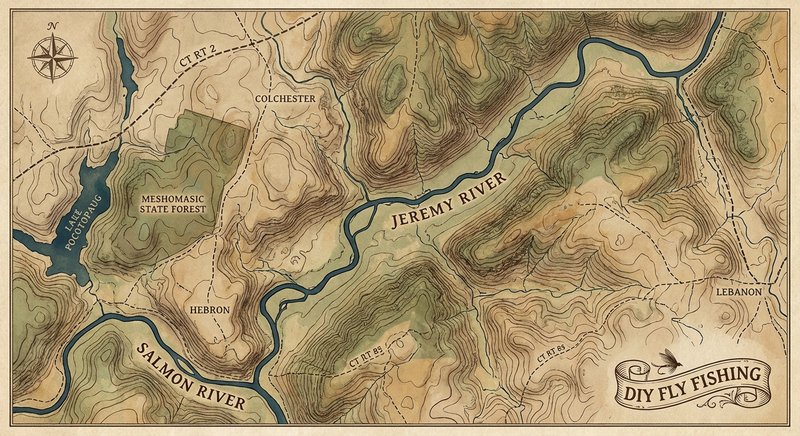
Jeremy River
Fly fishing in Connecticut · Beginner · Best seasons: Spring, Summer, Fall
Target Species
Brown Trout, Brook Trout
About This Water
Middlesex County stream with wild trout. Salmon River tributary.
Fishing Recommendations
The Jeremy River is one of Connecticut’s hidden gems. While it often plays second fiddle to its neighbor, the Salmon River, the Jeremy offers a more intimate, technical, and classic New England freestone experience. Flowing through Colchester and Hebron, it is a quintessential "pocket water" stream that rewards the observant angler.
🎣 Location Overview
The Jeremy River is a primary tributary to the Salmon River. It is characterized by its clear, cool water, rocky substrate, and dense riparian canopy. Unlike the wider, more open Salmon River, the Jeremy is tighter and more "brushy," requiring accurate casting and stealth.
What makes it special is its diversity of water. You will find everything from fast-moving riffles and plunge pools to slow, deep bends with undercut banks. Much of the river parallels the Air Line State Park Trail, which provides excellent hiking access to stretches that are far removed from road noise. It feels much more "wild" than many other stocked streams in the state.
🐟 Target Species & Behavior
- Brown Trout: The Jeremy receives a healthy stocking of Brown Trout from the CT DEEP. However, because of the river's deep holes and woody debris, it has a decent population of "holdovers"—fish that have survived a season or more and become much warier and darker in color.
- Brook Trout: You will find stocked brookies in the main stem, but the upper reaches and the small feeder springs hold wild, native Brook Trout. These fish are small (4–8 inches) but vibrantly colored and extremely aggressive.
Behavior: These fish are structure-oriented. In the Jeremy, if there isn't a rock or a log over their heads, they feel vulnerable. They hold in the "cushion" in front of boulders or in the deep troughs behind them. During hatches, they will move into the tail-outs of pools to sip emergers.
📅 Best Times to Fish
- Spring (April – June): This is the prime window. The state stocks heavily in April. By May, the water temperatures stabilize, and the major insect hatches begin.
- Summer (July – August): The Jeremy can get low and clear. Focus on the early morning (6:00 AM – 10:00 AM) or the last hour of light. Pro Tip: Bring a thermometer. If the water hits 70°F, stop fishing to protect the trout.
- Fall (September – October): A fantastic time to be on the river. The Brown Trout become aggressive and territorial ahead of the spawn. The foliage along the Air Line Trail makes for a spectacular backdrop.
- Optimal Conditions: Fish 24–48 hours after a moderate rain. The slight stain in the water gives the trout confidence to leave their hiding spots.
🪰 Recommended Flies & Techniques
Dry Flies
The Jeremy has classic hatches. You don't need a thousand patterns; you need a good presentation.
- Spring: Hendrickson (#12-14), March Brown (#10-12), and Blue Winged Olives (#18-22).
- Summer: Elk Hair Caddis (#14-18) is the bread and butter here. Terrestrials are vital—Ants and Beetles (#14-16) dropped near undercut banks are deadly.
- Fall: BWO and Isonychia (#12).
Nymphs
Nymphing accounts for 80% of the fish caught here.
- Patterns: Pheasant Tail (#14-18), Gold-Ribbed Hare’s Ear (#12-16), and Prince Nymphs.
- Tactics: Tight-line (Euro) nymphing is incredibly effective in the Jeremy’s pocket water. If using an indicator, keep it small and subtle.
Streamers
For the bigger holdover Browns, don't be afraid to go big.
- Patterns: Woolly Buggers (Black or Olive, #8-10) or small Muddler Minnows.
- Technique: Swing them through the deep bends or "strip-and-pause" through the larger pools.
💡 Pro Tips & Local Knowledge
- Hike the Air Line Trail: Most anglers crowd the bridges at Route 85 or Grayville Rd. Park at the Air Line Trail trailhead and walk a mile in. You'll find pristine water that sees half the fishing pressure.
- The "Two-Fly" Rig: Because the water is varied, I always run a "Dry-Dropper." Use a high-visibility dry fly (like a Stimulator) and hang a small Pheasant Tail nymph 18 inches below it. This allows you to cover the riffles and the pools simultaneously.
- Stealth is Mandatory: The water is often crystal clear. Wear earthy colors (greens/browns), avoid splashing, and cast from a low profile. If you see the fish, they have likely already seen you.
- The Confluence: Where the Jeremy meets the Blackledge River to form the Salmon River is a "honey hole." This area holds more fish because of the increased oxygen and depth.
⚠️ Important Information
- Access: Key access points include Grayville Falls Town Park (beautiful but can be busy) and various crossings along Route 85. The Air Line Trail is the best way to access the middle stretches.
- Regulations: The Jeremy River generally falls under "Statewide Streams" regulations, but it borders the Salmon River Trout Management Area (TMA).
- Check the current CT DEEP Fishing Guide for specific dates on Catch & Release vs. Harvest seasons.
- Licenses: You must have a valid Connecticut Fishing License and a Trout & Salmon Stamp. These can be purchased online via the CT DEEP website.
- Wading Safety: The rocks in the Jeremy are notoriously "greasy" with algae. Felt soles or studded rubber boots are highly recommended to avoid a dunking.
Guide’s Final Word: The Jeremy is a river for the "thinking angler." It’s not about long casts; it’s about short, accurate placements and reading the water. Treat the wild Brookies with care, and you’ll find this to be one of the most rewarding small streams in Southern New England.
Bug Hatches & Matching Flies
| Hatch | Type | Peak months | Time of day | Hook sizes | Matching flies |
|---|---|---|---|---|---|
| Blue Winged Olive Baetis | mayfly | April, October | Mid-day/Afternoon | #18-22 | BWO Sparkle Dun #18-20, Pheasant Tail #18-22, RS2 #20-22 |
| Hendrickson Ephemerella subvaria | mayfly | April, May | Afternoon | #12-14 | Red Quill #12-14, Hendrickson Emerger #12-14, Hare's Ear #12-14 |
| Grannom Caddis Brachycentrus | caddis | April, May | Morning/Afternoon | #14-16 | Elk Hair Caddis (Olive) #14-16, Peacock Caddis #16, Deep Sparkle Pupa #14-16 |
| Sulfur Ephemerella invaria/dorothea | mayfly | May, June | Evening | #14-18 | Sulfur Parachute #14-18, CDC Sulfur Emerger #16-18, Frenchie #16-18 |
| Light Cahill Stenacron / Stenonema | mayfly | June, July | Evening/Dusk | #12-14 | Light Cahill #12-14, Gold Ribbed Hare's Ear #12-14 |
| Isonychia (Slate Drake) Isonychia bicolor | mayfly | June, September | Late Afternoon/Evening | #10-12 | Iso Parachute #10-12, Zug Bug #10-12, Prince Nymph #10-12 |
| Cinnamon Caddis Hydropsyche | caddis | June, July, August | Evening | #16-18 | Elk Hair Caddis (Tan) #16-18, LaFontaine Sparkle Pupa #16-18 |
| Trico Tricorythodes | mayfly | July, August, September | Early Morning | #22-26 | Trico Spinner #22-24, Trico Parachute #22-24 |
| Terrestrials Formicidae / Coleoptera | terrestrial | July, August, September | All Day | #12-18 | Black Foam Ant #14-18, Flying Ant #16-18, Cinnamon Ant #16-18 |
| Winter Stonefly Taeniopterygidae | stonefly | February, March | Mid-day | #16-20 | Early Brown Stone #16-18, Copper John (Black) #16-20 |