Johns River
Fly fishing in North Carolina · Beginner · Best seasons: Spring, Summer, Fall
Target Species
Brown Trout, Rainbow Trout
About This Water
Mountain stream near Blowing Rock with wild and stocked trout. Good access.
Fishing Recommendations
The Johns River in North Carolina is one of the hidden gems of the Pisgah National Forest. Often overshadowed by its famous neighbor, Wilson Creek, the Johns River offers a more secluded, rugged experience for anglers seeking both wild and stocked trout in a classic Appalachian freestone setting.
🎣 Location Overview
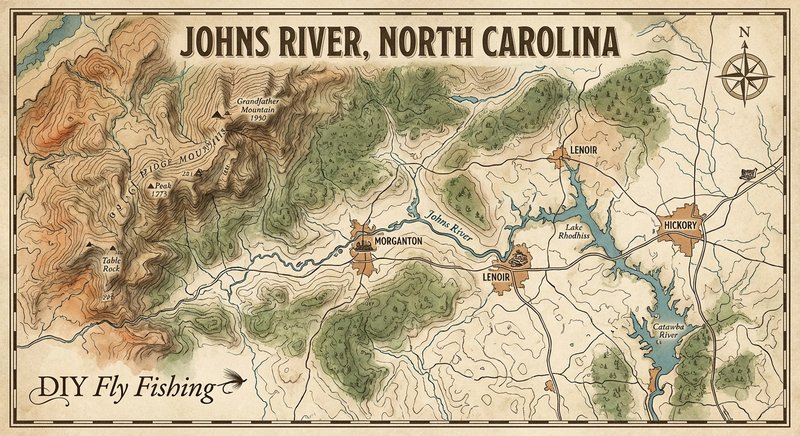
The Johns River originates in the steep, high-elevation ridges of the Blue Ridge Mountains near Blowing Rock and flows south through Caldwell and Burke counties. It is characterized by its dramatic gradient, crystalline water, and massive granite boulders.
What makes the Johns River special is its diversity of water. The upper reaches and its primary headwater tributaries (like Gragg Prong and Lost Cove Creek) are technical, "Wild Trout" waters. As the river descends, it widens into broader runs and deep pools that are managed as "Hatchery Supported" waters. It is an "intimate" river—even in the wider sections, you are often surrounded by dense rhododendron and steep canyon walls, providing a true wilderness feel just a short drive from Morganton or Lenoir.
🐟 Target Species & Behavior
The river is home to Rainbow and Brown Trout.
- Brown Trout: In the upper, wild sections, the Browns are spooky and highly territorial. They hold in the "dark water"—under overhanging rhododendrons, beneath undercut banks, or in the deep shadows of boulders. In the fall, they become more aggressive as they prepare to spawn.
- Rainbow Trout: These are more likely to be found in the faster "bubbly" water. They hold in the heads of pools and in the pocket water behind mid-stream rocks.
- Behavior: Because this is a freestone ledge-and-pool system, fish are highly opportunistic. During the heat of summer, they move into the most oxygenated riffles; during the colder months, they stack up in the slowest, deepest belly of the pools.
📅 Best Times to Fish
- Spring (March – May): This is the prime window. The "Hatchery Supported" sections are stocked starting in March, and the wild fish become active as the water hits the 50°F mark. This coincides with major aquatic insect hatches (Quill Gordons and March Browns).
- Summer (June – August): Focus on the high-elevation headwaters where the canopy provides shade. Early morning and late evening are the only productive times in the lower stretches. Look for terrestrial activity (ants, beetles, and hoppers).
- Fall (October – November): This is arguably the most beautiful time. The Brown trout are colored up, and the cooling water temperatures spark a second feeding frenzy before winter.
- Prime Window: 9:00 AM to 3:00 PM in the Spring/Fall; 6:00 AM to 10:00 AM in the Summer.
🪰 Recommended Flies & Techniques
Top Fly Patterns
- Nymphs:
- Pat’s Rubber Legs (Coffee/Black) - Size 8–12. Essential for imitating the large Golden Stoneflies found here.
- Pheasant Tail (Bead Head) - Size 14–18.
- Frenchie - Size 16. A great "searching" nymph for the fast pocket water.
- Dry Flies:
- Yellow Stimulator - Size 12–14. Perfect for the "Yellow Sally" hatches.
- Parachute Adams - Size 14–18. The gold standard for matching various mayflies.
- Elk Hair Caddis (Tan or Olive) - Size 14–16.
- Streamers:
- Woolly Bugger (Black or Olive) - Size 8–10. Best used after a rain when the water has a slight "tea" stain.
Techniques
- Tight-Line (Euro) Nymphing: Because the river is so rocky, traditional indicator nymphing can lead to constant snags. Tight-lining allows you to lead your flies through the deep pockets between boulders more effectively.
- Dry-Dropper: This is the most popular method for the Johns River. Use a high-floating dry (like a Stimulator) with a 24-inch dropper to a small Pheasant Tail. This covers both the surface and the sub-surface in shallow runs.
- Stealthy Approach: The water is exceptionally clear. Always fish "up-stream" so you are approaching the fish from behind their field of vision.
💡 Pro Tips & Local Knowledge
- The "Hike-In" Rule: On the Johns River, the quality of fishing is directly proportional to the distance from your car. Most casual anglers stay near the bridges and pull-offs. If you hike 20 minutes into the steeper gorge sections, you’ll find fish that haven't seen a fly in weeks.
- Watch the Gauge: There isn't a dedicated USGS gauge for the upper Johns. Use the Wilson Creek near Adako gauge as a proxy. If Wilson Creek is flowing above 250 cfs, the Johns will likely be too high and dangerous to wade. Ideal fishing levels are 100–180 cfs on the Wilson gauge.
- The "Terrestrial" Secret: In late August, don't overlook a size 14 Green Weenie. It’s a local Appalachian staple that imitates the Inchworms that fall from the rhododendrons. It is incredibly effective on the Johns River.
⚠️ Important Information
- Regulations: The Johns River is subject to various regulations depending on exactly where you are.
- The lower sections are typically Hatchery Supported (closed in March, check NCWRC for specific dates).
- Upper tributaries are often Wild Trout (single hook, artificial only).
- Always check the NC Wildlife Resources Commission (NCWRC) trout map before you go.
- Access: Much of the river is accessed via FS 45 (Brown Mountain Beach Rd) and NC 181. Be respectful of private property boundaries, which are common once you leave the National Forest sections.
- Safety: The rocks in the Johns River are notorious for being slippery. Felt-soled boots with tungsten studs are highly recommended. This is also black bear and timber rattlesnake country—keep your eyes open and your food secured.
- Cell Service: Expect zero cell service once you descend into the river valley. Download your maps for offline use beforehand.
Bug Hatches & Matching Flies
| Hatch | Type | Peak months | Time of day | Hook sizes | Matching flies |
|---|---|---|---|---|---|
| Blue Winged Olive Baetis | mayfly | March, April, October, November | Late Morning/Afternoon | #18-22 | RS2 #18-22, Parachute Adams #18-22, Pheasant Tail Nymph #18-20 |
| Quill Gordon Epeorus pleuralis | mayfly | March, April | Midday | #12-14 | Quill Gordon #12-14, Gold Ribbed Hare's Ear #12-14 |
| March Brown Maccaffertium vicarium | mayfly | April, May | Afternoon | #10-14 | American March Brown #10-12, Hares Ear Nymph #10-14 |
| Sulphur Ephemerella invaria | mayfly | May, June | Evening | #14-18 | Sulphur Parachute #14-18, CDC Sulphur Emerger #16-18 |
| Yellow Sally Isoperla | stonefly | May, June, July | Late Afternoon/Evening | #14-16 | Yellow Stimulator #14-16, Yellow Sally Nymph #14-16 |
| Tan Caddis Hydropsyche | caddis | April, May, September | Morning/Evening | #14-18 | Elk Hair Caddis #14-18, Holy Grail #14-16, Frenchie #14-18 |
| Golden Stonefly Acronuria | stonefly | June, July | Morning/Night | #6-10 | Pat's Rubber Leg #6-10, Golden Stone #8-10 |
| Light Cahill Stenacron canadense | mayfly | June, July | Evening | #12-14 | Light Cahill #12-14 |
| Terrestrials Formicidae/Coleoptera | terrestrial | July, August, September | All Day | #12-18 | Chernobyl Ant #12-14, Black Foam Beetle #14-18, Green Weenie #14-16 |