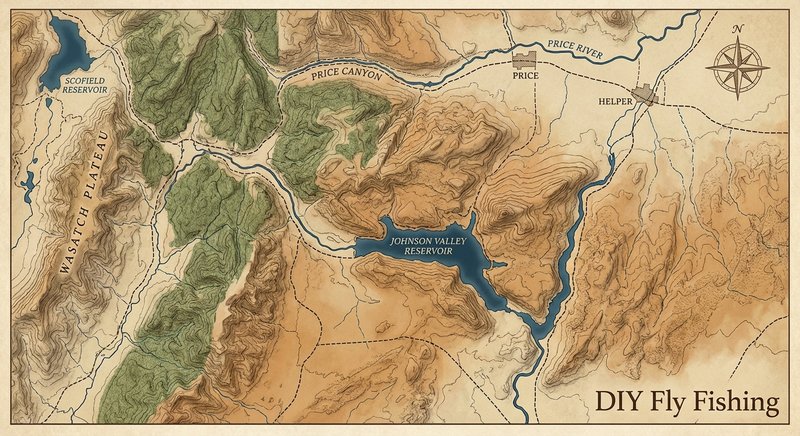
Johnson Valley Reservoir
Fly fishing in Utah · Beginner · Best seasons: Summer, Fall
Target Species
Brook Trout, Cutthroat Trout
About This Water
High mountain lake on Boulder Mountain. Brook and cutthroat trout.
Fishing Recommendations
Welcome to one of Utah’s high-country gems. As a guide who has spent plenty of time on the Fish Lake Plateau, I can tell you that Johnson Valley Reservoir is often overlooked in favor of its famous neighbor, Fish Lake. However, for the fly angler seeking beautiful Brook Trout and scrappy Cutthroats in a more intimate setting, Johnson Valley is a premier destination.
Here is your professional guide to fishing Johnson Valley Reservoir.
🎣 Location Overview
Located at an elevation of approximately 8,800 feet in the Fish Lake National Forest, Johnson Valley Reservoir is a mid-sized impoundment fed primarily by Sevenmile Creek. Unlike the massive, deep waters of Fish Lake, Johnson Valley is shallower and more accessible to the fly angler—especially those in float tubes or kayaks.
The reservoir is surrounded by stunning stands of aspen and ponderosa pine. It offers a classic "mountain lake" feel with crystalline water that can become quite weedy in the late summer. This weed growth, while a nuisance to gear anglers, creates a massive biological engine that produces high counts of scuds and damsel nymphs, leading to fast-growing, healthy trout.
🐟 Target Species & Behavior
The reservoir is managed primarily for Brook Trout and Cutthroat Trout.
- Brook Trout: These are the stars of the show. They congregate near the inlet of Sevenmile Creek and along the rocky eastern shore. They are aggressive and highly visual feeders. In the fall, they move toward the shallows and the inlet to spawn, displaying brilliant orange bellies.
- Cutthroat Trout: Usually found cruising the drop-offs and the edges of weed beds. They are opportunistic and will often follow a streamer right to your float tube.
- Behavior: Because the lake is relatively shallow, these fish are "cruisers." They move along the edges of the weed lines looking for scuds and midges. They are light-sensitive, so they tend to move into deeper water (10–15 feet) during the brightest parts of the day.
📅 Best Times to Fish
Optimal Seasons
- Summer (Late June – August): This is the prime window for dry fly action and damselfly hatches. Once the ice clears (usually late May) and the water warms slightly, the fish become very active.
- Fall (September – October): My personal favorite. The Brook Trout are in their spectacular spawning colors and become extremely aggressive. The crowds thin out, and the "bite" remains consistent all day as the fish bulk up for winter.
Best Times of Day
- Early Morning (Sunrise to 10:00 AM): The water is usually glass-calm, making it perfect for spotting cruising fish and fishing midges.
- Evening (6:00 PM to Dusk): A frantic dry fly window often occurs as the wind dies down and the evening midge and caddis hatches begin.
🪰 Recommended Flies & Techniques
Top Fly Patterns
- Scuds (Sizes 12–16): This is the "bread and butter." Olive, orange, or grey. Most fish here have stomachs full of these.
- Chironomids (Sizes 16–20): Zebra Midges in black/silver or red/gold.
- Damselfly Nymphs (Sizes 10–14): Long, slender olive nymphs with Marabou tails.
- Streamers: Olive or Black Woolly Buggers, and the Pine Squirrel Leech.
- Dry Flies: Parachute Adams, Griffith’s Gnat, and Stimulators (if you see hoppers on the banks in August).
Effective Techniques
- The "Slow Crawl" Nymphing: Fish a scud or damselfly nymph on a long leader (12–15 feet) with an intermediate sinking line. Use an agonizingly slow retrieve along the edges of the weed beds.
- Static Indicator Rig: Suspend a midge or scud 4–8 feet below a small indicator. This is deadly when the water is calm.
- Streamer Stripping: Use a weighted bugger near the Sevenmile Creek inlet. Use erratic "strip-strip-pause" motions to trigger the Brookies’ predatory instinct.
💡 Pro Tips & Local Knowledge
- The Inlet Advantage: The area where Sevenmile Creek enters the reservoir (western side) is a magnet for fish. The moving water brings in oxygen and food. Focus your efforts here, but keep a respectful distance from other anglers.
- The Float Tube is King: While you can fish from the bank, the weed beds often extend 20 feet out. A float tube or pontoon boat allows you to stay on the outside of the weeds and cast back toward the shore, which is the "strike zone."
- The "Scud Twitch": If you’re using a scud pattern, give it tiny, 1-inch twitches. Scuds in this lake are active swimmers, and that little movement often triggers a take.
- Watch the Wind: Like Fish Lake, the wind can whip up quickly in the afternoon. If you see whitecaps forming, head for the ramp. High-altitude weather changes fast.
⚠️ Important Information
- Access: Access is excellent via Highway 25. There are paved parking areas and a boat ramp on the south end.
- Regulations: Always check the current Utah Fishing Guidebook. Generally, standard trout limits apply, but be aware of any "Community Fishery" or "Brood Stock" specific changes that occur seasonally.
- Camping: There are several developed campgrounds nearby (Bowery Creek, Doctor Creek) and plenty of dispersed camping in the surrounding National Forest.
- High Altitude Prep: You are at nearly 9,000 feet. The sun is intense, and the air is thin. Bring more water than you think you need and high-SPF sunscreen.
Guide’s Final Word: Johnson Valley is a place of solitude and strategy. Don't rush your casts. Watch the water for a few minutes before you get in—you’ll often see the Brookies "tailing" in the shallows like mini-bonefish. Tight lines!
Bug Hatches & Matching Flies
| Hatch | Type | Peak months | Time of day | Hook sizes | Matching flies |
|---|---|---|---|---|---|
| Chironomids Chironomidae | midge | June, July | All Day | #12-22 | Zebra Midge #16-20, Ice Cream Cone #12-16, Griffith's Gnat #18-22 |
| Callibaetis Callibaetis spp. | mayfly | July, August | Morning/Afternoon | #12-16 | Parachute Adams #14-16, Hare's Ear Nymph #14-16, Callibaetis Spinner #14-16 |
| Damselflies Enallagma spp. | terrestrial | July, August | Morning/Afternoon | #10-14 | Marabou Damsel #10-12, Adult Damsel #12-14 |
| Cinnamon Caddis Hydropsyche spp. | caddis | July, August | Evening | #14-18 | Elk Hair Caddis #14-16, LaFontaine's Deep Sparkle Pupa #16 |
| Scuds Gammarus lacustris | terrestrial | May, September | All Day | #12-16 | Ray Charles #14-16, UV Orange Scud #12-16 |
| Water Boatmen Corixidae | terrestrial | September, October | Afternoon | #14-18 | Water Boatman #14-16, Prince Nymph #14-18 |
| Carpenter Ants Camponotus spp. | terrestrial | July, August | Afternoon | #10-16 | Black Foam Ant #12-16, Chernobyl Ant #10-14 |
| Small Black Midges Pseudocloeon | midge | May, October | Morning | #20-24 | Morgan's Midge #20-22, WD-40 #20-24 |