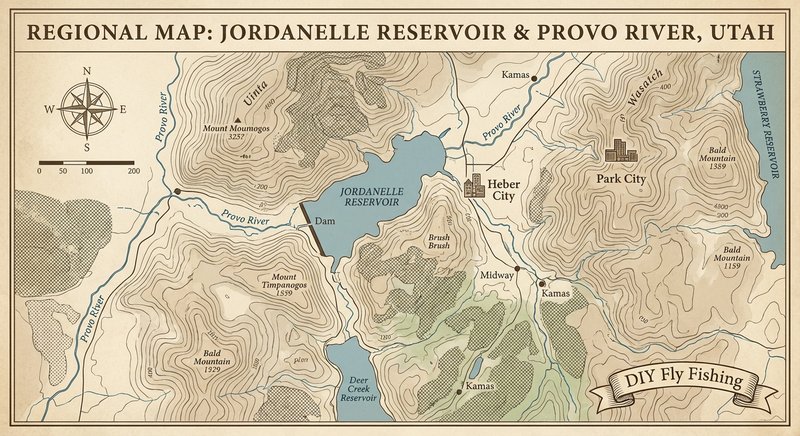
Jordanelle Reservoir
Fly fishing in Utah · Beginner · Best seasons: Spring, Summer, Fall
Target Species
Smallmouth Bass, Rainbow Trout, Perch
About This Water
Park City area reservoir with excellent smallmouth bass. Also trout and perch.
Fishing Recommendations
As an expert guide who has spent years navigating the high-mountain waters of the Wasatch Back, I can tell you that Jordanelle Reservoir is a unique beast. Located just minutes from Park City, it is a premier "blue-ribbon" stillwater fishery that offers a distinct blend of cold-water trout fishing and warm-water bass action.
Here is your comprehensive guide to tackling Jordanelle.
🎣 Location Overview
Jordanelle Reservoir is a massive impoundment of the Provo River. What makes it special is its clarity and depth. It sits at about 6,100 feet in elevation, surrounded by stunning mountain views. Unlike many murky lowland reservoirs, Jordanelle is often crystal clear, which makes for exciting "sight" opportunities but also requires finesse from the angler.
The reservoir is divided into three main areas: Hailstone (the main recreational hub), Rock Cliff (the quiet, river-fed inlet), and Ross Creek (the non-motorized north arm). For the fly angler, the diversity of structure—from submerged willow forests to steep rocky cliffs—provides a playground for different techniques.
🐟 Target Species & Behavior
Smallmouth Bass
The "Smallies" are the crown jewel of Jordanelle. They are incredibly prolific here.
- Behavior: In spring, they move into the shallows (1–10 feet) to spawn. In summer, they retreat to rocky drop-offs and submerged ledges.
- Feeding: They primarily target juvenile Yellow Perch and Crawfish. If you find rocks, you find bass.
Rainbow Trout
The DWR stocks Jordanelle heavily with Rainbows.
- Behavior: They prefer the cooler water near the Provo River inlet (Rock Cliff) or the deeper "thermocline" during mid-summer.
- Feeding: They focus on midge hatches in the early morning and opportunistic baitfish or terrestrial patterns in the fall.
Yellow Perch
- Behavior: Usually found in large schools near weed beds or sandy bottoms.
- Feeding: They are aggressive and will hit small streamers or nymphs. They serve as the primary forage for the trophy Smallmouth and the occasional Brown Trout.
📅 Best Times to Fish
- Spring (May – June): This is the prime window for Smallmouth. As water temperatures hit 55–60°F, the bass move to the shoreline. This is when you can catch them on topwater or shallow streamers.
- Summer (July – August): Best for early birds. You must be on the water at sunrise. Once the sun hits the water and the wake boats arrive, the fish dive deep.
- Fall (September – October): My personal favorite. The recreational boaters disappear, and the fish move back into the shallows to gorge before winter. The Brown Trout also begin staging near the Rock Cliff inlet to spawn.
- Prime Window: 5:30 AM to 9:30 AM. The "evening rise" can also be spectacular for trout near the inlets.
🪰 Recommended Flies & Techniques
For Smallmouth Bass
- Patterns:
- Crayfish: Near-Nuff Crawfish, Clouser Minnows (Olive/Orange).
- Surface: Boogle Bugs or small poppers in black or chartreuse.
- Streamers: Game Changers or Woolly Buggers (Size 4-6) in Olive.
- Technique: Use a Type 3 or Type 5 sinking line. Cast toward rocky points, let it sink for 10–15 seconds, and use a "strip-strip-pause" retrieve. The pause is when they usually strike.
For Rainbow Trout
- Patterns:
- Nymphs: Zebra Midges (Size 18-22) under a dry fly (Hopper-Dropper).
- Streamers: Bunny Leeches or Marabou Muddlers.
- Technique: Focus on the Rock Cliff arm. Look for the current seams where the Provo River enters the still water.
For Perch
- Patterns: Small white or chartreuse streamers (Size 10-12).
- Technique: Slow-stripping near the bottom in the Ross Creek arm.
💡 Pro Tips & Local Knowledge
- Beat the Wake: Jordanelle is a popular boating lake. By 10:00 AM in the summer, the "surf boats" create massive swells. To fly fish effectively, you must be off the main body of the lake by mid-morning. Use a float tube or kayak to access the "no-wake" zones in Ross Creek or Rock Cliff.
- The "Rock Cliff" Secret: The area where the Provo River enters is a biological engine. In the fall, big Brown Trout (20"+) move out of the depths and toward this inlet. Swing large streamers here during a low-light, drizzly day for a shot at a trophy.
- Color Palette: Because the water is so clear, natural colors work best. Stick to Olive, Brown, and Sand. Only use "loud" colors (Chartreuse/Pink) if the water is stained after a heavy rain.
- Watch the Wind: Jordanelle is notorious for "The Canyon Wind" that kicks up in the afternoon. If you see whitecaps forming, get off the water immediately—it gets dangerous for float tubers quickly.
⚠️ Important Information
- Access:
- Hailstone: Main entrance, best for boat launching.
- Rock Cliff: Located on the eastern end (Highway 32). Best for river-style fly fishing and wading.
- Ross Creek: North end (off Highway 189). Best for non-motorized quiet fishing.
- Regulations: A valid Utah Fishing License is required. Jordanelle is part of the State Park system, so there is a daily vehicle fee (approx. $15–$20) to enter.
- Invasive Species: Always Clean, Drain, and Dry your gear. Jordanelle is monitored for Quagga mussels; if you bring a boat or kayak, ensure you follow decontamination protocols.
Guide’s Final Word: Jordanelle is a "thinking person's" lake. Don't just cast blindly. Look for the transition zones where rock meets sand, or where deep water meets a shallow shelf. Find the structure, match the color of a crawfish, and hold on tight!
Bug Hatches & Matching Flies
| Hatch | Type | Peak months | Time of day | Hook sizes | Matching flies |
|---|---|---|---|---|---|
| Chironomids Chironomidae | midge | April, May, June, September | All Day | #12-22 | Zebra Midge #16-20, Ice Cream Cone #12-16, Griffith's Gnat #18-22 |
| Callibaetis Callibaetis | mayfly | June, July, August | Late Morning/Early Afternoon | #12-16 | Callibaetis Spinner #14-16, Hare's Ear Nymph #12-16, Parachute Adams #14-18 |
| Damselflies Enallagma | terrestrial | June, July | Midday | #10-14 | Marabou Damsel Nymph #10-14, Adult Damsel #12-14 |
| Traveling Sedge Hesperophylax | caddis | June, July | Evening | #8-12 | Godzilla Caddis #8-10, Elk Hair Caddis #10-14 |
| Cicadas Okanagana | terrestrial | May, June | All Day | #6-10 | Black Cicada #6-10, Chernobyl Ant #8-12 |
| Grasshoppers Melanoplus | terrestrial | July, August, September | Afternoon | #8-14 | Hopper Juan #10-12, Dave's Hopper #8-12 |
| Water Boatmen Corixidae | terrestrial | September, October | All Day | #14-18 | Water Boatman #14-16, Prince Nymph #14-18 |
| Blue Winged Olive Baetis | mayfly | April, October | Afternoon | #18-22 | RS2 #18-22, BWO Sparkle Dun #18-20 |