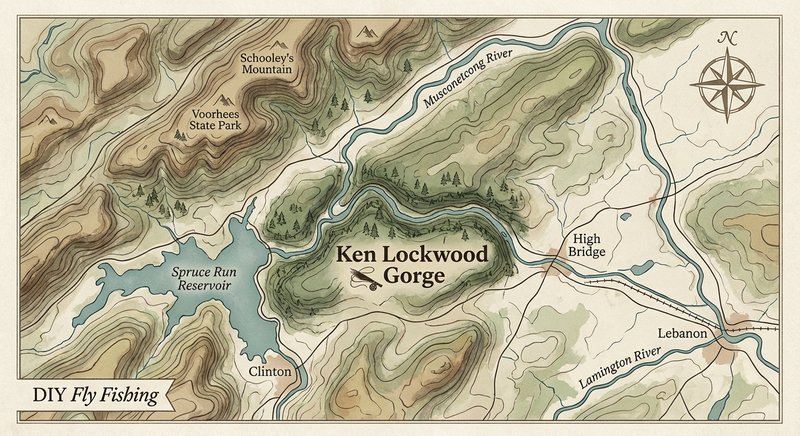
Ken Lockwood Gorge
Fly fishing in New Jersey · advanced · Best seasons: spring, fall
Target Species
Brown Trout, Rainbow Trout
About This Water
Spectacular canyon section of the South Branch Raritan. Catch-and-release area with trophy brown trout and beautiful scenery.
Fishing Recommendations
Welcome to one of the most storied stretches of water in the Mid-Atlantic. As your guide, I can tell you that Ken Lockwood Gorge (KLG), located on the South Branch of the Raritan River, is the "Crown Jewel" of New Jersey fly fishing. It offers a rugged, mountain-stream aesthetic that makes you forget you’re in the most densely populated state in the US.
Here is your comprehensive guide to fishing the Gorge.
🎣 Location Overview
Ken Lockwood Gorge is a 2.5-mile stretch of the South Branch of the Raritan River protected as a Year-Round Trout Conservation Area. What makes it special is its geology: the river drops through a steep, hemlock-lined canyon filled with massive boulders, creating classic "pocket water" that you typically only find in the Catskills or the Rockies.
The water is characterized by high gradients, deep plunge pools, heavy riffles, and technical runs. Because of the canopy cover and the oxygenation from the boulders, it stays cooler longer than other NJ streams, though it is still a freestone-style river that relies on rain and seasonal temperatures.
🐟 Target Species & Behavior
- Brown Trout: You will find both stocked fish and a resilient population of wild "holdover" browns. These fish are wary. They tuck deep into the undercut banks and the "dark water" behind large boulders. During hatches, they move to the heads of pools to intercept nymphs.
- Rainbow Trout: Primarily stocked by the state, these fish are more aggressive and often hold in the faster, highly oxygenated "white water" or right in the middle of the riffles.
- Behavior: Due to high angler pressure, the fish here are "educated." They will often inspect a fly and refuse it if the drift isn't perfect. Micro-drag is your enemy here.
📅 Best Times to Fish
- Spring (Mid-April to June): This is the peak. The Hendrickson hatch in late April starts the party, followed by Sulphurs and March Browns in May. This is when the largest fish are most active.
- Fall (October to November): The water cools down, and the Brown Trout become aggressive as they prepare for the spawn. The foliage in the Gorge is spectacular, and the crowds are thinner than in the spring.
- Best Time of Day:
- Spring: 10:00 AM – 4:00 PM (as the water warms and bugs hatch).
- Late Spring/Summer: "Prime Time" is the last 90 minutes of daylight (the Sulphur spinner fall).
- Conditions: Look for a flow between 100 cfs and 200 cfs at the High Bridge gauge. If it's under 60 cfs, the fish are very spooky; over 300 cfs, the wading becomes dangerous.
🪰 Recommended Flies & Techniques
Top Fly Patterns
- Dries:
- Hendrickson/Red Quill (#12-14) in April.
- Sulphurs (#14-18) in May/June.
- Elk Hair Caddis (#14-16) (Tan or Olive) – an all-season staple.
- Blue Winged Olive (BWO) (#18-22) on cloudy, drizzly days.
- Nymphs:
- Pheasant Tail (#14-18) - mimics almost everything.
- Zebra Midge (#18-22) - essential for technical winter/early spring fishing.
- Frenchies or Perdigons - heavy flies to get down fast in the pocket water.
- Streamers:
- Woolly Buggers (Black or Olive) - swing these through the deep plunge pools.
Techniques
- Euro Nymphing / Tight-Line Nymphing: This is arguably the most effective way to fish the Gorge. The complex currents and "micro-eddies" created by boulders make traditional indicator fishing difficult. Getting your flies deep into the pockets without drag is key.
- The "Dry-Dropper": In the shallower riffles, use a buoyant Elk Hair Caddis with a small Pheasant Tail dropped 18 inches below it.
- Reach Casts: When dry fly fishing the flatter sections (like the "Upper Flats"), use a reach cast to keep your fly line from crossing different current speeds before your fly does.
💡 Pro Tips & Local Knowledge
- Fish the "Buckets": Many anglers walk past the small pockets (the size of a kitchen sink) behind boulders. These "buckets" often hold the largest wild browns because they provide protection and a conveyor belt of food.
- The Stone Bridge: The area around the old stone bridge is iconic, but it gets the most pressure. If you want better fishing, hike further into the center of the Gorge, away from the access points at either end.
- Stealth Matters: Because the water is often clear, wear earthy tones (greens/browns) and avoid splashing. Kneeling while casting into a pool will significantly increase your hook-up rate.
- Check the Gauge: Always check the USGS gauge for the South Branch Raritan at High Bridge before driving out. If there's been heavy rain, the Gorge can turn into a chocolate milk torrent quickly.
⚠️ Important Information
- Regulations: Ken Lockwood Gorge is a Year-Round Trout Conservation Area.
- Catch and Release ONLY.
- Artificial Lures/Flies ONLY (No bait, no scented lures).
- Single Hook ONLY (If your lure has a treble, you must clip two of the hooks).
- Access: You can enter from the bottom (High Bridge/River Road) or the top (Hoffman’s Crossing Road). The main road through the Gorge is closed to vehicles, so be prepared to walk.
- Safety: The rocks in KLG are notoriously slippery (often called "Greased Bowling Balls"). Studded wading boots and a wading staff are highly recommended.
- License: You must have a valid New Jersey Fishing License and a Trout Stamp.
The Gorge is a place that rewards patience and technical skill. Slow down, observe the water for a few minutes before casting, and enjoy the finest trout water New Jersey has to offer. Tight lines!
Bug Hatches & Matching Flies
| Hatch | Type | Peak months | Time of day | Hook sizes | Matching flies |
|---|---|---|---|---|---|
| Blue Winged Olive Baetis | mayfly | April, October, November | Afternoon | #18-22 | RS2 #20-22, BWO Sparkle Dun #18-20, Pheasant Tail #18-22 |
| Hendrickson Ephemerella subvaria | mayfly | April, May | Afternoon | #12-14 | Red Quill #12-14, Hendrickson Emerger #14, Gold Ribbed Hare's Ear #12-14 |
| Tan Caddis Hydropsyche | caddis | May, June | Evening | #14-16 | Elk Hair Caddis #14-16, LaFontaine's Deep Sparkle Pupa #14-16, Holy Grail #14-16 |
| Sulphur Ephemerella invaria/dorothea | mayfly | May, June | Evening | #14-18 | Comparadun Sulphur #16-18, Sulphur CDC Emerger #16-18, Mercer's Poxyback Sulphur #16-18 |
| Light Cahill Stenacron canadense | mayfly | June, July | Evening | #12-14 | Light Cahill #12-14, Cream Usual #14, Light Cahill Wet Fly #12-14 |
| Trico Tricorythodes | mayfly | July, August, September | Morning | #22-26 | Trico Spinner #22-24, Zebra Midge #22-24, Trico Parachute #22-24 |
| Slate Drake Isonychia bicolor | mayfly | June, September | Afternoon/Evening | #10-12 | Isonychia Nymph #10-12, Parachute Adams #12, Iso Emerger #10-12 |
| Ants and Beetles Formicidae/Coleoptera | terrestrial | July, August, September | All Day | #12-20 | Black Foam Ant #16-20, Cinnamon Ant #16-18, Crowe Beetle #12-16 |
| Little Black Stonefly Capniidae | stonefly | February, March | Late Morning | #16-20 | Little Black Stonefly #18, Prince Nymph #16-18, Black Copper John #18 |