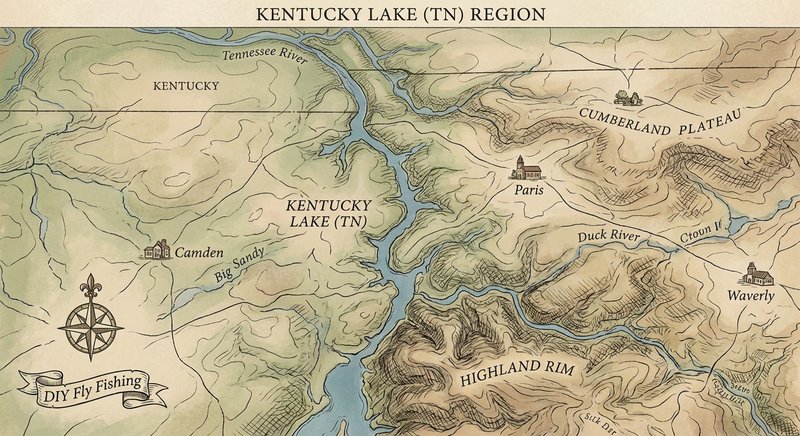
Kentucky Lake (TN)
Fly fishing in Tennessee · Beginner · Best seasons: Spring, Summer, Fall
Target Species
Largemouth Bass, Crappie, Catfish
About This Water
Large TVA reservoir with excellent bass and crappie. Western Tennessee fishing destination.
Fishing Recommendations
Welcome to the "South’s Great Lake." As a fly fishing guide, I can tell you that Kentucky Lake is often overlooked by fly anglers because of its massive size and reputation as a conventional gear powerhouse. However, for those who know how to work the shorelines, secondary points, and tailwaters, it offers some of the most productive warm-water fly fishing in the United States.
Here is your comprehensive guide to fly fishing the Tennessee portion of Kentucky Lake.
🎣 Location Overview
Kentucky Lake is a massive impoundment of the Tennessee River, stretching 184 miles from the Pickwick Dam in Tennessee to the Kentucky Dam. It is one of the largest man-made lakes in the world by surface area.
What makes it special is the sheer variety of habitat: sprawling mud flats, deep river channels, submerged standing timber, and countless bays and inlets. For the fly angler, the Tennessee portion (stretching from the state line up to Pickwick) offers manageable depths and excellent "skinny water" opportunities in the backs of creeks. The water is generally stained to murky, which actually plays to the fly angler's advantage by allowing for closer approaches and the use of bulky, vibration-heavy flies.
🐟 Target Species & Behavior
Largemouth Bass
These are the kings of the lake. In Kentucky Lake, they are "structure-oriented." They hold tight to submerged stumps, buckbrush, and rocky points. They feed heavily on gizzard shad and bluegill. On a fly rod, you aren't just looking for fish; you’re looking for the specific piece of wood or rock they are using as an ambush point.
Crappie
Kentucky Lake is arguably the Crappie Capital of the World. While traditionally a jig-and-minnow game, crappie are voracious predators that will smash small streamers. They school up around "stake beds" (man-made brush piles) and submerged timber. They are light-sensitive, moving deep during the bright sun and shallowing up during low light.
Catfish (Channel and Blue)
Yes, you can catch them on a fly! On Kentucky Lake, catfish frequent the rocky rip-rap along bridges and dams. During the summer, they move into surprisingly shallow water (2–4 feet) at night and during dawn/dusk to feed on mussels and baitfish along the flats.
📅 Best Times to Fish
- Spring (March – May): Prime Time. As water temps hit 55°F, bass move to secondary points. At 60–65°F, they are in the back of the creeks spawning. This is the best time for fly anglers to reach fish in 2–5 feet of water. Crappie spawn in April and are easily reachable in the buckbrush.
- Summer (June – August): Early morning and late evening are mandatory. As the sun rises, fish move to the "ledges" (the drop-offs to the main river channel), which are difficult to fish with a fly rod. Focus on the first two hours of daylight with topwater poppers.
- Fall (September – November): The "Second Spring." As temps drop, shad migrate into the backs of the creeks, and the bass follow. This is the best time for "match the hatch" baitfish patterns.
🪰 Recommended Flies & Techniques
For Largemouth Bass
- Patterns:
- Topwater: BoogleBugs (size 2), Dahlberg Divers, and large foam frogs.
- Subsurface: Game Changers (white/shad), Clouser Minnows (chartreuse/white), and Murdich Minnows.
- Technique: Use an 8-weight rod with a weight-forward floating line or a "bass taper." Cast tight to the "buckbrush" (willows). If using a popper, let the rings disappear before your first strip.
For Crappie
- Patterns:
- Woolly Buggers (size 8–10) in white, pink, or chartreuse.
- Micro-Clousers or "Crappie Candy" patterns.
- Technique: Use a 4-weight or 5-weight rod. Use a slow, rhythmic "strip-strip-pause" retrieve. The hit usually happens on the pause.
For Catfish
- Patterns: Large, weighted Woolly Buggers (Black or Olive) or heavy crawfish imitations.
- Technique: Fish the rip-rap near the bridges. You must get the fly to the bottom. Use a sink-tip line and "crawl" the fly along the rocks.
💡 Pro Tips & Local Knowledge
- The "Ledge" Alternative: Most local boaters fish the deep ledges. Fly anglers should do the opposite: Find the "Flats next to Deep Water." Look for a shallow flat that sits right next to the main river channel. Fish will move up onto the flat to feed and retreat to the deep water for safety.
- The Shad Die-Off: If you get a sudden cold snap in late fall/early winter, look for "stunned" shad. Use a white streamer and fish it with almost no movement—just a dead drift with an occasional twitch.
- Watch the Current: Since this is a dam-controlled system, "pulling water" (generating electricity) creates a current. Bass will nose into the current behind a stump to wait for food. Always cast upstream of the structure and let your fly drift past it.
- The "Yellow Flower" Rule: Local legends say when the yellow flowers (Yellow Jessamine) bloom in the spring, the crappie are in the bushes. That is your signal to grab the 5-weight.
⚠️ Important Information
Access
- Public Access: There are dozens of TVA boat ramps. Paris Landing State Park is a primary hub for the Tennessee side and offers great bank access and easy launching.
- Wading: Wading is limited due to the muddy bottom, but you can wade some of the gravel points near the Tennessee National Wildlife Refuge (be mindful of seasonal closures).
Regulations & Permits
- License: A Tennessee Fishing License is required. If you cross into the Kentucky portion, you must have a Kentucky license; there is no reciprocal agreement for the entire lake (only a small portion near the state line).
- Creel Limits: Kentucky Lake has specific length and creel limits for Bass and Crappie. Check the TWRA website for current year-specific regulations.
Safety
- Barges: This is a commercial waterway. Stay clear of the main channel if you are in a kayak or small boat; barge wakes are massive and can take a long time to reach you.
- Wind: Because the lake is north-south oriented, a strong North or South wind can create dangerous "rollers." If the wind is over 15 mph, stick to the protected bays and creeks.
Bug Hatches & Matching Flies
| Hatch | Type | Peak months | Time of day | Hook sizes | Matching flies |
|---|---|---|---|---|---|
| Giant Mayfly (Hex) Hexagenia limbata | mayfly | June, July | Evening/Night | #6-10 | Hexagenia Spinner #6-8, Wiggle Nymph #8-10, Hexagenia Emerger #8 |
| Chironomids Chironomidae | midge | March, April, October | All Day | #18-24 | Zebra Midge #18-22, Griffith's Gnat #20-24, Snowshoe Midge #20-22 |
| White Mayfly Ephoron album | mayfly | August, September | Evening | #12-14 | White Wulff #12-14, Ephoron Emerger #14, White Paradun #14 |
| Spotted Sedge Hydropsyche | caddis | May, June | Evening | #14-18 | Elk Hair Caddis #14-16, Gold Ribbed Hare's Ear #14-18, Caddis Pupa #16 |
| Grasshoppers Melanoplus | terrestrial | August, September | Afternoon | #8-12 | Dave's Hopper #8-10, Chernobyl Ant #8-12, Joe's Hopper #10-12 |
| Trico Tricorythodes | mayfly | July, August, September | Morning | #20-24 | Trico Spinner #20-24, RS2 #20-22 |
| Speckled Wing Quill Callibaetis | mayfly | May, September | Morning | #14-16 | Callibaetis Spinner #14-16, Hare's Ear Nymph #14-16, Parachute Adams #14-18 |
| Black Ants Formicidae | terrestrial | July, August | Afternoon | #16-20 | Black Foam Ant #16-18, Cinnamon Ant #16-20 |