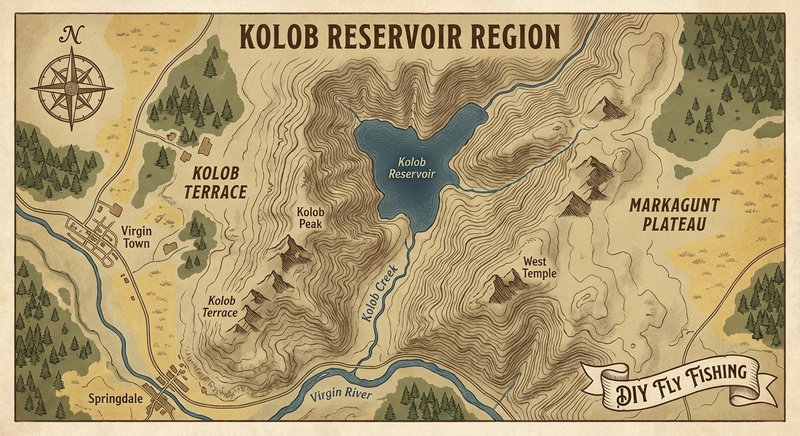
Kolob Reservoir
Fly fishing in Utah · Beginner · Best seasons: Summer, Fall
Target Species
Rainbow Trout, Cutthroat Trout
About This Water
High elevation reservoir near Zion National Park. Rainbow and cutthroat trout.
Fishing Recommendations
Tight lines! As your guide for this high-country excursion, I can tell you that Kolob Reservoir is one of Southern Utah’s crown jewels. Sitting at roughly 8,100 feet on the edge of Zion National Park, it offers a stark, beautiful contrast to the red rock desert below.
Here is your comprehensive guide to fly fishing Kolob Reservoir.
🎣 Location Overview
Kolob Reservoir is a high-altitude impoundment located on the Kolob Terrace. What makes it special is its productivity. Unlike many high-mountain lakes that are "lean," Kolob is rich in nutrients, leading to massive insect hatches and exceptionally fast growth rates for trout.
The water is generally clear but has significant weed growth along the margins, which serves as a massive pantry for trout. Because of its elevation, it stays cool when the rest of Southern Utah is sweltering, making it the premier summer destination for fly anglers in the region. It is a "stillwater" fishery that fishes more like a spring creek in terms of insect diversity.
🐟 Target Species & Behavior
- Rainbow Trout: These are the heavy hitters of the reservoir. They are frequently stocked but grow quickly into the 18–22 inch range. They are aggressive and prone to aerial displays when hooked.
- Cutthroat Trout (Bear Lake Strain): These fish are stunning, often showing deep orange slashes. They tend to cruise the shoreline and drop-offs more methodically than the rainbows.
Behavior: These fish are "cruisers." Unlike river trout that wait for food to come to them, Kolob trout are constantly on the move, patrolling the weed lines and the "drop-off" (where the shallow shelf falls into deep water). They are highly opportunistic but can become selective during a heavy midge or damselfly hatch.
📅 Best Times to Fish
- Summer (Late June – August): This is prime time. The famous Damselfly hatch occurs in late June and July. This is the most exciting time to be on the water as trout will gorge on nymphs migrating toward the shore and adults hovering over the water.
- Fall (September – October): As the water cools, the trout move back into the shallows to bulk up for winter. The crowds thin out, and the fish become very aggressive toward streamers.
- Time of Day:
- Morning: Best for calm water and sight-casting to cruising fish.
- Evening: The "Magic Hour" usually brings a prolific midge or caddis hatch, causing the surface to boil with rising fish.
🪰 Recommended Flies & Techniques
Techniques
- Indicator Nymphing: The most consistent producer. Hang a fly 5–10 feet under a slip-indicator along the weed edges.
- The "Slow Strip": Using an intermediate (slow-sink) line, cast parallel to the weed lines and use a very slow, rhythmic 2-inch strip.
- Dry Fly: Best during the evening midge hatches or the heat of a Damselfly emergence.
Top Fly Patterns
- Chironomids (Midges): Size 12–18. Colors: Blood red, "Ice" (silver/white), and Zebra Midges. These are the staple food source here.
- Damselflies: Size 10–14. Marabou Damsel nymphs in olive are essential in July.
- Scuds: Size 14–16. Olive or orange. The reservoir is crawling with these freshwater shrimp.
- Balanced Leeches: Size 8–12. Black, Bruised (Purple/Black), or Olive. Excellent under an indicator.
- Terrestrials: In late summer, don't overlook a size 12 Fat Albert or Hopper dropped near the wind-blown banks.
💡 Pro Tips & Local Knowledge
- Master the Weed Line: The fish stay where the food is. Use a float tube or kayak to position yourself just outside the weed beds and cast back toward the shore, stripping your fly along the edge of the vegetation.
- The "Kolob Twitch": When fishing midges under an indicator, if the water is dead calm, give your line a tiny "twitch" every 30 seconds. This subtle movement often triggers a strike from a following trout.
- Watch the Wind: The wind usually picks up in the afternoon. Don't leave! The wind pushes "shucks" and crippled insects toward the leeward shore, creating a feeding frenzy. Focus on the "choppy" water where trout feel safer coming shallow.
- Be Prepared for "Cruisers": If you see a fish cruising the shoreline, do not cast at it. Cast 5–10 feet in front of its path and let the fly settle.
⚠️ Important Information
- Access: Access is primarily via Kolob Terrace Road out of Virgin, UT. The road is paved but steep and winding. It is generally inaccessible by car in winter due to heavy snow.
- Regulations: Kolob has specific regulations to maintain the trophy quality of the fish.
- Limit: Check current Utah DWR proclamations, but typically there is a limit of 2 trout, and only 1 may be over 22 inches.
- Bait: Often restricted to artificial flies and lures only (check signs at the ramp for seasonal changes).
- Boating: There is a primitive boat ramp. Gasoline motors are allowed but most anglers prefer float tubes, pontoons, or kayaks for a stealthier approach.
- Altitude Warning: You are at 8,000+ feet. Hydrate aggressively and wear high-SPF sunscreen. The weather can change from 75°F and sunny to a lightning storm in 15 minutes—bring a rain shell.
Bug Hatches & Matching Flies
| Hatch | Type | Peak months | Time of day | Hook sizes | Matching flies |
|---|---|---|---|---|---|
| Chironomids Chironomidae | midge | May, June, September | All day | #12-20 | Zebra Midge #16-20, Ice Cream Cone #12-16, Griffith's Gnat #18-22 |
| Callibaetis (Speckled Duns) Callibaetis | mayfly | June, July, August | Late Morning/Early Afternoon | #12-16 | Hare's Ear Nymph #14-16, Parachute Adams #14-16, Callibaetis Spinner #14-16 |
| Damselfly Enallagma | other | June, July | Late Morning/Afternoon | #10-14 | Marabou Damsel #10-12, Adult Damsel #12-14 |
| Caddis (Traveler/Sedge) Hesperophylax | caddis | July, August | Evening | #10-14 | Elk Hair Caddis #12-14, Godzilla Caddis #10-12 |
| Scuds (Freshwater Shrimp) Gammarus | other | April, May, October | All day | #12-16 | Ray Charles #14-16, Olive Scud #12-16 |
| Dragonfly Anisoptera | other | July, August | Afternoon | #6-10 | Dredge Nymph #8-10, Wooly Bugger (Olive) #6-10 |
| Terrestrials (Ants/Beetles) Formicidae/Coleoptera | terrestrial | August, September | Afternoon | #12-18 | Chernobyl Ant #8-12, Black Foam Beetle #14-16 |
| Water Boatmen Corixidae | other | September, October | Morning/Afternoon | #14-18 | Water Boatman #14-16, Prince Nymph #14-18 |