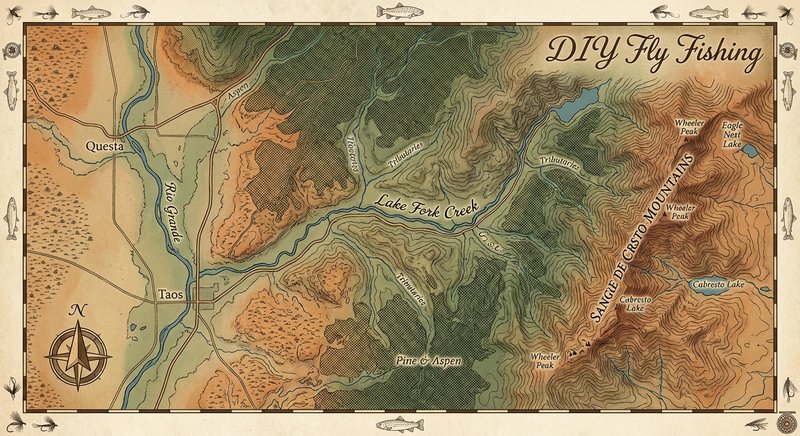
Lake Fork Creek
Fly fishing in New Mexico · Intermediate · Best seasons: Summer, Fall
Target Species
Brown Trout
About This Water
Tributary to the Pecos with wild brown trout. Less pressured than main river.
Fishing Recommendations
Welcome to one of the hidden gems of the Sangre de Cristo Mountains. As your guide, I can tell you that Lake Fork Creek is a high-altitude paradise for the angler who values scenery, wild fish, and technical "pocket water" fishing.
Flowing from the alpine heights near Williams Lake down toward the village of Taos Ski Valley, this is a quintessential New Mexico mountain stream.
🎣 Location Overview
Lake Fork Creek is a tributary of the Rio Hondo, located north of Taos within the Carson National Forest. What makes this water special is its dramatic gradient and alpine setting. The creek tumbles over boulders, creates deep plunge pools, and carves out tight undercut banks at roughly 9,000 to 11,000 feet in elevation.
The water is gin-clear and cold year-round. It is not a river for long, sweeping casts; rather, it is a "mountain theater" where you’ll be bow-and-arrow casting, high-sticking, and creeping through the willows. Anglers love it because it offers a true wilderness experience just a short hike from the Taos Ski Valley parking areas.
🐟 Target Species & Behavior
The primary resident here is the Wild Brown Trout. While you may occasionally find a Brook Trout in the higher reaches or a stray Rainbow/Rio Grande Cutthroat, the Browns own this creek.
- Behavior: These fish are wild and wary. Because the water is so clear, they have exceptional vision. However, because the growing season is short, they are opportunistic feeders.
- Holding Spots: Look for the "cushion" in front of large boulders, the tail-outs of plunge pools, and anywhere there is an undercut bank or overhanging willow branch. In the faster sections, they will sit in the seams where fast and slow water meet.
- Size: Expect fish in the 7–11 inch range. A 13-inch Brown in this creek is a trophy.
📅 Best Times to Fish
Due to its high elevation, Lake Fork Creek has a narrow fishing window.
- Summer (Late June – August): This is the prime window. Once the snowpack melts (usually by late June), the water settles into a perfect flow. This is peak dry-fly season.
- Fall (September – mid-October): My personal favorite. The Aspen trees turn gold, and the Brown Trout become aggressively territorial as they prepare for the fall spawn.
- Time of Day: At this altitude, the water stays cold. You don't need to be there at dawn. 10:00 AM to 4:00 PM is the "Golden Window" when the sun hits the water and activates the insect life.
🪰 Recommended Flies & Techniques
You don’t need a massive fly box here, but you do need the right presentation.
Top Fly Patterns
- Dry Flies: Elk Hair Caddis (Size 14-18) in tan or orange; Parachute Adams (Size 16-20); Royal Wulff (Size 14-16) for high visibility in white water.
- Terrestrials: This is critical in August and September. Use Foam Beetles, Amy’s Ants, or small Dave’s Hoppers.
- Nymphs: Bead-head Pheasant Tails (Size 16-18) and Copper Johns (Red or Blue, Size 18).
Effective Techniques
- Dry-Dropper: This is the most effective rig. Use a buoyant dry fly (like a Stimulator) and hang a small nymph about 18 inches below it.
- The "Short Game": You will rarely have more than 10-15 feet of fly line out. Use a 7.5-foot leader tapered to 5X.
- High-Sticking: Keep as much fly line off the water as possible to prevent "drag," which is caused by the complex, multi-directional currents of the pocket water.
💡 Pro Tips & Local Knowledge
- Stealth is Everything: If you can see the fish, they have already seen you. Always fish upstream. Wear earthy colors (tans and greens) to blend into the willows.
- The "One-Cast" Rule: In these small pools, you usually get one perfect cast. If you slap the water or "lined" the pool, move on to the next pocket.
- Focus on the Shadows: As the sun gets high, Browns will move into the shadows cast by boulders or trees. Even a shadow the size of a dinner plate can hold a nice fish.
- Upper vs. Lower: The water near the Williams Lake trailhead is more open and alpine. The sections further down toward the Ski Valley are tighter and more technical. Both hold fish, but the lower sections often hold slightly larger Browns.
⚠️ Important Information
- Access: Access is excellent via Highway 150. Park at the Taos Ski Valley "Hikers Parking" or near the Williams Lake Trailhead. The creek runs parallel to many of the hiking trails.
- Regulations: You must have a valid New Mexico Fishing License and a Gila Trout/Lesser Prairie-Chicken Habitat Stamp (usually included in the standard resident/non-resident license packages). Always check the latest NM Department of Game and Fish "Ribiac" rules for current bag limits, though Catch and Release is highly encouraged here to preserve the wild population.
- Safety: You are in Bear Country. While attacks are rare, be bear-aware and store food properly.
- Altitude: You are fishing at 10,000+ feet. Hydrate aggressively and be aware of the signs of altitude sickness. Weather can turn from sunny to a lightning storm in 15 minutes—bring a raincoat.
Guide’s Final Word: Lake Fork Creek isn't about the size of the fish; it's about the purity of the pursuit. Take your time, watch your shadow, and enjoy one of the most beautiful small streams in the American Southwest.
Bug Hatches & Matching Flies
| Hatch | Type | Peak months | Time of day | Hook sizes | Matching flies |
|---|---|---|---|---|---|
| Blue Winged Olive Baetis | mayfly | April, May, September, October | Late Morning/Afternoon | #18-22 | Parachute Adams #18-22, RS2 #20-22, Pheasant Tail #18-20 |
| Pale Morning Dun Ephemerella | mayfly | June, July, August | Late Morning/Early Afternoon | #14-18 | PMD Sparkle Dun #16-18, Military May #16-18, Split Case PMD #16 |
| Mother's Day Caddis Brachycentrus | caddis | May | Afternoon | #14-16 | Elk Hair Caddis (Olive) #14-16, Peacock Caddis #16, Holy Grail #14-16 |
| Little Yellow Sally Isoperla | stonefly | July, August | Afternoon/Evening | #14-16 | Yellow Sally Dry #14-16, Jim's Yellow Sally #14-16 |
| Golden Stonefly Hesperoperla pacifica | stonefly | June, July | All Day/Evening | #8-12 | Pat's Rubber Leg #8-12, Chubby Chernobyl #10-12 |
| Midge Chironomidae | midge | January, February, March, December | Morning/Midday | #20-26 | Zebra Midge #20-24, Griffith's Gnat #20-22, Top Secret Midge #22-24 |
| Spotted Sedge Hydropsyche | caddis | July, August, September | Late Afternoon/Dusk | #14-18 | Tan Elk Hair Caddis #14-18, LaFontaine's Deep Sparkle Pupa #16-18 |
| Terrestrials Formicidae / Orthoptera | terrestrial | July, August, September | Afternoon | #12-18 | Parachute Ant #16-18, Black Foam Beetle #14-16, Dave's Hopper #12 |