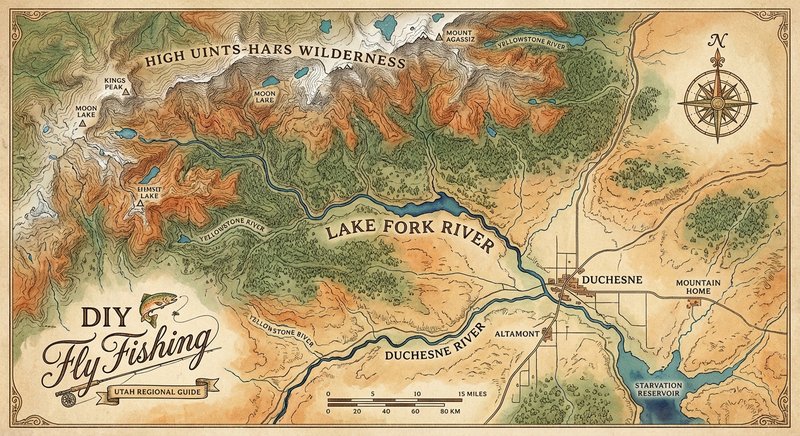
Lake Fork River
Fly fishing in Utah · Beginner · Best seasons: Summer, Fall
Target Species
Brown Trout, Cutthroat Trout
About This Water
Uinta Mountain stream with wild trout. Good access in upper canyon.
Fishing Recommendations
The Lake Fork River, flowing from the high peaks of the High Uintas Wilderness down toward the Duchesne River, is one of Utah’s premier "under the radar" fisheries. It offers a stunning variety of water—from high-gradient alpine pocket water to meandering meadow bends and a productive tailwater section below Moon Lake.
Here is your guide to mastering the Lake Fork.
🎣 Location Overview
The Lake Fork is a tale of two rivers. The Upper Lake Fork (above Moon Lake) is a wild, rugged, and remote wilderness fishery characterized by boulder-strewn pockets and high-alpine meadows. The Lower Lake Fork (below Moon Lake) acts more like a tailwater/spring creek hybrid, offering more stable temperatures and larger fish.
What makes this water special is the solitude. While the nearby Provo River gets the crowds, the Lake Fork offers a classic Western "big sky" mountain experience. The water is crystal clear, cold, and highly oxygenated, creating a perfect habitat for wild trout.
🐟 Target Species & Behavior
- Brown Trout: These are the kings of the lower river and the section below the Moon Lake dam. They are wary and favor structure. Look for them in undercut banks, behind large mid-stream boulders, and in the deep "buckets" at the tail-outs of runs. In the fall, they become highly aggressive.
- Cutthroat Trout (Colorado River Cutthroat): Found primarily in the upper reaches and the wilderness sections. They are beautiful, opportunistic feeders. They hold in the swifter riffles and the heads of pools, often looking up for a dry fly.
- Bonus Species: You will also encounter wild Brook Trout in the higher elevations and the occasional Rainbow Trout in the lower sections.
📅 Best Times to Fish
Summer (July – August)
This is the "Golden Era" on the Lake Fork. Once the spring runoff subsides (usually by early July), the dry fly fishing is world-class.
- Time of Day: 9:00 AM to 11:00 AM for the morning rise; 6:00 PM to dusk for the evening caddis blizzard.
- Conditions: Clear water and stable flows.
Fall (September – October)
The most scenic time to be on the river. The aspens turn gold, and the Brown Trout prepare for their spawn.
- Time of Day: 11:00 AM to 4:00 PM. The water needs to warm up slightly to get the bugs moving.
- Conditions: Low, technical water. This is prime time for big streamers or tiny technical nymphs.
🪰 Recommended Flies & Techniques
Dry Flies
The Lake Fork is a "dry-first" river during the summer.
- Patterns: Stimulators (Orange/Yellow #12-16), Parachute Adams (#14-18), Elk Hair Caddis (Tan/Olive #14-16).
- Terrestrials: In August/September, use Fat Alberts, Amy’s Ants, or foam beetles near the grassy banks.
Nymphing
When the fish aren't rising, a Dry-Dropper rig is the most effective way to cover water.
- Patterns: Frenchies (#16-18), Zebra Midges (Red or Black #18-20), and Pheasant Tails (#16).
- Technique: Fish the "seams" where fast water meets slow water. In the deeper holes below Moon Lake, a weighted nymph under an indicator is necessary.
Streamers
For the larger Browns, especially in the fall or on overcast days.
- Patterns: Gold Ribbed Hare’s Ear streamers or Olive/Black Wooly Buggers (#8-10).
- Technique: "Strip and Pause" through deep pools or swing them through the tail-outs.
💡 Pro Tips & Local Knowledge
- The "Yellowstone Bridge" Stretch: This is a fantastic area for access. If you head upstream from here, you enter the wilderness where the fish see very few flies.
- Stealth is Key: Because the water is so clear, the fish can see you from a distance. Wear earthy tones (olive/tan), avoid "lining" the fish with your fly line, and try to fish upstream so you approach from behind the trout's field of vision.
- The Moon Lake Tailwater: The first mile below the dam holds some of the largest Browns in the system. Use light 5x or 6x tippet here, as these fish are more "educated" than their cousins upstream.
- Match the Caddis: The Lake Fork has a massive caddis population. If you see fish slashing at the surface in the evening, use an Elk Hair Caddis and give it a slight "skitter" to mimic the natural insect's movement.
⚠️ Important Information
- Access: Much of the river is within the Ashley National Forest. However, there are patches of private property in the lower valley—always look for "Posted" signs and respect private land.
- Regulations: Generally, Utah's standard limit applies (4 trout), but many anglers choose Catch and Release to preserve the wild Cutthroat populations. Check the current Utah Fishing Guidebook before heading out.
- Wilderness Safety: This is bear and moose country. Carry bear spray if you are hiking deep into the wilderness sections.
- Supplies: The nearest towns with limited supplies are Duchesne and Altamont. Fill up on gas and snacks before heading up the canyon road.
Guide’s Final Word: The Lake Fork isn't about catching 20-inch fish every cast; it’s about the purity of the experience. Bring a 4-weight rod, a box of dries, and a camera—you’re going to need all three.
Bug Hatches & Matching Flies
| Hatch | Type | Peak months | Time of day | Hook sizes | Matching flies |
|---|---|---|---|---|---|
| Blue Winged Olives (BWO) Baetis | mayfly | April, May, September, October | Midday | #18-22 | RS2 #18-22, Parachute Adams #18-22, Barr Emerger #20 |
| Pale Morning Duns (PMD) Ephemerella excrucians | mayfly | June, July, August | Late Morning/Afternoon | #14-18 | Pheasant Tail Nymph #14-18, PMD Sparkle Dun #16-18, Quigley Cripple #16 |
| Golden Stoneflies Hesperoperla pacifica | stonefly | June, July | Morning/Afternoon | #8-12 | Pats Rubber Legs #8-12, Chubby Chernobyl #10-12, Golden Rogue Stone #8-10 |
| Spotted Sedge (Caddis) Hydropsyche | caddis | July, August | Evening | #14-16 | Elk Hair Caddis #14-16, LaFontaine's Deep Sparkle Pupa #14-16, Godzilla Caddis #14 |
| Yellow Sallies Isoperla | stonefly | June, July | Afternoon/Evening | #14-16 | Yellow Sally Foam Dry #14-16, Iron Lotus #16, Little Yellow Stone Nymph #14 |
| Tricos Tricorythodes | mayfly | August, September | Early Morning | #20-24 | Trico Spinner #20-24, Sunken Trico Spinner #22, Griffith's Gnat #20-22 |
| Midges Chironomidae | midge | March, April, October, November | All Day | #18-24 | Zebra Midge #18-22, Morgan's Midge #20-22, Palomino Midge #20-22 |
| Terrestrials (Hoppers/Ants) Orthoptera/Formicidae | terrestrial | July, August, September | Midday/Afternoon | #10-16 | Parachute Hopper #10-12, Cinnamon Ant #14-16, Amy's Ant #12 |