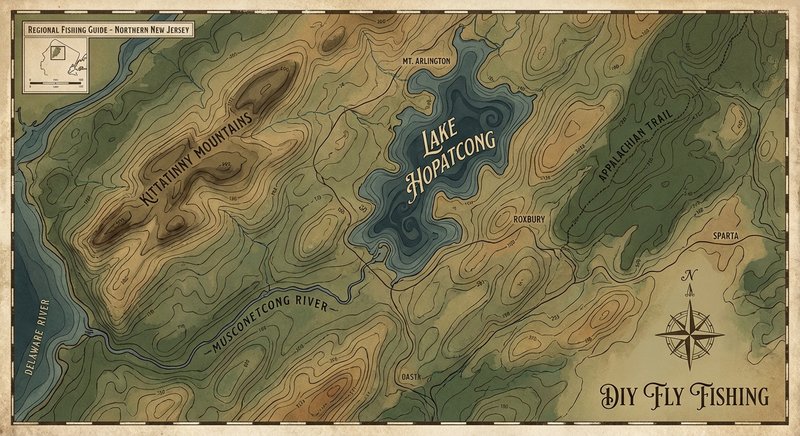
Lake Hopatcong
Fly fishing in New Jersey · beginner · Best seasons: spring, fall
Target Species
Rainbow Trout, Brown Trout, Lake Trout
About This Water
New Jersey's largest lake with trout stocking. Multiple access points and good spring fishing.
Fishing Recommendations
As an expert guide, I have spent a lot of time breaking down the complexities of New Jersey’s largest lake. Lake Hopatcong is often overlooked by fly anglers because of its reputation as a "powerboat lake," but for those who know how to navigate its waters during the shoulder seasons, it offers some of the most productive trout fishing in the Mid-Atlantic.
Here is your comprehensive guide to fly fishing Lake Hopatcong.
🎣 Location Overview
Lake Hopatcong is the crown jewel of New Jersey’s freshwater system. Covering about 2,500 acres with over 30 miles of shoreline, it is a glacial lake that offers a unique "two-story" fishery. While it is famous for its warm-water species (Bass and Muskellunge), its depth—reaching up to 60 feet—allows it to hold cold-water salmonids.
What makes it special for the fly angler is the biomass. The lake is incredibly fertile, supporting a massive population of landlocked alewives (herring). This means the trout here grow fast and "shoulder-heavy." The water characteristics vary from shallow, weedy bays to steep, rocky drop-offs and submerged points.
🐟 Target Species & Behavior
Rainbow and Brown Trout
The NJ Division of Fish & Wildlife stocks thousands of these annually.
- Behavior: In the spring and fall, these fish cruise the upper 10–15 feet of the water column. They are highly migratory, following schools of alewives.
- Feeding: They are primarily piscivorous (fish-eaters) in this lake. While they will take a midge hatch in April, they prefer high-protein meals.
Lake Trout
While less common than in Round Valley Reservoir, Lake Hopatcong has a persistent population of Lake Trout.
- Behavior: These are "bottom dwellers" for most of the year. However, during the late fall (November) and very early spring (immediately after ice-out), they move into shallower water (15–20 feet) to cruise rocky shoals.
- Feeding: Strictly forage-based. They focus on alewives and white perch fry.
📅 Best Times to Fish
Optimal Seasons
- Spring (April – Early June): This is the prime window. As the lake wakes up, trout are found near the surface and close to the shorelines before the "thermocline" pushes them deep.
- Fall (October – November): As water temperatures drop below 60°F, trout return to the shallows. This is the best time for trophy Browns.
Time of Day
- Dawn and Dusk: This is mandatory on Hopatcong. Because of the heavy recreational boat traffic during the day, trout become "boat shy." The "low light" periods are when the alewives rise to the surface, and the trout follow.
- Overcast Days: A light drizzle or a gray, "fishy" sky will keep the trout active in the upper water column all day.
🪰 Recommended Flies & Techniques
Top Fly Patterns
- Streamers (The "Go-To"):
- Alewife Clouser Minnow: White/Grey or Blue/White (Size 2–6).
- Gamechangers: Small 3-inch versions in white or "pearl" to mimic wounded herring.
- Woolly Buggers: White or Olive with silver tinsel.
- Nymphs/Midges:
- Zebra Midges: (Size 18–20) in black or red for early spring mornings.
- Chironomids: Suspended under an indicator in calm coves.
Effective Techniques
- The "Countdown" Method: You must use a sinking line (Type 3 or Type 6 sinking tip). Cast toward rocky points, count to 10, 15, or 20 seconds to find the "strike zone," and use an erratic strip-strip-pause retrieve.
- Trolling the Fly (Mooching): If you are in a kayak or boat, let out 60 feet of sinking line with a large streamer and paddle slowly (1.5–2 mph). This covers water and locates schools of fish.
- Indicator Fishing: In April, fish a bead-head nymph 4–6 feet under a float near the mouth of the various feeder streams (like the Musconetcong inlet).
💡 Pro Tips & Local Knowledge
- Find the "Drop-Offs": Focus your efforts where the bottom drops from 10 feet to 25 feet quickly. Areas around Chestnut Point and Henderson Cove are legendary for holding trout.
- Watch the Birds: If you see gulls diving, they are targeting alewives pushed to the surface by predatory trout. Get your fly into that "blitz" immediately.
- The "Bubble" Trick: In the spring, the water near the Great Cove or the State Park docks warms up faster. Trout congregate here for the early insect activity.
- Night Fishing for Browns: Large Brown Trout in Hopatcong become nocturnal in the late spring. Throwing a large, dark-colored streamer near rocky docks at night can result in a career-best fish.
⚠️ Important Information
Access
- Hopatcong State Park: Located at the southern end. It offers excellent boat ramps and some limited shoreline access for fly casting.
- Lee’s County Park: Another great launch point with access to the deeper "main basin" of the lake.
- Kayak is King: Because of the docks and private property, fishing from a kayak or small boat is significantly more productive than shore fishing.
Regulations
- License: A valid NJ Freshwater Fishing License AND a Trout Stamp are required.
- Limits: Check the current NJ Fish & Wildlife Digest, as size and creel limits for trout can change seasonally.
Special Considerations
- Boat Traffic: From Memorial Day to Labor Day, the lake is extremely busy with wake boats and jet skis. For your safety and sanity, be off the water by 9:00 AM or fish only on weekdays.
- Temperature: Once the surface water hits 72°F (usually late June), stop targeting trout. The stress of the catch in warm water is usually fatal for them at that point. Stick to the "Cold Water" months.
Tight lines, and watch the wind—it can whip up quickly on the main haul!
Bug Hatches & Matching Flies
| Hatch | Type | Peak months | Time of day | Hook sizes | Matching flies |
|---|---|---|---|---|---|
| Midges Chironomidae | midge | March, April, October, November | All Day | #18-24 | Zebra Midge #18-22, Griffith's Gnat #20-24, Palomino Midge #20-22 |
| Giant Mayfly (Hex) Hexagenia limbata | mayfly | June, July | Evening/Night | #6-10 | Hexagenia Dry #6-8, Hexagenia Nymph #8-10, Paradrake #8-10 |
| Spotted Sedge Hydropsyche | caddis | May, June, July | Evening | #14-18 | Elk Hair Caddis #14-16, Hydropsyche Larva #14-16, Iris Caddis #16 |
| Blue-Winged Olive Baetis species | mayfly | April, May, September, October | Afternoon | #18-22 | BWO Sparkle Dun #18-20, Pheasant Tail #18-22, RS2 #20-22 |
| White Winged Curse Caenis | mayfly | July, August | Early Morning | #22-26 | Caenis Spinner #24-26, Brassie #22-24 |
| Trico Tricorythodes | mayfly | August, September | Morning | #20-24 | Trico Spinner #22-24, Trico Drown Spinner #22-24 |
| Terrestrial Ants and Beetles Formicidae / Coleoptera | terrestrial | July, August, September | All Day | #12-18 | Chernobyl Ant #12-14, Black Foam Beetle #14-16, Cinnamon Ant #16-18 |
| Damselflies Enallagma species | terrestrial | June, July, August | Afternoon | #10-14 | Damselfly Nymph #10-12, Adult Damselfly #12-14 |