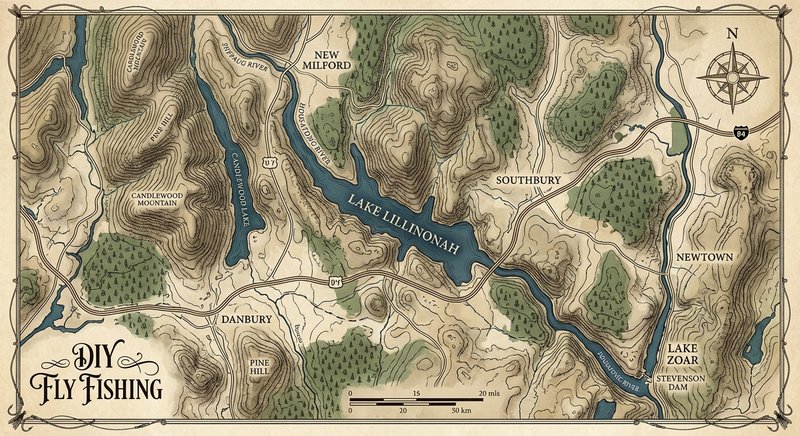
Lake Lillinonah
Fly fishing in Connecticut · Intermediate · Best seasons: Spring, Summer, Fall
Target Species
Largemouth Bass, Smallmouth Bass, Walleye
About This Water
Housatonic impoundment with bass fishing. Scenic valley reservoir.
Fishing Recommendations
Welcome to Lake Lillinonah, the second-largest lake in Connecticut and one of the most underrated fly fishing destinations in the Northeast. As a guide, I often tell clients that if they want a manicured park experience, go elsewhere. Lillinonah is raw, riverine, and full of sunken timber. It is a "working" lake, acting as a reservoir for the Housatonic River, and its fluctuating water levels create a dynamic environment where the fish are strong and the scenery is wild.
Here is your comprehensive guide to fly fishing Lake Lillinonah.
🎣 Location Overview
Lake Lillinonah is a 1,900-acre impoundment of the Housatonic and Shepaug Rivers. Unlike its neighbor, Candlewood Lake, which is a traditional "bowl" style reservoir, Lillinonah is long, narrow, and winding. It is characterized by steep, forested banks, rocky cliffs, and an incredible amount of downed timber.
What makes it special for the fly angler is its river-like nature. There is often a subtle current, especially in the upper reaches. The water is slightly more turbid (stained) than other CT lakes, which actually works in the fly fisher's favor by making fish less "leader-shy" and more willing to strike aggressive streamers and topwater patterns.
🐟 Target Species & Behavior
Largemouth Bass
Lillinonah is a "big wood" lake. Largemouths here are structure-oriented. They hold tight to the fallen trees that line the banks. Because the water level fluctuates due to the Shepaug Dam, these fish are mobile, moving from the outer edges of the timber to the inner root balls as the water rises and falls.
Smallmouth Bass
Smallmouths here favor the rocky points, the "cliffs" near the main channel, and the faster water at the northern end where the Housatonic flows in. They feed heavily on crayfish and the abundant alewife (landlocked herring) population.
Walleye
The CT DEEP stocks Lillinonah heavily with Walleye. These are "ghosts" for many fly anglers, but they are catchable. They are light-sensitive and spend their days in 20–30 feet of water. However, they move into the 5–10 foot range on rocky shoals and flats during low-light periods (dusk/dawn) to hunt baitfish.
📅 Best Times to Fish
- Spring (April – June): This is the prime window. As the water hits 55°F, bass move into the shallow coves (like Pond Brook) to spawn. This is the best time for fly anglers to target trophy fish in less than 6 feet of water.
- Summer (July – August): Focus on the "Magic Hour." The heat pushes fish deep during the day. Target the first two hours of daylight and the last hour of dusk with topwater flies.
- Fall (September – early November): As the water cools, the "Fall Feed" begins. Bass follow alewives into the creek arms. This is streamer season.
- Optimal Conditions: Overcast, drizzly days are legendary on Lillinonah. The lower light brings the Walleye up and makes the Smallmouths lose their inhibitions.
🪰 Recommended Flies & Techniques
For Bass (Large & Small)
- Topwater: Dahlberg Divers and BoogleBugs (size 2-4). Work these tight to the wood structure. Don't be afraid of a "loud" pop; the stained water means fish use their lateral lines to find prey.
- Streamers: Game Changers (white or chartreuse) to mimic alewives. For Smallmouth, use Clouser Minnows in tan/white or olive/white to bounce along rocky points.
- Sub-Surface: Meat Whistles or Crayfish patterns (size 2-4) in orange/brown.
For Walleye
- The "Dredge": You must use a sink-tip line (Type 5 or 6).
- Flies: Large, heavy Bunny Leeches or Zonkers in black, purple, or chartreuse. Walleye respond well to silhouettes and vibration.
- Technique: Use a "strip-strip-pause" retrieve. Most hits happen on the pause as the fly sinks back toward the bottom.
💡 Pro Tips & Local Knowledge
- Follow the Current: If the Shepaug Dam is pulling water, the fish will stack up on the downstream side of points. Look for "seams" just like you would on a trout river.
- The "Pond Brook" Arm: This is the most famous area of the lake. It's shallower and holds a massive concentration of Largemouths. It’s a great place for a float tube or kayak if you want to avoid the main lake's wind.
- Watch the Wood: Lillinonah is notorious for floating debris. After a heavy rain, entire logs will float just below the surface. If you are operating a motorboat, be extremely cautious.
- Color Palette: In the spring, go bright (Chartreuse/White). In the fall, match the "young of the year" baitfish with silvers and greys.
⚠️ Important Information
Access
- Route 133 Boat Launch (Brookfield/Bridgewater): The primary state-run ramp. Large and well-maintained.
- Pond Brook Boat Launch (Newtown): Better for smaller boats and closer to the best Largemouth habitat.
Regulations
- Licenses: A valid Connecticut Inland Fishing License is required.
- Walleye Limits: There are strict length and creel limits for Walleye (typically 18" minimum, but check current CT DEEP Angler’s Guide for seasonal changes).
- Invasive Species: Clean, drain, and dry your gear. Lillinonah has dealt with Zebra Mussel threats; don't be the one to spread them.
Safety
The water level can drop or rise several feet in a single day due to hydroelectric power generation. If you beach your boat on a stump to fish a bank, make sure you aren't high and dry an hour later!
Tight lines, and watch those logs!
Bug Hatches & Matching Flies
| Hatch | Type | Peak months | Time of day | Hook sizes | Matching flies |
|---|---|---|---|---|---|
| White Fly Ephoron leukon | mayfly | August, September | Evening | #12-14 | White Wulff #12-14, Ephoron Spinner #14, Snowshoe Emerger #12-14 |
| Tan Caddis Hydropsyche | caddis | May, June, July | Evening | #14-18 | Elk Hair Caddis (Tan) #14-16, Pupa (Tan/Olive) #14-18, Soft Hackle Hare's Ear #14-16 |
| Damselfly Enallagma | terrestrial | June, July, August | Morning/Afternoon | #10-14 | Braided Butt Damselfly #10-12, Marabou Damsel Nymph #12-14, Parachute Damsel #12 |
| Blue Winged Olive Baetis | mayfly | April, May, September, October | Afternoon | #18-22 | RS2 (Olive) #18-22, BWO Sparkle Dun #18-20, Pheasant Tail #18-20 |
| Midges Chironomidae | midge | March, April, October, November | All Day | #18-24 | Zebra Midge #18-22, Griffith's Gnat #20-24, Chironomid Pupa #16-20 |
| Hellgrammite Corydalus cornutus | stonefly | June, July | All Day | #4-8 | Murray's Hellgrammite #4-8, Pat's Rubber Legs (Black) #6-8, Beaded Hellgrammite #6-10 |
| Giant Michigan Mayfly Hexagenia limbata | mayfly | June, July | Late Evening/Night | #6-10 | Hexagenia Spinner #6-8, Hex Nymph #8-10, Deer Hair Hex #6-8 |
| Terrestrial Ants and Beetles Formicidae / Coleoptera | terrestrial | July, August, September | Afternoon | #12-18 | Chernobyl Ant #10-14, Black Foam Beetle #14-16, Cinnamon Ant #16-18 |