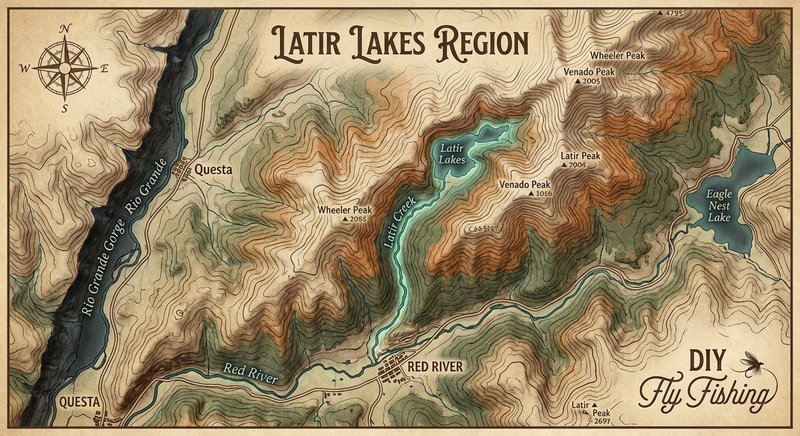
Latir Lakes
Fly fishing in New Mexico · Advanced · Best seasons: Summer, Fall
Target Species
Cutthroat Trout
About This Water
Remote alpine lakes near Wheeler Peak. Native cutthroat trout fishing.
Fishing Recommendations
Welcome to one of the crown jewels of Southern Rocky Mountain fly fishing. As your guide, I can tell you that the Latir Lakes represent the pinnacle of high-alpine angling in New Mexico. This is a rugged, breathtaking chain of nine lakes nestled in the Sangre de Cristo Mountains near the Colorado border.
If you are looking for solitude and the opportunity to catch New Mexico’s state fish in its most pristine habitat, you’ve found the right place.
🎣 Location Overview
The Latir Lakes are a series of nine alpine cirque lakes ranging in elevation from 11,000 to over 12,500 feet. What makes this area special is its location within the Rio Costilla Park and Agriculture Trust (RCPAT)—a private tract of land owned by the descendants of the original Spanish settlers.
Unlike many crowded public waters, the Latir Lakes offer a true "backcountry" feel. The water is crystal clear, cold, and surrounded by dramatic peaks and scree slopes. Each lake has its own personality: the lower lakes are easier to access and surrounded by timber, while the upper lakes sit above the tree line in the alpine tundra, offering a moonscape-like beauty.
🐟 Target Species & Behavior
The primary prize here is the Native Rio Grande Cutthroat Trout.
- Behavior: These fish are opportunistic but can be notoriously "spooky" due to the incredible water clarity. In the thin air of the high alpine, they spend their short summer season aggressively feeding to prepare for the long winter.
- Holding Patterns: Look for fish cruising the "shelves"—the transition zone where the shallow shore drops off into deep blue water. They often patrol these edges in a predictable loop.
- Feeding: Their diet consists heavily of midges, scuds (freshwater shrimp), callibaetis mayflies, and—most importantly in late summer—terrestrials like ants and beetles blown off the surrounding peaks.
📅 Best Times to Fish
The window of opportunity at Latir is short due to the extreme elevation.
- Summer (Late June – August): This is the prime window. The ice usually clears by mid-June. July brings the best "dry fly" action as the water warms and insect life peaks.
- Fall (September – Early October): This is the "trophy" window. The Cutthroats take on spectacular spawning colors (vibrant oranges and reds), and they feed aggressively before the lakes freeze.
- Time of Day: Unlike lower elevation streams, you don't need to be there at dawn. The fishing usually picks up around 10:00 AM once the sun hits the water, activating insect life and making it easier to sight-fish.
- Weather Note: Be off the high ridges by 2:00 PM. Monsoon thunderstorms are frequent in July and August and are deadly at this elevation.
🪰 Recommended Flies & Techniques
Presentation is often more important than the specific fly, but you must have these in your box:
Dry Flies
- Parachute Adams (#16-20): The gold standard for matching midges and small mayflies.
- Amy’s Ant or Chubby Chernobyl (#12-14): Great as attractors or as the "buoy" in a dry-dropper rig.
- Black Carpenter Ant or Foam Beetle (#14-18): Deadly in August and September when the wind blows insects onto the water.
- Griffith’s Gnat (#18-22): For those glassy mornings when fish are rising to tiny midges.
Sub-Surface
- Flashback Pheasant Tail (#16-18): Matches the local callibaetis nymphs.
- Ray Charles or Olive Scuds (#14-16): A staple food source in these lakes year-round.
- Zebra Midge (Red or Black, #18-22): Hang this 18 inches under a dry fly.
- Woolly Bugger (Olive or Thin Mint, #10-12): Retrieve slowly along the drop-offs if the wind picks up.
Technique Tips
- The "Stalk": Stay low. If you can see the fish, they can see you. Wear drab clothing to blend into the rocks.
- The Lead: When sight-casting to a cruising trout, cast 3–5 feet in front of its path. Do not "plop" the fly right on its head.
- Long Leaders: Use a 9-foot to 12-foot leader tapered to 5X or 6X fluorocarbon. The water is too clear for heavy tippets.
💡 Pro Tips & Local Knowledge
- The "Upper Lake" Strategy: Lake 1 and 2 are the most pressured. If you have the lungs for it, hike up to Lakes 7, 8, or 9. These upper lakes hold fewer but often larger fish, and you will likely have the water entirely to yourself.
- Wind is your Friend: A "glassy" lake surface makes the fish hyper-alert. A slight "riffle" or "chop" on the water hides your line and makes the fish more confident in taking a fly.
- The "Slow Strip": If using a nymph or scud without an indicator, use a very slow "hand-twist" retrieve. You aren't swimming the fly; you're just keeping the slack out.
⚠️ Important Information
- Access & Permits: This is not National Forest land. You must purchase a permit from the Rio Costilla Park and Agriculture Trust. Permits can be bought at the gatehouse on the way in.
- The Road: The drive to the Latir Lakes trailhead is legendary for its roughness. A High-Clearance 4WD vehicle is mandatory. Do not attempt this in a standard passenger car or a "soft-road" SUV.
- Regulations: Regulations can change; generally, it is catch-and-release or highly restricted harvest to protect the native Cutthroat genetics. Always check the current RCPAT rules at the gate.
- Physical Fitness: You are fishing at nearly 12,000 feet. Altitude sickness is real. Drink twice as much water as you think you need and take it slow.
- Leave No Trace: This ecosystem is extremely fragile. Stay on marked trails to avoid crushing alpine flora that takes decades to grow.
Tight lines, and enjoy the pursuit of the Rio Grande Cutthroat! It is a bucket-list experience for any serious fly fisher.
Bug Hatches & Matching Flies
| Hatch | Type | Peak months | Time of day | Hook sizes | Matching flies |
|---|---|---|---|---|---|
| Callibaetis (Speckled Duns) Callibaetis spp. | mayfly | July, August, September | Late Morning to Early Afternoon | #12-16 | Parachute Adams #14-16, Callibaetis Spinner #14-16, Hare's Ear Nymph #12-16 |
| Chironomids (Midges) Chironomidae | midge | June, July, August | All Day | #18-24 | Zebra Midge #18-22, Griffith's Gnat #20-22, Ice Bud Midge #18-20 |
| Scuds (Freshwater Shrimp) Gammarus | terrestrial | June, July, August, September | All Day | #14-18 | Ray Charles #14-16, Flashback Scud #16-18 |
| Damselflies Enallagma spp. | terrestrial | July, August | Morning to Mid-Afternoon | #10-12 | Marabou Damsel Nymph #10-12, Adult Blue Damsel #10-12 |
| Cinnamon Ants Formicidae | terrestrial | July, August, September | Afternoon | #14-18 | Cinnamon Ant #14-18, Flying Ant #16 |
| Spotted Sedge Hydropsyche | caddis | July, August | Evening | #14-16 | Elk Hair Caddis #14-16, Pupa Emerger #14-16 |
| Water Boatmen Corixidae | terrestrial | August, September, October | Afternoon | #14-16 | Water Boatman #14-16, Prince Nymph (Small) #16-18 |
| Alpine Grasshoppers Melanoplus spp. | terrestrial | August, September | Afternoon | #10-14 | Joe's Hopper #12-14, Amy's Ant #12-14 |