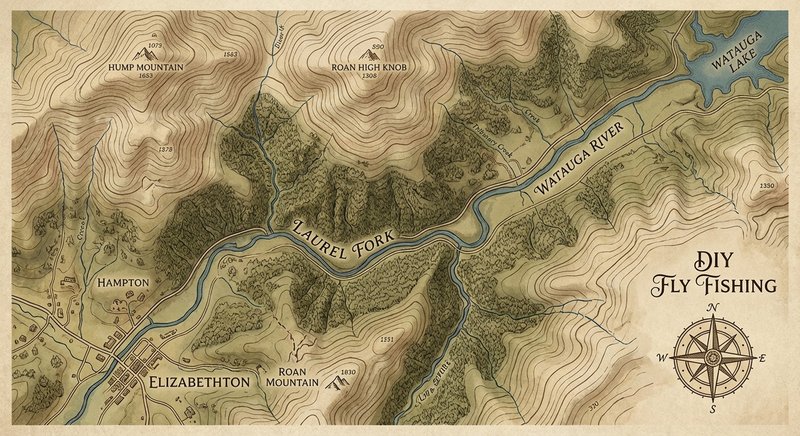
Laurel Fork
Fly fishing in Tennessee · Intermediate · Best seasons: Spring, Summer, Fall
Target Species
Rainbow Trout, Brook Trout
About This Water
Wild trout stream near Hampton. Scenic fishing in Cherokee National Forest.
Fishing Recommendations
Welcome to one of the most rugged and beautiful "blue ribbon" experiences in the Southern Appalachians. As your guide, I can tell you that Laurel Fork in Carter County, Tennessee, is a quintessential mountain freestone stream. While many anglers flock to the nearby tailwaters of the Watauga and Holston, Laurel Fork offers a primitive, wild trout experience within the Pond Mountain Wilderness.
Here is your comprehensive guide to fly fishing Laurel Fork.
🎣 Location Overview
Laurel Fork is a tributary of the Watauga River, but it feels worlds apart from the big valley rivers. It is characterized by high-gradient plunges, massive boulders, and dense rhododendron "hells" that overhang the water.
What makes it special is the Pond Mountain Wilderness section. The stream carves a deep gorge, highlighted by the spectacular 55-foot Laurel Falls. This is "pocket water" fishing at its finest. The water is crystal clear, cold, and highly oxygenated. Anglers love it because it requires technical casting, physical hiking, and offers the reward of wild, vibrant fish in a cathedral-like forest setting.
🐟 Target Species & Behavior
The stream is managed primarily as a wild trout fishery.
- Rainbow Trout: Found throughout the lower and middle sections. These are wild, hard-fighting fish. They aren't huge (typically 7–10 inches), but they are incredibly opportunistic. They hold in the "cushion" in front of boulders and in the deep plunge pools below falls.
- Brook Trout: The prize of the high country. In the upper reaches (above the falls and into the headwaters), you will find the Southern Appalachian Brook Trout. These are small, stunningly colorful, and very shy.
- Behavior: Because food is relatively scarce in these nutrient-poor mountain streams, the fish are not usually "picky" about fly patterns, but they are extremely spooky. If they see your shadow or feel the vibration of a heavy footstep on a rock, the pool is "done" for the next hour.
📅 Best Times to Fish
Optimal Seasons
- Spring (Late March – June): This is the prime window. Water levels are stable, and the major hatches (Quill Gordons, March Browns, and Hendricksons) occur.
- Summer (July – August): While the big rivers get too hot, Laurel Fork stays cool due to the canopy. This is the time for terrestrial patterns (ants and beetles).
- Fall (September – November): A magical time. The Brook Trout take on deep orange spawning colors. Low water requires extreme stealth, but the fish are aggressive before winter sets in.
Best Times of Day
- Morning/Late Afternoon: During summer, avoid the midday sun when shadows are harsh. In the spring and fall, the "warm" window of 10:00 AM to 4:00 PM is often best for insect activity.
🪰 Recommended Flies & Techniques
Top Fly Patterns
- Dry Flies:
- Yellow Stimulator (Size 12-16): Mimics stoneflies and acts as a high-vis attractor.
- Parachute Adams (Size 14-18): The gold standard for matching generic mayflies.
- Elk Hair Caddis (Size 14-16): Best for the choppy pocket water.
- Royal Wulff: High visibility in the foam.
- Nymphs:
- Pheasant Tail (Size 16-18): Mimics almost any nymph in the stream.
- Prince Nymph (Size 14-16): The "bead head" version is great for getting deep in plunge pools.
- Terrestrials:
- Black Ants and Foam Beetles: Essential for summer fishing under the rhododendrons.
Effective Techniques
- The Dry-Dropper: This is the most effective rig. Use a buoyant dry fly (like a Stimulator) and hang a small nymph (like a Pheasant Tail) 18–24 inches below it.
- High-Sticking: Because the currents are complex, keep as much fly line off the water as possible. Use a short, accurate cast and follow the fly with your rod tip to avoid "drag."
- Bow-and-Arrow Cast: You will need this. The brush is tight, and traditional backcasts are often impossible.
💡 Pro Tips & Local Knowledge
- The "Hike-In" Rule: The easiest access points (near Dennis Cove) get the most pressure. If you want the best fishing, hike 1.5 to 2 miles into the gorge. The further you get from the trailhead, the less educated the fish are.
- Fish the "Broken" Water: Don't spend too much time in the long, flat, glass-like pools. The fish see you too easily. Focus on the "white water" or the choppy surface where the fish feel protected from overhead predators.
- Rod Choice: Leave your 9-foot 5-weight at home. A 7-foot to 7.5-foot 3-weight rod is the perfect tool for Laurel Fork. It allows for tight casting under the tree canopy.
- Wear Drab Colors: Avoid bright shirts. Wear greens, browns, or greys to blend into the forest.
⚠️ Important Information
Access
- Dennis Cove Trailhead: Located outside of Hampton, TN. This provides access to the upper sections and the trail down to the falls.
- Lower Access: You can access the lower sections via the Appalachian Trail/Laurel Falls Trailhead near Hampton, but be prepared for a steep hike.
Regulations & Permits
- License: A valid Tennessee Fishing License with a Trout Supplement is required.
- Wild Trout Regs: Much of Laurel Fork is under "Wild Trout" regulations. This typically means Single Hook, Artificial Lure Only. No corn, worms, or powerbait. Always check the current TWRA (Tennessee Wildlife Resources Agency) guide before heading out.
Special Considerations
- Safety: The rocks in Laurel Fork are notoriously slippery (slicker than the Watauga). Wading boots with felt or carbide studs are highly recommended.
- Wildlife: This is black bear country. Keep your food secured and be aware of your surroundings.
- Cell Service: Expect zero cell service once you drop into the gorge. Tell someone your plan before you go.
Tight lines, and enjoy the solitude of the Laurel Fork gorge!
Bug Hatches & Matching Flies
| Hatch | Type | Peak months | Time of day | Hook sizes | Matching flies |
|---|---|---|---|---|---|
| Quill Gordon Epeorus pleuralis | mayfly | March, April | Midday | #12-14 | Quill Gordon Dry #12-14, Quill Gordon Nymph #12-14 |
| Blue Quill Paraleptophlebia adoptiva | mayfly | March, April | Midday | #16-18 | Blue Quill Dry #16-18, Pheasant Tail Nymph #16-18 |
| Sulfur Ephemerella invaria/rotunda | mayfly | May, June | Late Afternoon/Evening | #14-16 | Sulfur Parachute #14-16, Sulfur Emerger #14-16 |
| Yellow Sally Isoperla spp. | stonefly | May, June, July | Afternoon/Evening | #14-16 | Yellow Stimulator #14-16, Little Yellow Stone Nymph #14-16 |
| Tan Caddis Hydropsyche spp. | caddis | April, May, June, September | Evening/All Day | #14-18 | Elk Hair Caddis #14-18, Holy Grail Caddis #14-16 |
| Light Cahill Stenacron interpunctatum | mayfly | June, July, August | Evening | #12-14 | Light Cahill Dry #12-14, Gold Ribbed Hare's Ear #12-14 |
| Blue Winged Olive Baetis spp. | mayfly | March, October, November | Midday/Overcast | #18-22 | BWO Parachute #18-22, RS2 #20-22 |
| Terrestrials (Ants/Beetles) Formicidae / Coleoptera | terrestrial | July, August, September | All Day | #12-18 | Black Foam Beetle #14-16, Cinnamon Ant #16-18 |