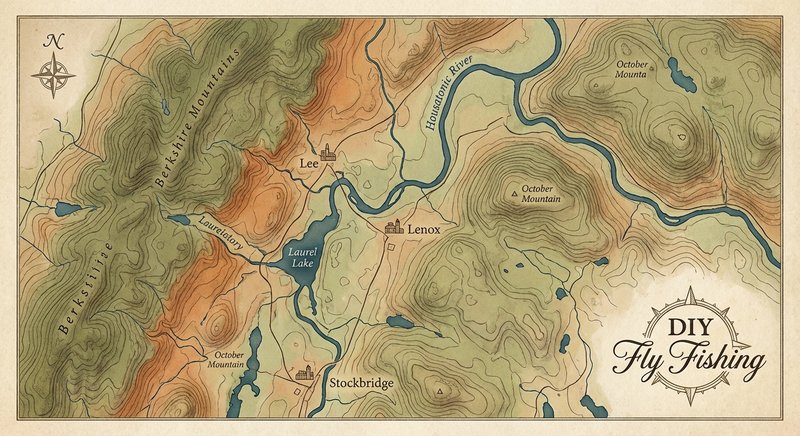
Laurel Lake
Fly fishing in Massachusetts · Beginner · Best seasons: Spring, Summer, Fall
Target Species
Rainbow Trout, Brown Trout, Bass
About This Water
Berkshire County lake with trout. Lee/Lenox area.
Fishing Recommendations
As an expert guide with years of experience navigating the limestone-rich waters of the Berkshires, I can tell you that Laurel Lake in Lee and Lenox is a unique gem in the Massachusetts fishing landscape. Unlike many of the acidic, tea-colored ponds in the region, Laurel Lake sits on a limestone shelf, giving it a higher pH and incredible productivity that supports both cold-water trout and warm-water game fish.
Here is your comprehensive guide to fly fishing Laurel Lake.
🎣 Location Overview
Laurel Lake is a 170-acre "great pond" nestled in the heart of the Berkshires. What makes it special is its depth and water chemistry. Reaching depths of over 50 feet, it maintains a cold "hypolimnion" (bottom layer) even in the heat of summer, allowing stocked trout to "hold over" and grow to impressive sizes.
Anglers love it because it offers a "triple threat": high-quality trout fishing, trophy-sized Largemouth Bass, and a scenic backdrop of the Berkshire Hills. The water is generally quite clear, which demands a stealthy approach and technical precision from fly anglers.
🐟 Target Species & Behavior
Rainbow & Brown Trout
- Behavior: MassWildlife stocks Laurel Lake heavily in both Spring and Fall. Rainbows tend to cruise the upper 10 feet of the water column in spring, while Browns are more structure-oriented and light-sensitive.
- Feeding: They focus on midge larvae, small crustaceans, and the lake’s prolific Hexagenia (mayfly) and caddis hatches. Large Browns eventually turn piscivorous, feeding on golden shiners and young perch.
Largemouth & Smallmouth Bass
- Behavior: Largemouths dominate the weedy eastern and northern bays. Smallmouths are less common but can be found patrolling the steeper drop-offs and rocky areas near the center and western shore.
- Feeding: They are aggressive predators here, keyed in on crayfish, dragonflies, and the abundant panfish population.
📅 Best Times to Fish
Spring (April – June)
- The Window: This is the prime time for trout. Immediately after ice-out, trout are found in the shallows seeking warmth.
- Time of Day: Late morning to mid-afternoon when the sun warms the water slightly.
Summer (July – August)
- The Window: Focus on Bass in the early mornings and late evenings. Trout will retreat to the deep "kettle" holes (30-45ft deep).
- Time of Day: First light (5:00 AM – 8:00 AM) is essential for topwater bass action.
Fall (September – November)
- The Window: As water temperatures drop, trout move back to the shallows. This is the best time to hunt for "holdover" Browns that have survived the summer.
- Time of Day: All day; overcast days are particularly productive.
🪰 Recommended Flies & Techniques
For Trout
- Nymphing: Use a Zebra Midge (size 18-22) or a Pheasant Tail under a sensitive indicator. If fishing from a boat, "naked nymphing" (long leader, no indicator) with a slow twitch is deadly.
- Dry Flies: During the late June Hexagenia hatch, use a size 6-8 Yellow Drake or Hex Parasol. For daily rises, an Adirondack Masked Sedge or Griffith’s Gnat works well.
- Streamers: A Woolly Bugger (Olive or White) on a sinking tip line is the gold standard here.
For Bass
- Topwater: Frog patterns, Poppers, or Dahlberg Divers worked along the lily pad edges.
- Subsurface: Game Changers or Clouser Minnows in yellow/perch patterns to mimic the local forage.
Presentation Tip
Because the water is clear, use long fluorocarbon leaders (9–12 feet) tapering to 5X or 6X for trout. For bass, 2X or 3X is sufficient to pull them out of the weeds.
💡 Pro Tips & Local Knowledge
- The "Drop-Off" Strategy: The western shore has a much steeper gradient than the eastern shore. If you are targeting trout in the late spring, find the "ledge" where the water drops from 10 feet to 25 feet. Trout cruise this edge like a highway.
- The Hex Hatch: Late June evenings produce a massive Hexagenia limbata (giant yellow mayfly) hatch. It is one of the few places in Western MA where you can reliably catch 20-inch trout on the surface at dusk.
- Baitfish Mimicry: The lake is full of Yellow Perch. If the trout or bass aren't hitting insects, switch to a streamer with yellow and orange barred marabou.
- Wind is your Friend: A slight chop on Laurel Lake breaks up the surface film, making the fish less spooky. If it's glass-calm, you'll need to fish deeper or use much longer leaders.
⚠️ Important Information
- Access: There is a concrete state boat ramp located on the southern end off Route 20. There is also a small public beach area, but fishing is restricted in the swimming zone during summer months.
- Non-Motorized Advantage: While motors are allowed, a kayak or canoe is the best way to fly fish this lake. It allows you to silently approach the weed lines and shallow flats without spooking fish.
- Regulations:
- A Massachusetts freshwater fishing license is required.
- Trout regulations follow the general statewide rules (3 fish per day), but I highly recommend Catch and Release for holdover fish to maintain the trophy quality of the lake.
- Invasive Species: Be sure to wash your boat/gear before and after entering. Zebra mussels and invasive weeds are a constant concern in Berkshire County limestone lakes.
Guide’s Final Word: Laurel Lake is a "thinking man's" fishery. It doesn't always give up its secrets easily, but if you match the hatch and respect the water's clarity, it can provide some of the best fly fishing in New England. Tight lines!
Bug Hatches & Matching Flies
| Hatch | Type | Peak months | Time of day | Hook sizes | Matching flies |
|---|---|---|---|---|---|
| Midges Chironomidae | midge | April, May, September, October | All Day | #18-24 | Zebra Midge #18-22, Griffith's Gnat #20-22, Palomino Midge #20-24 |
| Giant Michigan Mayfly (Hex) Hexagenia limbata | mayfly | June, July | Dusk/Night | #6-10 | Hexagenia Spinner #6-8, Paradrake Hex #8-10, Hexagenia Nymph #6-10 |
| Speckled Spinner / Speckled Dun Callibaetis | mayfly | May, June, August, September | Late Morning | #14-16 | Callibaetis Spinner #14-16, Hare's Ear Nymph #14-16, Mercer's Callibaetis Cripple #14-16 |
| Blue-Winged Olive Baetis / Acerpenna | mayfly | April, May, September, October | Afternoon | #18-22 | BWO Parachute #18-22, RS2 #20-22, Pheasant Tail Nymph #18-20 |
| Damselfly Enallagma | terrestrial | June, July | Morning/Afternoon | #10-14 | Marabou Damsel Nymph #10-12, Adult Damsel #12-14 |
| Spotted Sedge Hydropsyche | caddis | May, June, July | Evening | #14-18 | Elk Hair Caddis #14-16, LaFontaine's Deep Sparkle Pupa #14-18, Godzilla Caddis #14 |
| Flying Ants Formicidae | terrestrial | August, September | Afternoon | #16-20 | Black Foam Ant #16-18, Fur Ant #18-20 |
| Angler's Curse Caenis | mayfly | July, August | Early Morning | #22-26 | Caenis Spinner #24-26, Trico Parachute #22-24 |
| Black Beetle Coleoptera | terrestrial | July, August | All Day | #12-16 | Foam Beetle #14-16, Cinnamon Ant #16 |