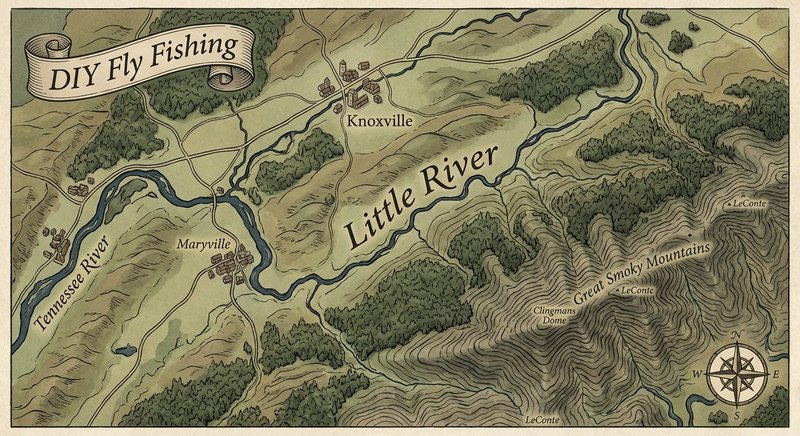
Little River
Fly fishing in Tennessee · Intermediate · Best seasons: Spring, Summer, Fall
Target Species
Rainbow Trout, Brown Trout, Brook Trout
About This Water
Great Smoky Mountains stream with wild rainbow and brown trout. Beautiful freestone fishing.
Fishing Recommendations
The Little River in East Tennessee is arguably the crown jewel of the Great Smoky Mountains National Park (GSMNP). Flowing from the high-elevation peaks down through Elkmont and into the town of Townsend, it offers over 30 miles of fishable water. It is a classic freestone stream, characterized by crystalline water, ancient boulders, and a "wild" character—every fish in the park is 100% wild and stream-born.
🎣 Location Overview
The Little River is special because of its diversity. It is divided into several "prongs" and sections, each offering a different experience:
- The Upper Reaches (Above Elkmont): Tight, high-gradient pocket water surrounded by rhododendrons.
- The Middle Section (Elkmont to "The Wye"): Large boulders, deep plunge pools, and beautiful runs.
- The Lower Section (Below the Wye): Larger, slower water where the river leaves the park, known for trophy potential.
Anglers love the Little River for its accessibility and its challenge. While the fish are famously "spooky" due to the clarity of the water, the reward of catching a vibrant, wild Southern Appalachian Brook Trout in its ancestral home is unmatched.
🐟 Target Species & Behavior
- Rainbow Trout: The most common species found throughout the river. They are opportunistic and hold in the "faster" water—the heads of riffles and the bubbly seams of pocket water.
- Brown Trout: Found primarily in the middle and lower sections. They are the apex predators here. During the day, they tuck under undercut banks or deep beneath boulders. They become active during low light (dawn/dusk) or after a heavy rain.
- Brook Trout (Speckled Trout): The only trout native to these mountains. You will find them primarily in the high-elevation headwaters above 3,000 feet. They are small (usually 5–8 inches) but exceptionally beautiful and aggressive.
📅 Best Times to Fish
Optimal Seasons
- Spring (March - May): The "Golden Era." This is when the major hatches occur (Quill Gordons, March Browns). Water temperatures rise into the 50s, making fish very active.
- Summer (June - August): Great for "Dry-Dropper" rigs. Focus on the higher elevations where water stays cooler. Fishing is best in the early morning and late evening.
- Fall (September - November): Stunning scenery and the Brown Trout spawn. As water cools, fish feed heavily to prepare for winter. October is arguably the best month for dry fly action with Terrestrials and Blue Winged Olives.
Prime Windows
- The "Temperature Rule": In the Smokies, the magic number is 50°F. If the water is below 45°F, fishing is slow. Once it hits 50–55°F, the river comes alive.
- Low Light: Because the water is so clear, mid-day sun often puts fish down. Cloudy days are an angler's best friend on the Little River.
🪰 Recommended Flies & Techniques
Top Fly Patterns
- Dry Flies:
- Attractors: Royal Wulff, Stimulator (Yellow/Orange), Thunderhead (a local favorite).
- Match the Hatch: Quill Gordon (Early Spring), Light Cahill, Yellow Sally (Late Spring/Summer), Parachute Adams (Year-round).
- Terrestrials: Green Weenie (legendary here), Foam Beetles, Ants.
- Nymphs:
- Pheasant Tail (beaded and non-beaded), Prince Nymph, Tellico Nymph, and the Frenchie.
- Streamers:
- Wooly Buggers (Olive/Black) for the deeper pools in the lower river.
Techniques
- The "Dry-Dropper": The most effective way to fish the Little River. Use a buoyant dry (like a Stimulator) with a small nymph (like a Pheasant Tail) tied 18–24 inches below it.
- Short Line Nymphing: Because of the complex currents around boulders, "high-sticking" or Euro-style nymphing keeps your line off the water and prevents drag.
- Stealth: This is the most important "technique." Wear drab colors (earth tones), move slowly, and stay low. If you can see the fish, they have likely already seen you.
💡 Pro Tips & Local Knowledge
- The "Green Weenie": If you are struggling, tie on a Green Weenie. This simple chartreuse chenille pattern mimics the inchworms that fall from the canopy and is a staple for GSMNP guides.
- Target the "Soft Water": In the heavy pocket water of the Little River, fish don't want to fight the main current. Look for the "pillows" of soft water just in front of or behind large boulders.
- The Elkmont Section: Park at the Elkmont campground and hike up the Little River Trail. The further you walk away from the road, the less pressured the fish are and the more aggressive they become.
- Watch the "Wye": The Townsend Wye is where the prongs meet. It gets crowded with swimmers in summer, but the deep holes just downstream hold some of the largest Brown Trout in the park.
⚠️ Important Information
Access
- Roadside Access: Much of the Little River follows Little River Road, offering easy "hop out and fish" access.
- Backcountry: For Brook Trout, prepare to hike. The Metcalf Bottoms area and the trailheads near Elkmont are the best jumping-off points.
Regulations & Permits
- License: You need either a valid Tennessee OR North Carolina state fishing license. Either one is honored throughout the National Park. No special trout stamp is required within the park boundaries.
- Lures: Single hook, artificial lures ONLY. No bait (corn, worms, powerbait) is allowed. This is strictly enforced.
- Size/Creel Limits: Generally, there is a 7-inch minimum size limit for all trout, and a combined creel of 5 fish per day. (Check current NPS signs at trailheads for any updates).
Special Considerations
- Safety: The boulders are incredibly slick. Felt-soled boots or studded wading boots are highly recommended.
- Bears: This is black bear country. Keep your food secured in your vehicle or in bear-proof containers if camping.
- Water Levels: Check the USGS gauge for "Little River near Townsend." Ideal flows are between 1.5ft and 2.5ft. Anything over 3.0ft can be dangerous to wade.
Bug Hatches & Matching Flies
| Hatch | Type | Peak months | Time of day | Hook sizes | Matching flies |
|---|---|---|---|---|---|
| Quill Gordon Epeorus pleuralis | mayfly | March | Mid-day | #12-14 | Quill Gordon Dry #12-14, Hare's Ear Nymph #12-14 |
| Blue Quill Paraleptophlebia adoptiva | mayfly | March, April | Late morning to Afternoon | #16-18 | Blue Quill Dry #16-18, Pheasant Tail Nymph #16-18 |
| Yellow Sally Isoperla spp. | stonefly | May, June, July | Late Afternoon/Evening | #14-16 | Yellow Stimulator #14-16, Yellow Sally Nymph #14-16 |
| Tan Caddis Hydropsyche | caddis | April, May, June | Evening | #14-18 | Elk Hair Caddis #14-18, Holy Grail Caddis #14-16 |
| Light Cahill Stenacron interpunctatum | mayfly | May, June, July | Evening | #12-14 | Light Cahill Dry #12-14, Cream Usual #14 |
| Blue Winged Olive Baetis spp. | mayfly | February, March, October, November | Afternoon | #18-22 | Parachute Adams #18-22, RS2 #20-22 |
| March Brown Maccaffertium vicarium | mayfly | April, May | Mid-day | #10-14 | March Brown Dry #10-12, Gold Ribbed Hare's Ear #12-14 |
| Golden Stonefly Acroneuria spp. | stonefly | June, July | Night/Morning | #6-10 | Girdle Bug #8-10, Golden Stone Nymph #8-12 |
| Terrestrials Formicidae / Coleoptera | terrestrial | July, August, September | All day | #12-18 | Parachute Ant #14-18, Black Foam Beetle #12-16 |
| Midges Chironomidae | midge | December, January, February | Any | #18-24 | Zebra Midge #18-22, Griffith's Gnat #18-22 |