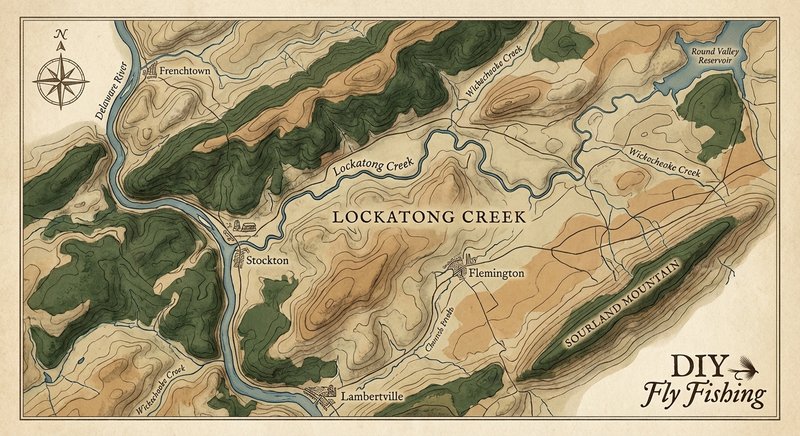
Lockatong Creek
Fly fishing in New Jersey · advanced · Best seasons: spring, fall
Target Species
Brown Trout
About This Water
Hunterdon County spring creek with wild brown trout. Technical fishing in pastoral setting.
Fishing Recommendations
As an expert guide who has spent years navigating the technical pocket waters of the Mid-Atlantic, I can tell you that Lockatong Creek is one of New Jersey’s true "hidden gem" streams. Tucked away in the rolling hills of Hunterdon County, it offers a more intimate, secluded experience compared to the high-pressure waters of the nearby South Branch or Musconetcong.
Here is your comprehensive guide to fly fishing Lockatong Creek.
🎣 Location Overview
The Lockatong Creek is a tributary of the Delaware River, carving its way through a scenic, heavily wooded corridor. What makes it special is its "freestone" character; unlike the limestone spring creeks of Pennsylvania, the Lockatong is rain-fed and rocky, featuring a classic gradient of plunges, riffles, and deep, shaded pools.
Anglers love the Lockatong because it feels wild. Much of the fishable water is flanked by steep banks and dense hemlocks, providing a sense of solitude. The water is generally clear but can take on a "tannic" or tea-colored hue after rain. It is a technical stream—overhanging branches and tight quarters require precise casting, but the reward is often a stunning wild or holdover trout in a beautiful setting.
🐟 Target Species & Behavior
While the state stocks the Lockatong with Rainbows and Brookies, the Brown Trout is the king of this creek.
- Holdover Potential: Because of the deep pools and cool canopy, a fair number of Brown Trout survive the summer heat, becoming "holdovers" that take on wild characteristics—vibrant red spots and buttery yellow bellies.
- Behavior: These Browns are wary. During the day, they tuck tightly under undercut banks, beneath fallen logs, or at the very head of pools where oxygen is highest.
- Feeding: They are opportunistic. In the spring, they focus on aquatic insects (Mayflies and Caddis). In the fall, they become aggressive territorial defenders and will move to strike larger streamers or terrestrial patterns.
📅 Best Times to Fish
Optimal Seasons
- Spring (April – June): This is the prime window. Water levels are usually stable, and the major insect hatches occur.
- Fall (Late September – November): As temperatures drop, the Brown Trout become active again before spawning. The fall foliage makes this one of the most beautiful times to be on the water.
Best Times of Day
- Spring: Mid-morning to late afternoon (10 AM – 4 PM) as the sun warms the water and triggers insect activity.
- Fall: Early morning or late evening. Brown Trout are more comfortable moving into shallow water under low-light conditions.
Prime Conditions
Look for a "dropping and clearing" flow. Fishing 24–48 hours after a moderate rain is ideal, as the slightly murky water gives the angler better cover to approach wary fish.
🪰 Recommended Flies & Techniques
Top Fly Patterns
- Dry Flies:
- Adams Parachute (Size 14-18) – The gold standard for any hatch.
- Elk Hair Caddis (Size 14-16) – Tan or Olive; fish these in the riffles.
- Blue Winged Olive (BWO) (Size 18-20) – Crucial for overcast spring days.
- Nymphs:
- Pheasant Tail (Size 16-18) – Mimics almost any mayfly nymph.
- Hare’s Ear (Size 14-16) – Great for the "buggy" look in deeper runs.
- Zebra Midge (Size 18-22) – Essential for winter or low-water periods.
- Streamers:
- Woolly Bugger (Size 8-12) – Black or Olive. Swing these through deep pools.
Effective Techniques
- Tight-Line Nymphing: Because the creek is narrow and rocky, traditional indicator nymphing can be difficult. Using a "Euro" style or tight-line approach allows you to feel the bottom without getting hung up.
- The "Stealth" Approach: Since the water is often shallow, stay low. Kneel if you have to. Cast upstream and let your fly drift naturally back toward you.
- Dapping: In overgrown sections, you may not be able to cast. Simply poking your rod tip through the brush and "dapping" a dry fly on the surface can trigger explosive strikes.
💡 Pro Tips & Local Knowledge
- Focus on the Pockets: Many anglers walk right past the small "pocket water" (buckets behind rocks). On the Lockatong, a 12-inch Brown Trout will happily live in a pocket no bigger than a kitchen sink if it has enough cover.
- The "Kingwood" Stretch: Focus your efforts on the sections between Kingwood and Raven Rock. This area has the best gradient and rock structure.
- Long Leaders: Use a 9-foot to 12-foot leader tapered to 5X or 6X fluorocarbon. The fish here are "leader shy" due to the clarity of the water.
- Match the Bottom: If you aren't seeing rises, use a nymph that matches the color of the stream bed rocks—usually dark browns and olives.
⚠️ Important Information
Access Information
Most access is found along Route 29 (near the confluence with the Delaware) and various bridge crossings like Kingwood-Lockatong Road. Be mindful that while there are public stretches and Green Acres land, some banks are private property. Look for NJ Fish & Wildlife signs.
Regulations & Permits
- License: You must have a valid New Jersey Fishing License and a Trout Stamp.
- Method: Much of the Lockatong is governed by statewide trout regulations, but always check the current NJ Freshwater Fishing Digest for updated "Trout Stocked" vs. "Wild Trout" designations, as rules on creel limits can change.
- Season Closures: Be aware of the pre-season stocking closures in the spring (usually late March through early April) when fishing is prohibited.
Special Considerations
- Ticks & Wading: Hunterdon County is heavy tick country; wear repellent. The rocks in the Lockatong are famously slippery (often referred to as "snot rocks")—felt-soled boots or studs are highly recommended.
- Temperature Watch: In the late spring, if the water temp hits 68°F, stop fishing. The Lockatong can warm up quickly, and hooking a trout in warm water is often fatal for the fish.
Bug Hatches & Matching Flies
| Hatch | Type | Peak months | Time of day | Hook sizes | Matching flies |
|---|---|---|---|---|---|
| Blue-Winged Olive Baetis / Pseudocloeon | mayfly | March, April, September, October | Midday | #18-22 | RS2 #18-22, Parachute BWO #18-22, Pheasant Tail #18-20 |
| Hendrickson Ephemerella subvaria | mayfly | April, May | Afternoon | #12-14 | Hendrickson Dark #12-14, Red Quill #14, Hare's Ear #12-14 |
| Grannom Caddis Brachycentrus | caddis | April | Morning/Afternoon | #14-16 | Grannom Pupa #14-16, Elk Hair Caddis (Olive) #14-16 |
| Sulphur Ephemerella invaria / dorothea | mayfly | May, June | Evening | #14-18 | Sulphur Parachute #14-18, Sulphur Emerger #16-18, Pheasant Tail #14-18 |
| Light Cahill Stenacron / Stenonema | mayfly | June, July | Evening | #12-14 | Light Cahill #12-14, Gold Ribbed Hare's Ear #12-14 |
| Tan Caddis Hydropsyche | caddis | May, June, July, August | Morning/Evening | #14-18 | Tan Elk Hair Caddis #14-18, LaFontaine Sparkle Pupa #14-16, Frenchie #14-18 |
| Midges Chironomidae | midge | January, February, March, December | Midday | #20-24 | Zebra Midge #20-24, Griffith's Gnat #20-22 |
| Terrestrials Formicidae / Coleoptera | terrestrial | July, August, September | All Day | #12-18 | Black Foam Ant #14-18, Crowe Beetle #12-16, Dave's Hopper #10-12 |