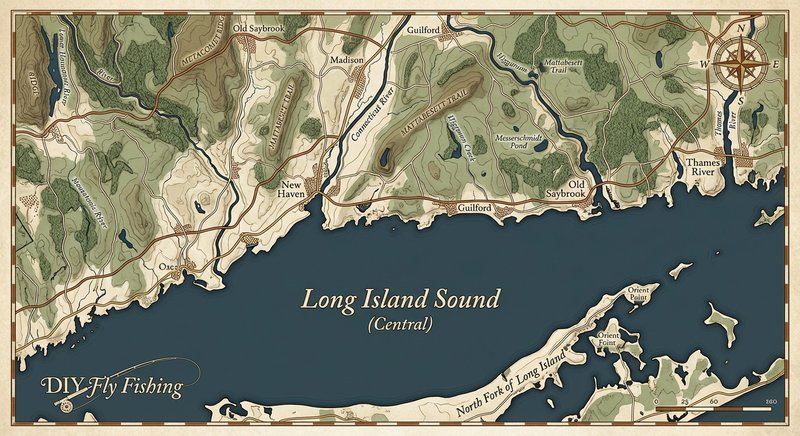
Long Island Sound (Central)
Fly fishing in Connecticut · Intermediate · Best seasons: Spring, Summer, Fall
Target Species
Striped Bass, Bluefish, Fluke
About This Water
Saltwater fishing near New Haven. Striped bass and bluefish.
Fishing Recommendations
Welcome to the "Center of the Sound." As a guide in these waters, I can tell you that Central Connecticut offers some of the most diverse salt-fly opportunities on the Eastern Seaboard. From the jagged granite of the Thimble Islands to the massive outflows of the Connecticut and Housatonic Rivers, this region is a playground for the technical angler.
Here is your guide to fly fishing Central Long Island Sound.
🎣 Location Overview
The Central Long Island Sound (stretching roughly from Milford to Old Saybrook) is defined by its glacial geology. Unlike the sandy beaches of the South Shore of Long Island, the Connecticut coastline is "bouldery." It is characterized by rocky points, submerged reefs (moraines), and extensive salt marshes.
What makes this area special is the interstitial water. You have massive tidal exchanges twice a day that flush nutrients from the estuaries into the Sound, creating a "conveyor belt" of baitfish. Anglers love it because you can transition from sight-casting on a shallow sand flat to dredging a deep-water reef in a single afternoon.
🐟 Target Species & Behavior
Striped Bass (The King)
- Behavior: Stripers are structure-oriented ambush predators. In the spring, they hold in the warmer tidal rivers. By summer, the "cows" (large females) move to deeper, cooler reefs, while "schoolies" remain in the rocks and salt ponds.
- Feeding: They focus on "the hatch." This includes Silversides, Bay Anchovies, Menhaden (Bunker), and the famed Cinder Worms in late May.
Bluefish (The Yellow-Eyed Demon)
- Behavior: Pure aggression. Bluefish move in fast-traveling schools, often driving bait to the surface in "blitzes."
- Feeding: They are not picky but require a fast, erratic retrieve. If there is a splash on the surface, they are likely there.
Fluke (Summer Flounder)
- Behavior: Often overlooked by fly anglers, Fluke are aggressive predators that sit on the sandy edges of rocky reefs.
- Feeding: They watch the "overhead" for small baitfish and shrimp. To catch them on a fly, you must get your fly to the bottom and keep it there.
📅 Best Times to Fish
- Spring (May - June): This is the peak for "numbers." The Cinder Worm hatch in the salt ponds and estuaries (usually around the new/full moons in late May) provides world-class sight fishing for stripers.
- Summer (July - August): The "dog days." Best fishing is nocturnal or at the crack of dawn. Focus on deeper reefs (15–25 feet) using heavy sinking lines or fish the "Boulder Gardens" at night with surface sliders.
- Fall (September - November): The Fall Run. This is the most electric time of year. As water temps drop, baitfish migrate out of the rivers, triggering massive surface blitzes of Bass and Blues.
- The Window: The outgoing tide is generally preferred in CT, especially near river mouths, as it flushes bait out toward the fish.
🪰 Recommended Flies & Techniques
Top Fly Patterns
- The Clouser Minnow: (Chartreuse/White or Tan/White). The gold standard. Use #1/0 for general use and #2/0 for big water.
- Bob’s Banger (Popper): Essential for Bluefish and low-light Stripers. Silver or White/Red.
- Hollow Fleyes: For imitating large Menhaden (Bunker). These move a lot of water and have a great profile.
- Cinder Worm Fly: Small, red/pink estaz bodies with a dark head. Must be fished with a slow, rhythmic pulse.
- Ray’s Fly: A local classic. Simple, sparse, and deadly for imitating Silversides.
Techniques & Presentation
- The "Connecticut Twitch": When fishing streamers, use a two-handed strip (rod under arm) for maximum speed, or a "strip-strip-pause" to let the fly flutter like a wounded baitfish.
- Dredging the Reefs: Use a 300 to 400-grain sinking line. Cast up-current, let it sink to the rocks, and use short, sharp strips as the fly swings.
- Sight Fishing the Flats: In areas like Hammonasset or the mouth of the Housatonic, look for "muds"—clouds of silt kicked up by feeding fish.
💡 Pro Tips & Local Knowledge
- The Thimble Islands (Branford/Guilford): This is the "jewel" of the central sound. The narrow channels between the islands create incredible current seams. Fish the "down-current" side of any large rock.
- The "Boulder Gardens": Between Madison and Clinton, the shoreline is littered with "glacial erratics" (massive rocks). Experienced guides fish these at night using Intermediate lines and black Gurglers or sliders. Big fish hide in the "whitewash" where waves hit the rocks.
- Structure is Key: In the Sound, if you aren't losing the occasional fly to a rock, you aren't fishing deep enough. Stripers love the "shadow side" of underwater boulders.
- Watch the Birds: "Working birds" (Terns and Gulls) are your best scouts. If they are hovering and dipping, there are small baitfish and likely predators below.
⚠️ Important Information
- Access:
- Milford Point: Great for wading the mouth of the Housatonic.
- Hammonasset Beach State Park: Excellent flats fishing and rocky points (Meigs Point).
- Old Saybrook: Focus on the "Causeway" and the mouth of the CT River.
- Regulations: You must have a Connecticut Marine Waters Fishing License. For Striped Bass, Connecticut follows a strict slot limit (currently 28" to less than 31"). One fish per day. Always check the latest DEEP regulations before heading out.
- Safety: The Long Island Sound has a 6–7 foot tidal range. If you are wading a sandbar, watch your back. The rising tide can cut you off from the shore very quickly. Use a wading belt and always carry a pliers (for the Bluefish!).
Guide’s Final Word: Central CT is a "thinking man's" fishery. Don't just cast blindly—read the current, find the structure, and match the size of the bait. Tight lines!
Bug Hatches & Matching Flies
| Hatch | Type | Peak months | Time of day | Hook sizes | Matching flies |
|---|---|---|---|---|---|
| Cinder Worm Alitta succinea | midge | May, June | Late Afternoon/Evening | #10-14 | Red-Haired Stepchild #12, Page's Cinder Worm #10-14, Gurgler (Red/Pink) #10 |
| Saltmarsh Midge Chironomidae | midge | April, May, September | Morning/Evening | #18-24 | Zebra Midge #18-20, Griffith's Gnat #20-22 |
| Flying Ants Formicidae | terrestrial | August, September | Afternoon | #16-20 | Flying Ant #16-18, Fur Ant #18 |
| Coastal Grasshoppers Melanoplus | terrestrial | July, August, September | Afternoon | #8-12 | Joe's Hopper #10-12, Rainy's Grand Hopper #8-10 |
| Tidal Caenis (Angler's Curse) Caenis latipennis | mayfly | July, August | Dawn | #20-24 | Caenis Spinner #22-24, Micro-midge pupa #20 |
| Saltmarsh Beetles Coleoptera | terrestrial | June, July, August | All Day | #12-16 | Foam Beetle #14-16, Crowe Beetle #12 |
| Long-Horned Caddis Oecetis inconspicua | caddis | June, July | Evening/Night | #12-16 | Elk Hair Caddis #14-16, Hydropsyche Larva #12-14 |
| Brackish Water Corixids Corixidae | terrestrial | May, September | All Day | #14-18 | Water Boatman #16, Backswimmer #14 |