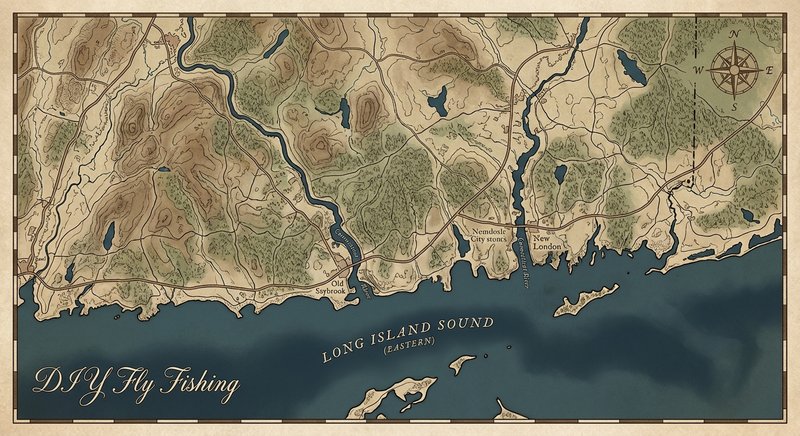
Long Island Sound (Eastern)
Fly fishing in Connecticut · Intermediate · Best seasons: Spring, Summer, Fall
Target Species
Striped Bass, Bluefish, False Albacore
About This Water
Saltwater fishing near Mystic. Famous striped bass fishery.
Fishing Recommendations
Welcome to the "Race," the "Gut," and the boulder-strewn shoreline of Eastern Long Island Sound. As a guide, I consider this stretch—from the Connecticut River mouth east to Stonington—to be some of the most technical and rewarding saltwater fly fishing in the Northeast.
This is where the Atlantic Ocean gets squeezed through narrow passages, creating massive rips, high-velocity currents, and an "aquarium" of baitfish. Here is your comprehensive guide to fishing Eastern Connecticut.
🎣 Location Overview
Eastern Long Island Sound is defined by its dynamic geology and tidal flow. Unlike the sandy, shallow flats of the Western Sound, the Eastern end is characterized by deep-water trenches, massive glacial erratic boulders, and heavy current.
What makes it special is the "confluence of energy." Water from the Atlantic pushes through the narrow gaps between Montauk, Plum Island, and Fishers Island, creating massive tidal rips (like The Race and Plum Gut). This nutrient-rich water supports a massive biomass of bait, drawing in world-class sportfish. Anglers love it because it offers everything from shallow-water sight casting on the flats of the Niantic River to "big game" style fly fishing in 10-foot standing waves.
🐟 Target Species & Behavior
Striped Bass (Rockfish)
- Behavior: In the spring, they are "reuniting" with the coast, often found in shallow estuaries. By summer, the "cows" (large females) hold deep in the cold-water rips or under boulder fields.
- Holding Spots: Look for "reversals" (eddies) behind large submerged rocks and the "seams" where fast water meets slow water.
- Diet: Early season: Silversides and grass shrimp. Late spring: Menhaden (Bunker). Fall: Bay Anchovies and Peanut Bunker.
Bluefish (Yellow-eyed Devils)
- Behavior: Aggressive, fast-moving, and often found "blitzing" on the surface. They are less structure-oriented than bass and prefer the middle of the water column in high-velocity rips.
- Diet: Anything that moves. They are notorious for "chopping" baits in half.
False Albacore (Little Tunny)
- Behavior: The "Ferraris" of the Sound. They arrive in late August/September. They are highly migratory, nervous, and have incredible eyesight. They move in "pods" and disappear as quickly as they appear.
- Diet: They are obsessed with Bay Anchovies and tiny Silversides. Matching the size of the hatch is mandatory.
📅 Best Times to Fish
Spring (May – June)
- Focus: The "Peep Show." Small bait brings schoolie bass into the estuaries (Niantic, Thames, and CT River).
- Prime Window: Late May when the larger "Post-Spawn" fish arrive from the Hudson and Chesapeake.
Summer (July – August)
- Focus: Night fishing or "low light" (dawn/dusk). The water warms up, pushing big fish into deeper, oxygen-rich rips like Bartlett Reef.
- Prime Window: The incoming tide at dawn.
Fall (September – October)
- Focus: The "Fall Blitz." This is the pinnacle. Albies arrive, and bass/blues gorge themselves for the migration south.
- Prime Window: Any time there is a "Blow" (wind) that pushes bait against the shoreline.
🪰 Recommended Flies & Techniques
Top Fly Patterns
- Gurglers & Bob’s Banger (Topwater): White or Chartreuse. Nothing beats a surface strike in the morning light.
- Clouser Minnow: The "Leatherman" of flies. Chartreuse/White or Olive/White. Essential for getting down in the current.
- Hollow Fleye (Bob Popovics style): For when large Menhaden (Bunker) are present. These provide a large profile without being heavy to cast.
- Mushmouth or Albie Candy: Tiny (Size 2 or 4) epoxy/UV resin flies to mimic Bay Anchovies for False Albacore.
Techniques
- The "Swing": Cast 45 degrees up-current into a rip, let your sinking line take the fly down, and let it "swing" through the standing waves. Strip only when the line straightens.
- Match the Hatch: If Albies are "sipping," go smaller. If they are "slashing," go faster with your retrieve.
- The Two-Handed Strip: For Bluefish and Albies, tuck the rod under your arm and use both hands to strip as fast as possible. You cannot outswim these fish.
💡 Pro Tips & Local Knowledge
- The "Fishers Island Sound" Secret: If the wind is howling in the main Sound, head into the protected waters of Fishers Island Sound. The boulder fields around Ram Island and Latimer Reef hold massive bass in just 3–6 feet of water.
- Watch the Birds: "Working birds" (Terns and Gulls) are your radar. Terns usually mean smaller bait (Albies/Schoolies); Gulls often mean larger bait (Big Blues/Bass).
- Structure is King: In Eastern CT, if you aren't risking losing your fly on a rock, you aren't deep enough. Use a 300–400 grain sinking head to reach the "strike zone" in the reefs.
- The "Thames River" Winter: If you are a die-hard, the Thames River in Norwich holds a "holdover" population of striped bass all winter long. Focus on deep holes with slow retrieves.
⚠️ Important Information
Access
- Boat: Public launches in Old Saybrook, Niantic (Mago Point), and Stony Creek provide excellent access.
- Shore: Harkness Memorial State Park and Rocky Neck State Park offer great wade fishing, but bring studded wading boots—the rocks are "black snot" slippery.
Regulations & Permits
- Marine License: A Connecticut Saltwater Fishing License is required.
- Striped Bass: CT has a "Slot Limit." Check current DEEP regulations as they change annually (usually 1 fish between 28" and <31"). Circle hooks are required when using bait, but fly anglers should practice "Catch and Release" on large breeders.
Safety
- The Current: The current in "The Race" can hit 5+ knots. If you are in a small craft (Kayak/Skiff), be extremely cautious of standing waves when the wind opposes the tide.
- Gear: 8-weight rods for schoolies/albies; 10-weight rods for the rips and big blues. Always carry pliers for Bluefish—they will bite back!
Bug Hatches & Matching Flies
| Hatch | Type | Peak months | Time of day | Hook sizes | Matching flies |
|---|---|---|---|---|---|
| Cinder Worm Nereis limbata | midge | May, June | Late Afternoon/Evening | #10-14 | Red/Pink Cinder Worm #12-14, Gurgler #10-12 |
| Salt Marsh Midge Chironomidae | midge | April, May, September | Morning/Evening | #18-24 | Zebra Midge #18-22, Griffith's Gnat #20-24 |
| Flying Ants Formicidae | terrestrial | August, September | Afternoon | #16-20 | Cinnamon Flying Ant #16-18, Black Fur Ant #18-20 |
| Blue-Winged Olive Baetis | mayfly | April, May, September, October | Late Morning/Afternoon | #18-22 | RS2 #20-22, BWO Sparkle Dun #18-22 |
| Spotted Sedge Hydropsyche | caddis | May, June, July | Evening | #14-16 | Elk Hair Caddis #14-16, Hydropsyche Larva #14-16 |
| Japanese Beetle Popillia japonica | terrestrial | July, August | All Day | #10-14 | Foam Beetle #12-14 |
| March Brown Maccaffertium vicarium | mayfly | May, June | Afternoon | #10-14 | March Brown Wet Fly #12-14, Hare's Ear Nymph #12-14 |
| Green Sedge Rhyacophila | caddis | May, June | Evening | #12-14 | Green Weenie #12-14, LaFontaine's Deep Sparkle Pupa #14 |