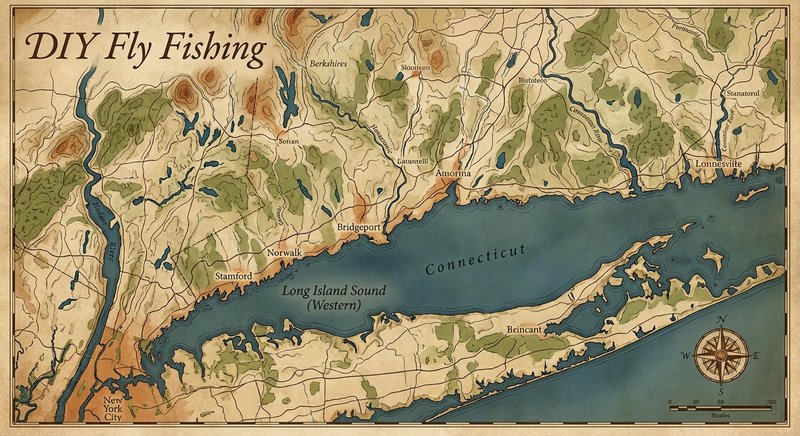
Long Island Sound (Western)
Fly fishing in Connecticut · Intermediate · Best seasons: Spring, Summer, Fall
Target Species
Striped Bass, Bluefish, Blackfish
About This Water
Saltwater fishing with striped bass and bluefish. Norwalk Islands area.
Fishing Recommendations
Welcome to the "Western Sound." As a guide in these waters, I can tell you that Western Long Island Sound (WLIS) is a unique, technical, and highly rewarding fishery. Unlike the wide-open sandy beaches of the Hamptons or the deep rips of Montauk, the WLIS is a world of boulder fields, tidal rivers, islands, and extreme tidal fluctuations.
Here is your professional guide to fly fishing the Western Connecticut shoreline.
🎣 Location Overview
The Western Long Island Sound—stretching roughly from Greenwich to Bridgeport—is characterized by its rugged, rocky coastline and the famous Norwalk Islands.
What makes this area special is the "structure." It is a nursery for baitfish and a labyrinth of reefs, "gardens" (submerged boulder fields), and salt marshes. The water is generally shallower and warmer than the Eastern Sound, which means the spring season starts earlier here. Anglers love it because it offers "skinny water" opportunities that feel more like stalking redfish in the flats than traditional North Atlantic fishing.
🐟 Target Species & Behavior
Striped Bass (Morone saxatilis)
- Behavior: The king of the Sound. In the spring, they hug the mudflats and tidal rivers (like the Housatonic and Norwalk Rivers) to soak up warmth. In summer, they move to deep rock piles or under the shade of docks.
- Feeding: They are ambush predators. They sit behind boulders (out of the current) and wait for the tide to sweep bait past them.
Bluefish (Pomatomus saltatrix)
- Behavior: Often called "yellow-eyed devils," these are aggressive, toothy fighters. You’ll find them in "blitzes" where they push bait to the surface, turning the water into a washing machine of foam.
- Feeding: Anything that moves fast. They favor menhaden (bunker), silversides, and bay anchovies.
Blackfish / Tautog (Tautoga onitis)
- Behavior: Traditionally a bait-fisherman's quarry, "Tog" are becoming a "bucket list" challenge for advanced fly anglers. They live strictly in heavy rock structure and shipwrecks.
- Feeding: Crabs and mussels. To catch them on a fly, you must get a weighted crab pattern directly into their "bedroom" among the rocks.
📅 Best Times to Fish
- Spring (Late April – June): This is prime time for schoolie stripers in the estuaries and rivers. As May progresses, larger migratory fish arrive to feed on the "bunker" (Atlantic Menhaden).
- Summer (July – August): The "Dog Days." Daytime fishing slows down as water temps rise. Pro Tip: Focus on "low light" (dawn and dusk) or go "night fishing" around lighted docks and bridges.
- Fall (September – early November): The legendary "Fall Run." As temperatures drop, fish forage heavily for their migration south. Expect massive surface blitzes of both blues and bass.
- Tides: In the WLIS, moving water is mandatory. The three hours surrounding high tide are usually most productive. A "falling tide" out of a salt marsh is a dinner bell for predators.
🪰 Recommended Flies & Techniques
Top Fly Patterns
- Chartreuse & White Clouser Minnow: The universal language of striped bass. Use heavy eyes to get down in the current.
- Leftys Deceiver (White/Blue): Best for mimicking larger forage like adult bunker or herring.
- The Gurgler: A topwater foam fly. There is nothing more exciting than a bass or blue smashing a Gurgler on a slow, rhythmic strip.
- Epoxy Anchovy / Silverside: Essential for late summer and fall when "rain bait" (tiny fish) is abundant.
- Strong’s Tautog Crab: For Blackfish. Weighted heavily with lead eyes to sink fast into the rocks.
Techniques
- Striped Bass: Use an Intermediate Sinking Line. Use a "strip-strip-pause" retrieve. The pause often triggers the strike as the fly mimics a wounded baitfish sinking.
- Bluefish: Switch to a Wire Tippet (or 50lb fluorocarbon) or you will lose your fly instantly. Use a fast, erratic two-handed retrieve to mimic a panicked fish.
- Blackfish: Use a Fast Sink Tip. Cast up-current of a rock pile, let the fly tumble into the rocks, and keep a tight line. If you feel a "tap-tap," set the hook hard and pull them away from the rocks immediately.
💡 Pro Tips & Local Knowledge
- The "Norwalk Islands": If you have a kayak or skiff, the waters around Sheffield and Chimon Islands are world-class. Look for "flats" between the islands on an incoming tide.
- The Boulder Fields: Locally known as "The Gardens," the area off Westport and Darien is treacherous for boat propellers but a goldmine for fly anglers. Look for "nervous water" over submerged rocks.
- Match the Hatch: In the spring, use small flies (2-3 inches). In the fall, don't be afraid to throw 8-10 inch "Hollow Fleyes" to mimic adult bunker.
- The "Shadow Line": When fishing bridges at night (like the I-95 overpasses), cast your fly into the dark water and strip it through the "light line." Bass sit in the dark and stare into the light waiting for prey.
⚠️ Important Information
Access
- Public Access: Shore access can be tricky in wealthy Fairfield County. Good public spots include Sherwood Island State Park (Westport), Penfield Reef (Fairfield), and Cummings Park (Stamford).
- Parking: Many coastal towns require resident parking permits in the summer. Check local town websites or fish State Parks to avoid tickets.
Regulations & Permits
- License: You must have a Connecticut Marine Waters Fishing License.
- Striped Bass: Connecticut follows a "Slot Limit" (currently 28" to less than 31"). You are allowed one fish per day within that window, but we strongly encourage Catch and Release to protect the fishery.
- Bluefish: Limit is 3 fish per person (5 on for-hire vessels).
Special Considerations
- Safety: The WLIS has a 7-foot tidal range. A rock you are standing on at low tide will be deep underwater three hours later. Always watch the tide behind you so you don't get stranded.
- Gear: An 8-weight or 9-weight rod is the standard workhorse for this area. Ensure your reel has a sealed drag, as the salt/sand here is brutal on gear.
Tight lines, and remember: If there's no movement in the water, there's no movement in the fish!
Bug Hatches & Matching Flies
| Hatch | Type | Peak months | Time of day | Hook sizes | Matching flies |
|---|---|---|---|---|---|
| Salt Marsh Midge Chironomidae | midge | April, May, September, October | All Day | #18-24 | Zebra Midge #18-22, Griffith's Gnat #20-24 |
| Blue-winged Olive Baetis | mayfly | April, May, September, October | Mid-day/Afternoon | #18-22 | RS2 #20-22, Parachute BWO #18-22 |
| Sulphur Ephemerella invaria | mayfly | May, June | Evening | #14-18 | Sulphur Parachute #14-16, Pheasant Tail Nymph #14-18 |
| Cinnamon Caddis Hydropsyche | caddis | June, July, August | Evening | #14-18 | Elk Hair Caddis #14-18, LaFontaine Sparkle Pupa #14-16 |
| Grannom Caddis Brachycentrus | caddis | April, May | Morning/Afternoon | #12-16 | Peacock Caddis #14-16, Green Weenie #12-14 |
| Trico Tricorythodes | mayfly | July, August, September | Early Morning | #22-26 | Trico Spinner #22-24, Drowned Trico #24 |
| Carpenter Ant Camponotus | terrestrial | August, September | Afternoon | #12-16 | Chernobyl Ant #12-14, Black Foam Ant #16 |
| Light Cahill Stenacron | mayfly | June, July | Evening | #12-14 | Light Cahill Dry #12-14, Gold Ribbed Hare's Ear #12-14 |