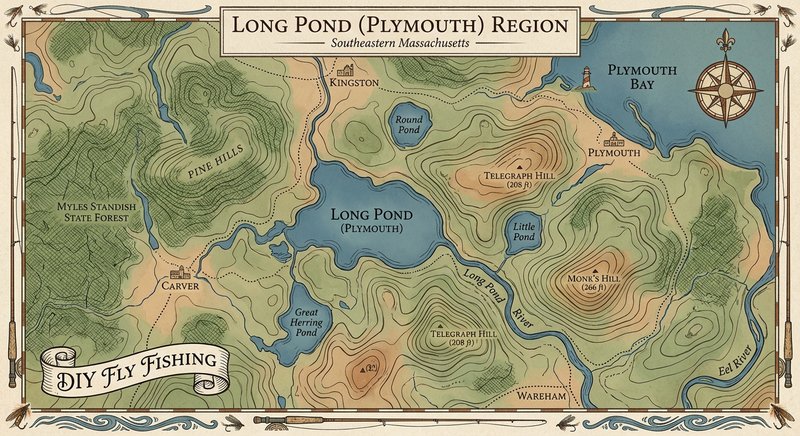
Long Pond (Plymouth)
Fly fishing in Massachusetts · Beginner · Best seasons: Spring, Summer, Fall
Target Species
Largemouth Bass, Pickerel, Perch
About This Water
Plymouth County pond with bass and pickerel. Large warmwater fishery.
Fishing Recommendations
As your guide for the South Shore, I’m excited to break down Long Pond in Plymouth. Not to be confused with the dozen other "Long Ponds" in Massachusetts, the Plymouth version is a premier destination for fly anglers targeting warm-water species. It is one of the largest and cleanest ponds in the region, offering a classic glacial kettle pond experience.
🎣 Location Overview
Long Pond is a 211-acre "kettle hole" pond characterized by its remarkably clear water and diverse structure. Unlike many shallow, muddy ponds in the area, Long Pond has significant depth (reaching up to 100 feet in spots) and a sandy, gravelly bottom.
What makes it special for the fly fisher is the visibility. On a calm day, you can sight-fish for cruising bass and pickerel along the drop-offs. The shoreline is a mix of developed residential areas and wooded stretches, featuring submerged timber, boulder piles, and lush weed beds. Because it is deep and spring-fed, it stays cooler longer than smaller ponds, providing a more consistent bite throughout the warmer months.
🐟 Target Species & Behavior
Largemouth Bass
These are the kings of Long Pond. Because of the clear water, they tend to be a bit more "spooky" than in stained water.
- Behavior: They transition from shallow spawning beds in late spring to the deep "edges" where the shelf drops from 5 feet to 15 feet in the summer.
- Feeding: They key in on juvenile sunfish, yellow perch, and a healthy population of crayfish.
Chain Pickerel
The "water wolves" of Plymouth are prolific here.
- Behavior: They lurk primarily in the weed pockets and lily pads. They are ambush predators and will often follow a fly all the way to your feet before striking.
- Feeding: They are less picky than bass and will hit anything that flashes or vibrates.
Yellow Perch
Often overlooked, the perch here grow to "jumbo" sizes.
- Behavior: They school up around submerged humps and gravel bars.
- Feeding: They focus on small minnows and insect larvae (midges and mayfly nymphs).
📅 Best Times to Fish
- Spring (Late April – June): This is the prime window. As the water hits 55-60°F, bass move into the shallows to spawn. Sight fishing is at its peak.
- Summer (July – August): Focus on the "Golden Hours." The midday sun can drive fish deep into the weeds or down the drop-offs. Fish from 5:00 AM to 8:00 AM or the last two hours before sunset for topwater action.
- Fall (September – October): As temperatures drop, fish become aggressive to bulk up for winter. This is the best time for large streamers as the bass move back into the shallows.
🪰 Recommended Flies & Techniques
Topwater (The Thrill)
- Flies: Dahlberg Divers (Frog or White), Gurglers (Chartreuse or Tan), and Hard-body Poppers.
- Technique: Cast tight to the shoreline or over weed pockets. Let the rings dissipate before the first twitch. Use a "pop-and-pause" cadence.
Sub-Surface (The Producer)
- Flies: Gamechangers (White/Silver), Woolly Buggers (Olive or Black with flash), and Clouser Minnows (Chartreuse/White).
- Technique: For the clear water of Long Pond, use an intermediate sinking line to get the fly down 4-6 feet along the drop-offs. Strip fast for pickerel and use a slower, erratic "jigging" motion for bass.
For the Perch
- Flies: Small Bead-head Prince Nymphs or size 10-12 Woolly Buggers.
- Technique: Use a 4-weight rod with a strike indicator or strip slowly near the bottom.
💡 Pro Tips & Local Knowledge
- Work the "Drop-Off": The most productive zone in Long Pond isn't the bank—it's the transition zone where the sandy flats drop into the deep blue water. Park your boat/kayak in the deep water and cast into the shallow shelf, stripping your fly down the slope.
- Color Matters: In this clear water, natural colors usually outperform "neon" colors. Think olive, tan, and white to mimic the natural forage. Save the bright chartreuse for overcast days.
- The Wind is Your Friend: A slight chop on the water breaks up the surface and makes the fish less wary of your fly line and leader.
- Stealth is Key: Because the water is so clear, long casts and light leaders (10-12lb fluorocarbon) are recommended. If you can see the fish, they can likely see you.
⚠️ Important Information
- Access: There is a public boat ramp located on Clark Road on the northern end of the pond. It is suitable for trailers, but also excellent for launching kayaks and canoes.
- Wading: Wading is possible in some areas near the ramp, but much of the shoreline is private property. A kayak or float tube is the "pro move" here to access the best structure.
- Regulations:
- A valid Massachusetts Freshwater Fishing License is required.
- Long Pond is managed as a "Great Pond." Be respectful of private docks and beachfronts.
- Safety: The pond can get busy with recreational boaters and jet skis during summer weekends. If you are in a kayak, stay close to the shoreline and use a safety flag.
Guide’s Final Word: Long Pond is a gem for the fly angler who enjoys "hunting" fish in clear water. Bring your polarized glasses, be patient with your presentation, and you'll find that these South Shore bass are some of the hardest-fighting fish in the county. Tight lines!
Bug Hatches & Matching Flies
| Hatch | Type | Peak months | Time of day | Hook sizes | Matching flies |
|---|---|---|---|---|---|
| Midges Chironomidae | midge | March, April, October, November | All Day | #18-24 | Zebra Midge #18-22, Griffith's Gnat #20-24, Palomino Midge #20-22 |
| Hendrickson Ephemerella subvaria | mayfly | April, May | Afternoon | #12-14 | Hendrickson Pink Lady #12-14, Red Quill #14, Pheasant Tail #12-14 |
| Cinnamon Sedge Hydropsyche | caddis | May, June, July | Evening | #14-18 | Elk Hair Caddis (Tan) #14-16, LaFontaine's Deep Sparkle Pupa #14-16, Iris Caddis #16 |
| Giant Yellow Drake (Hex) Hexagenia limbata | mayfly | June, July | Dusk/Night | #6-10 | Hexagenia Dry #6-8, Hexagenia Wiggle Nymph #8-10, Paradrake Hex #8 |
| Sulphurs Ephemerella dorothea | mayfly | May, June | Evening | #16-18 | Sulphur Parachute #16-18, Sulphur Emerger #16-18, CDC Sulphur #18 |
| Damselflies Enallagma | mayfly | June, July, August | Late Morning/Afternoon | #10-14 | Marabou Damsel #10-12, Braided Butt Damsel #12-14, Adult Damselfly (Blue) #12 |
| Tricos Tricorythodes | mayfly | July, August, September | Morning | #22-26 | Trico Spinner #22-24, RS2 (Black) #22-24 |
| Black Carpenter Ants Camponotus | terrestrial | August, September | All Day | #12-18 | Chernobyl Ant #12-14, Black Foam Ant #16-18, Fur Ant #14-16 |
| White-Winged Curse (Caenis) Caenis | mayfly | July, August | Early Morning | #24-28 | Caenis Spinner #24-26, Tiny White Midge #24 |
| Blue-Winged Olive Baetis | mayfly | April, May, September, October | Late Afternoon/Overcast Days | #18-22 | BWO Sparkle Dun #18-20, Barr's BWO Emerger #20-22, Blue Wing Olive Parachute #18-22 |