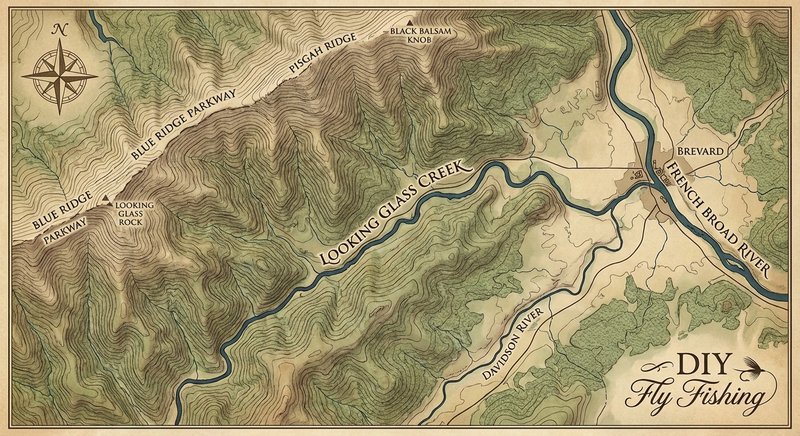
Looking Glass Creek
Fly fishing in North Carolina · Intermediate · Best seasons: Spring, Summer, Fall
Target Species
Brown Trout, Rainbow Trout
About This Water
Crystal clear stream in Pisgah Forest. Wild trout below Sliding Rock.
Fishing Recommendations
Looking Glass Creek is one of the "crown jewels" of the Pisgah National Forest. Located just outside of Brevard, North Carolina, it is a quintessential Appalachian freestone stream that offers a classic mountain fly fishing experience. As a guide, I find this water particularly rewarding because it balances accessibility with the challenge of technical, wild-trout fishing.
🎣 Location Overview
Looking Glass Creek is a high-gradient, cold-water tributary of the Davidson River. What makes it special is its accessibility—it parallels US-276—combined with its rugged, scenic beauty. You’ll find everything from massive plunge pools beneath iconic waterfalls (like Looking Glass Falls) to tight, technical pocket water and long, glassy runs.
The water is remarkably clear and stays cool even in the heat of summer due to the dense canopy cover and high elevation of its headwaters. Anglers love it because it feels like a wild mountain escape, yet you can be back in town for a celebratory craft beer in 15 minutes.
🐟 Target Species & Behavior
The creek is managed as Wild Trout Water, meaning the fish you catch are born and bred in this stream.
- Rainbow Trout: These are the most abundant species here. They are opportunistic and often hold in the faster "bubble lines" and the heads of pools. Expect them to be energetic, often jumping when hooked.
- Brown Trout: The "kings" of the deeper pools and undercut banks. The Browns in Looking Glass are notoriously "spooky." They tend to hide under rhododendron overgrowth or deep in the shadows of large boulders during the day, becoming more active during low-light periods or after a light rain.
- Behavior: These fish are wary. Because the water is crystal clear, they have excellent vision. If they see your silhouette or a splashy cast, the pool is "done" for thirty minutes.
📅 Best Times to Fish
- Spring (March – May): This is the prime window. The aquatic insect life awakens, and the trout are hungry after the winter lean. Expect the best dry fly action of the year during the Quill Gordon and March Brown hatches.
- Summer (June – August): While many low-elevation streams get too warm, Looking Glass stays fishable. Focus on the early morning (6:00 AM – 10:00 AM) or late evening. Terrestrial fishing (beetles/ants) is fantastic now.
- Fall (September – November): The Brown trout become aggressive as they prepare to spawn. The foliage is world-class, and the water levels are usually stable. October is a "golden month" here.
- Optimal Conditions: Overcast days are your best friend on Looking Glass. The lack of shadows helps mask your presence and encourages the larger Browns to leave their overhead cover.
🪰 Recommended Flies & Techniques
Top Fly Patterns
- Dry Flies: Yellow Stimulators (size 14-16), Parachute Adams (16-20), Elk Hair Caddis (14-18), and Royal Wulff. For summer, use foam beetles or Dave’s Hoppers.
- Nymphs: Pheasant Tail (16-18), Hare’s Ear (14-16), and the "Sexy Walt’s Worm." If the water is high, a Pat’s Rubber Legs in coffee/black is a killer.
- Streamers: Small Woolly Buggers (olive or black) or Muddler Minnows, fished through the deep plunge pools.
Techniques
- Dry-Dropper: This is the most effective way to cover Looking Glass. Use a buoyant dry fly (like a Stimulator) and hang a small unweighted nymph 18–24 inches below it.
- Tight-Line/Euro Nymphing: In the high-gradient pocket water, keeping your fly line off the water is essential to prevent drag.
- Bow-and-Arrow Cast: You will encounter tight tunnels of rhododendrons. Mastering this specialized cast is often the only way to reach the best "honey holes."
💡 Pro Tips & Local Knowledge
- Ditch the Waders in Summer: The creek is small enough that "wet wading" in quick-dry pants and wading boots is much more comfortable and stealthy from June through September.
- Stealth is Mandatory: Always approach a pool from downstream. Stay low—sometimes even crawling on your knees is necessary. If you can see the fish, they have likely already seen you.
- Fish the "In-Between" Water: Most anglers skip the shallow, rocky riffles to get to the big pools. Some of the most aggressive wild rainbows sit in water barely deep enough to cover their backs.
- Avoid the Tourists: The area around Looking Glass Falls is crowded. For better fishing, head upstream toward the Looking Glass Rock trailhead or explore the smaller tributaries feeding into the main stem.
⚠️ Important Information
- Access: Numerous pull-offs along US-276 provide easy access. However, be careful parking as the road is narrow and gets heavy traffic.
- Regulations: Looking Glass Creek is designated as Wild Trout Waters.
- Lure: Artificial lures with a single hook only.
- Limit: 4 trout per day (minimum size 7 inches), though Catch and Release is strongly encouraged by the local community to preserve the wild population.
- Safety: The rocks here are notoriously slippery ("Pisgah Grease"). Felt-soled boots or boots with studs are highly recommended. Always keep an eye on the weather; these mountain streams can rise rapidly during heavy afternoon thunderstorms.
- Permits: A valid North Carolina Fishing License with a Trout Privilege is required. You can purchase these online or at local fly shops in Brevard.
Bug Hatches & Matching Flies
| Hatch | Type | Peak months | Time of day | Hook sizes | Matching flies |
|---|---|---|---|---|---|
| Quill Gordon Epeorus pleuralis | mayfly | March, April | Midday | #12-14 | Quill Gordon Dry #12-14, Gordon Quill Nymph #12-14 |
| Blue Winged Olive Baetis species | mayfly | March, April, October, November | Late Morning/Afternoon | #18-22 | RS2 #20-22, Parachute Adams #18-22, Pheasant Tail Nymph #18-20 |
| Hendrickson Ephemerella subvaria | mayfly | April | Afternoon | #12-14 | Red Quill #14, Hendrickson Nymph #12-14 |
| March Brown Maccaffertium vicarium | mayfly | April, May | Midday/Afternoon | #10-14 | March Brown Wet Fly #12, Hare's Ear Nymph #10-12 |
| Yellow Sally Isoperla species | stonefly | May, June, July | Late Afternoon/Evening | #14-16 | Yellow Stimulator #14-16, Little Yellow Stone Nymph #14-16 |
| Light Cahill Stenacron interpunctatum | mayfly | June, July | Evening | #12-16 | Light Cahill #14-16 |
| Cinnamon Caddis Hydropsyche | caddis | May, June, September | Morning/Evening | #14-18 | Elk Hair Caddis (Tan) #14-16, Holy Grail #16, Pupa #14-18 |
| Golden Stonefly Acroneuria abnormis | stonefly | June, July | Evening/Night | #6-10 | Golden Stone Nymph #8-10, Pat's Rubber Legs #8-12 |
| Terrestrials Formicidae/Coleoptera | terrestrial | July, August, September | All Day | #12-18 | Cinnamon Ant #16-18, Crowe Beetle #14-16 |
| Green Drake Ephemera guttulata | mayfly | May | Evening | #8-10 | Green Drake Hairwing #8-10, Coffin Fly #10 |