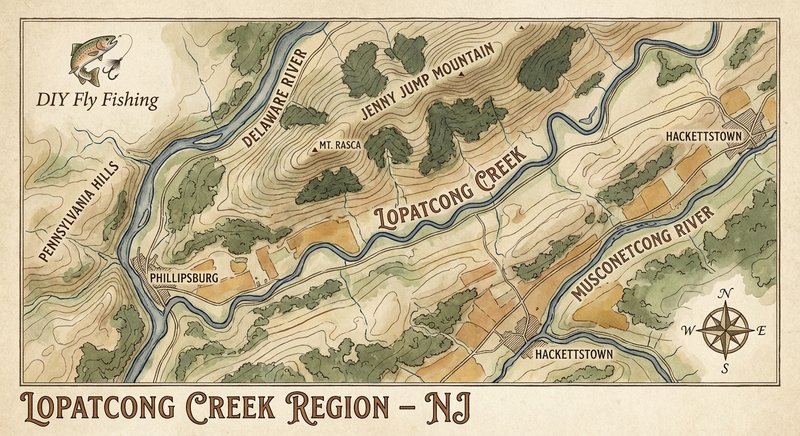
Lopatcong Creek
Fly fishing in New Jersey · intermediate · Best seasons: spring, summer
Target Species
Brown Trout, Brook Trout
About This Water
Small Warren County stream with surprising trout population. Spring-fed with cool summer temperatures.
Fishing Recommendations
Lopatcong Creek is one of New Jersey’s hidden gems. While many anglers flock to the Musconetcong or the Pequest, the "Lopy" offers a more intimate, technical experience for those who appreciate the nuances of small-stream fly fishing.
As a guide, I categorize this as a limestone-influenced spring creek. This is critical because the cold, mineral-rich groundwater keeps the Lopatcong cooler during the summer months and supports a healthy population of wild, naturally reproducing trout—a rarity in the Garden State.
🎣 Location Overview
Located in Warren County, the Lopatcong flows through a mix of pastoral farmland, suburban pockets, and wooded ravines before joining the Delaware River near Phillipsburg.
What makes it special is its thermal stability. Unlike freestone streams that spike in temperature during a July heatwave, the Lopatcong’s springs provide a sanctuary for trout. The water is generally clear, characterized by tight pockets, deep undercut banks, and long, glassy flats that require a stealthy approach. It is a "technical" stream—overhanging brush and tight casting lanes mean you’ll need to master the roll cast and the bow-and-arrow cast here.
🐟 Target Species & Behavior
- Wild Brown Trout: These are the superstars of the Lopatcong. They are buttery gold, exceptionally wary, and highly territorial. They hold tight to structure—look for them under overhanging root balls or in the "dark water" beneath undercut banks.
- Brook Trout: Found primarily in the upper reaches and cooler tributaries. They are opportunistic but fragile; they require the highest water quality.
- Behavior: Because this is a smaller system, the fish are "spooky." A heavy footfall on the bank or a sloppy line slap will clear a pool in seconds. They feed heavily on scuds and sowbugs (typical of limestone water) and look upward for terrestrials from June through September.
📅 Best Times to Fish
Optimal Seasons
- Spring (April – June): This is the "Main Event." The water levels are perfect, and the aquatic insect activity is at its peak.
- Summer (July – August): While other NJ streams may be too warm to fish ethically, the Lopatcong often stays in the mid-60s. This is the prime window for terrestrial fishing.
Best Times of Day
- Spring: Mid-morning to late afternoon (10:00 AM – 4:00 PM) when the sun warms the water enough to trigger hatches.
- Summer: First light (dawn) or the "magic hour" before dusk. The evening rise on the Lopatcong can be spectacular.
Prime Conditions
Overcast, drizzly days are the best for hunting the larger wild browns. The low light brings them out from under the banks and makes them less suspicious of your leader.
🪰 Recommended Flies & Techniques
Top Fly Patterns
- Nymphs:
- Cress Bug/Sowbug: (Size 14-18) This is a staple. Because of the limestone influence, these crustaceans are always on the menu.
- Pheasant Tail: (Size 16-20) Mimics the various Mayfly nymphs.
- Zebra Midge: (Size 18-22) In black or red; effective year-round.
- Dry Flies:
- Elk Hair Caddis: (Size 14-18) Great for searching riffles.
- Blue Winged Olive (BWO): (Size 18-22) Essential for those cloudy spring days.
- Ants & Beetles: (Size 14-18) Foam versions are highly effective in summer.
- Streamers:
- Woolly Bugger: (Size 10-12) In black or olive. Use these in the deeper pools during higher water.
Effective Techniques
- European Nymphing / Tight-Line: Very effective in the riffles and pocket water to avoid drag from the complex currents.
- The "Dry-Dropper": A high-vis foam ant with a small zebra midge or scud dropped 18 inches below it is the "Lopatcong Special" for summer.
- Stealth Presentation: Use long, 9-foot to 12-foot leaders tapered to 6X or even 7X tippet for the flat water.
💡 Pro Tips & Local Knowledge
- Fish the "Invisibles": Many anglers walk right past 6-inch deep riffles to get to the big pools. On the Lopatcong, wild browns will hold in surprisingly thin water if there is a bit of surface turbulence to hide them.
- The Bridge Strategy: Many access points are at bridges (e.g., near Route 519 or Strykers Rd). Don't just fish under the bridge; walk at least 200 yards upstream or downstream to find the less-pressured wild fish.
- Downstream Approach: In the tightest, brushiest sections, try "wet fly swinging" or drifting a nymph downstream of your position. It's often impossible to make an upstream cast without snagging a tree.
- Observe First: Spend 5 minutes watching a pool before you cast. You will often see a snout break the surface that you would have missed if you started casting immediately.
⚠️ Important Information
Access Information
- Much of the creek runs through private land. Always respect "Posted" signs.
- Public access can be found at various county bridge crossings and sections adjacent to public parks/open spaces in Lopatcong and Phillipsburg.
- The Marble Hill area and sections near Strykers Road are popular starting points.
Regulations & Permits
- License: You must have a valid New Jersey Fishing License and a Trout Stamp.
- Wild Trout Stream Regulations: Certain stretches are designated as "Wild Trout Streams." In these areas, there are specific lure/fly requirements (usually artificial only) and strict creel limits (often Catch & Release only). Always check the current NJ Fish & Wildlife Digest before your trip.
Special Considerations
- Wading: The rocks can be slippery; felt soles or studs are recommended.
- Conservation: Because this stream relies on wild reproduction, please practice Catch and Release and handle fish with wet hands to protect their slime coating. If water temperatures ever exceed 68°F, stop fishing to prevent trout mortality.
Bug Hatches & Matching Flies
| Hatch | Type | Peak months | Time of day | Hook sizes | Matching flies |
|---|---|---|---|---|---|
| Blue Winged Olive Baetis spp. | mayfly | March, April, September, October | Midday | #18-22 | RS2 #20-22, Parachute Adams #18-22, Pheasant Tail Nymph #18-20 |
| Sulphur Ephemerella invaria/dorothea | mayfly | May, June | Evening | #14-18 | Sulphur Parachute #14-16, Hare's Ear Nymph #14-16, Sulphur CDC Emerger #16-18 |
| Tan Caddis Hydropsyche spp. | caddis | April, May, June | Morning/Evening | #14-18 | Elk Hair Caddis #14-16, LaFontaine's Deep Sparkle Pupa #16, Caddis Larva (Green/Tan) #14-18 |
| Little Black Stonefly Taeniopteryx spp. | stonefly | February, March | Midday | #14-18 | Black Zebra Midge #18-20, Early Black Stonefly Dry #16, Prince Nymph #14-16 |
| Trico Tricorythodes spp. | mayfly | July, August, September | Early Morning | #22-26 | Trico Spinner #22-24, Griffith's Gnat #20-24, Trico Dun #24 |
| Light Cahill Stenacron canadense | mayfly | June, July | Evening/Dusk | #12-14 | Light Cahill Dry #12-14, Cream Variant #14, Gold Ribbed Hare's Ear #12-14 |
| Zebra Midge Chironomidae | midge | January, February, March, December | All Day | #18-24 | Zebra Midge #18-22, Palomino Midge #20-22, Griffith's Gnat #18-22 |
| Terrestrials (Ants/Beetles) Formicidae/Coleoptera | terrestrial | July, August, September | All Day | #12-18 | Black Foam Ant #16-18, Crowe Beetle #14-16, Dave's Hopper #12 |