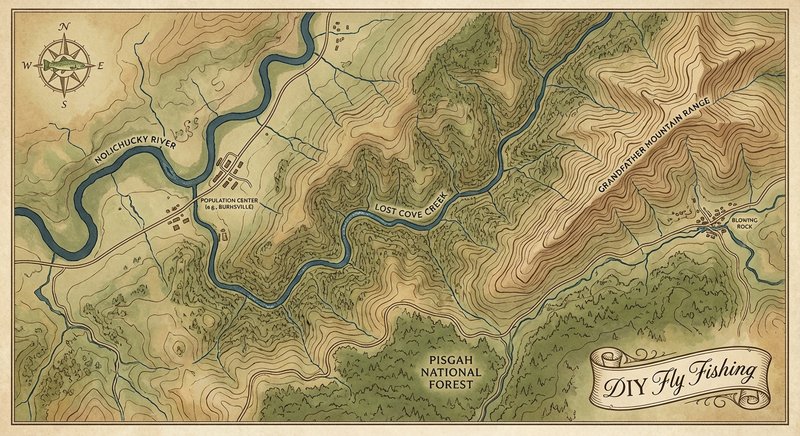
Lost Cove Creek
Fly fishing in North Carolina · Advanced · Best seasons: Spring, Summer, Fall
Target Species
Brown Trout, Rainbow Trout
About This Water
Remote wilderness stream in Wilson Creek Wilderness. Wild trout in pristine setting.
Fishing Recommendations
As an expert guide with years of experience navigating the technical waters of the Blue Ridge Mountains, I consider Lost Cove Creek to be one of the "Crown Jewels" of North Carolina fly fishing. This is not a roadside fishery; it is a wild, rugged, and rewarding backcountry experience.
Here is your comprehensive guide to fishing Lost Cove Creek.
🎣 Location Overview
Lost Cove Creek is located within the Lost Cove Wilderness Study Area in the Pisgah National Forest, near the Wilson Creek corridor. What makes this water special is its isolation. Because there are no roads leading directly to the creek, the fish here see far less pressure than those in nearby waters.
The creek is a classic high-gradient Appalachian freestone stream. It features dramatic drops, crystalline plunge pools, tight "pocket water," and massive granite boulders. The surrounding terrain is dense with rhododendron and hemlock, creating a cathedral-like canopy that keeps the water cool even in the heat of summer. It is a "Blue Ribbon" destination for anglers who value solitude and wild fish over easy access.
🐟 Target Species & Behavior
Lost Cove is strictly a Wild Trout water. You won't find any sluggish, pellet-fed stockies here.
- Wild Rainbow Trout: These are the primary residents. They are incredibly vibrant, often displaying deep pink lateral lines and heavy spotting. They are opportunistic and known for their aerial acrobatics when hooked.
- Wild Brown Trout: The "ghosts" of the creek. The larger browns tend to hold in the deeper, darker undercut banks or beneath the churning foam of the larger falls.
- Behavior: Because food is scarce in these sterile mountain environments, these fish are aggressive. However, because the water is gin-clear, they are extremely "spooky." If they see your silhouette or a splashy line, the pool is "done" for the next hour.
📅 Best Times to Fish
Optimal Seasons
- Spring (March – May): This is the prime window. The aquatic insect hatches (Quill Gordons, March Browns, and Hendricksons) are prolific, and the fish are hungry after a dormant winter.
- Summer (June – August): While other NC rivers get too warm, Lost Cove stays cool due to its elevation and canopy. This is the season for terrestrial fishing (ants and beetles).
- Fall (September – October): A magical time. The Brown Trout become aggressive as they prepare for the spawn, and the fall foliage in the gorge is world-class.
Best Times of Day
- Early Morning: Best during the heat of summer.
- Midday (11:00 AM – 3:00 PM): In the Spring and Fall, this is when the water warms just enough to trigger insect activity.
🪰 Recommended Flies & Techniques
Top Fly Patterns
- Dry Flies:
- Yellow Stimulator (Size 12-16): Mimics stoneflies and is highly visible in broken water.
- Parachute Adams (Size 14-18): The ultimate generalist.
- Elk Hair Caddis (Size 14-16): Great for the "skittering" caddis common in the gorge.
- Nymphs:
- Pheasant Tail (Size 16-20): Mimics almost every small mayfly nymph.
- Bead-head Prince Nymph (Size 14-16): The extra flash helps in the deep, dark plunge pools.
- Terrestrials:
- Black Foam Ants or Beetles (Size 14-18): Essential for summer success.
Effective Techniques
- The Dry-Dropper: This is the most effective way to fish Lost Cove. Use a high-floating dry (like a Stimulator) with 18–24 inches of 5X or 6X fluorocarbon tippet tied to a small nymph.
- High Sticking / Tight Line: Due to the erratic currents and boulders, long casts are rarely possible. Focus on short, controlled drifts, keeping as much fly line off the water as possible to avoid drag.
- The "Stealth Approach": Fish from the tail of the pool upward. Stay low—kneel if you have to.
💡 Pro Tips & Local Knowledge
- The Hike-In Factor: Most anglers enter via the Hunt-Fish Falls Trail or the Timber Ridge Trail. Pro tip: The further you hike away from the trailheads, the better the fishing gets. Most people stop within a half-mile of the falls; if you hike two miles in, you’ll have the water to yourself.
- Focus on the "Bubble Line": In the plunge pools, the fish sit right where the white bubbles begin to dissipate. They are looking for oxygen and easy food being washed down the "conveyor belt."
- Watch Your Backcast: The rhododendrons are "fly eaters." Practice your roll cast and side-arm cast before you head into the gorge.
- Color Matters: Wear drab colors (olive, tan, or camo). Bright white or red shirts will flash like a warning signal to wild trout in clear water.
⚠️ Important Information
- Regulations: Lost Cove Creek is designated as Catch and Release, Artificial Lures Only (Single Hook) by the NC Wildlife Resources Commission. No bait or multiple hooks are allowed.
- Access: This is a Wilderness Study Area. There are no facilities, and cell service is non-existent. Ensure you have a physical map or a downloaded GPS map (like Gaia or OnX).
- Safety: The rocks in Lost Cove are notoriously slippery—felt-soled boots or studs are highly recommended. Be mindful of sudden weather changes; the gorge can flash flood during heavy thunderstorms.
- Wildlife: This is prime Black Bear and Timber Rattlesnake country. Be bear-aware and watch where you step when climbing over logs and rocks.
Guide’s Final Word: Lost Cove Creek is a physical fishery. You will be tired at the end of the day, but the sight of a wild, buttery Brown Trout coming up to take a dry fly in a pool you hiked three miles to reach is an experience you won't soon forget. Tight lines!
Bug Hatches & Matching Flies
| Hatch | Type | Peak months | Time of day | Hook sizes | Matching flies |
|---|---|---|---|---|---|
| Quill Gordon Epeorus pleuralis | mayfly | March, April | Mid-day to Afternoon | #12-14 | Quill Gordon Dry #12-14, Quill Gordon Nymph #12-14 |
| Blue Winged Olive Baetis spp. | mayfly | March, April, October, November | Mid-day | #18-22 | RS2 #18-22, Parachute BWO #18-22 |
| Hendrickson Ephemerella subvariabilis | mayfly | April, May | Afternoon | #12-14 | Red Quill #12-14, Pheasant Tail Nymph #12-16 |
| Yellow Sally Isoperla spp. | stonefly | May, June, July | Late Afternoon/Evening | #14-16 | Yellow Stimulator #14-16, Little Yellow Stone Nymph #14-16 |
| March Brown Maccaffertium vicarium | mayfly | April, May | Afternoon | #10-14 | March Brown Western Style #10-12, Gold Ribbed Hare's Ear #10-14 |
| Cinnamon Caddis Hydropsyche spp. | caddis | May, June, July, August | Evening | #14-18 | Elk Hair Caddis (Tan) #14-18, LaFontaine's Deep Sparkle Pupa #14-16 |
| Light Cahill Stenacron interpunctatum | mayfly | June, July | Evening | #14-16 | Light Cahill Dry #14-16, Cream Usual #14-18 |
| Golden Stonefly Acroneuria spp. | stonefly | June, July | Evening/Night | #6-10 | Pat's Rubber Legs #6-10, Golden Stone Dry #8-10 |
| Terrestrials (Ants/Beetles) Formicidae / Coleoptera | terrestrial | July, August, September | All day | #12-18 | Black Foam Beetle #14-18, Cinnamon Ant #16-18 |