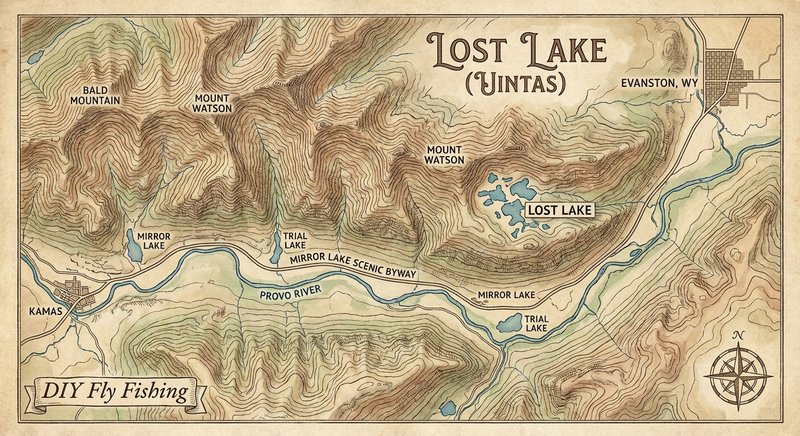
Lost Lake (Uintas)
Fly fishing in Utah · Advanced · Best seasons: Summer, Fall
Target Species
Cutthroat Trout
About This Water
Remote Uinta lake with wild cutthroat. Backcountry hiking required.
Fishing Recommendations
Welcome to the High Uintas. As your guide, I’m excited to break down Lost Lake. Situated at approximately 9,800 feet along the scenic Mirror Lake Highway, Lost Lake is a quintessential subalpine fishery. While it is one of the more accessible lakes in the region, it retains a wild character that rewards technical anglers and beginners alike.
Here is the professional breakdown for targeting Cutthroat Trout in Lost Lake.
🎣 Location Overview
Lost Lake is a stunning, high-elevation bowl lake characterized by crystal-clear water, submerged timber, and extensive lily pad fields. What makes it special is the "Shelf-and-Drop" topography. The lake has a shallow perimeter that extends 15–30 feet from the shore before dropping off into deep, sapphire-blue water.
Anglers love Lost Lake because it offers a "classic" Uinta experience: breathtaking views of Haystack Mountain and a high density of fish. While it is popular due to its proximity to the road, the fish remain active throughout the day because of the cooler water temperatures found at this altitude.
🐟 Target Species & Behavior
While Lost Lake also holds Brook Trout and the occasional Tiger Trout, the Bonneville Cutthroat Trout is a primary draw.
- Behavior: Cutthroats here are opportunistic but can be "leader shy" due to the water clarity. They are cruise-feeders; they patrol the edges of the drop-offs looking for insects falling from the trees or emerging from the silt.
- Where they hold: They rarely sit in the middle of the deep water. Look for them hovering just under the lily pads or cruising the "transition zone" where the shallow shelf meets the deep water.
- Feeding: Their diet consists heavily of scuds (freshwater shrimp), midges, and small damselfly nymphs. In late summer, they become hyper-focused on terrestrials (ants and beetles).
📅 Best Times to Fish
- Optimal Months:
- July & August: The peak of the dry fly action. The ice usually clears by mid-June, and by July, the bug life is in full swing.
- September & Early October: This is "trophy" season. As temperatures drop, the fish feed aggressively to bulk up for winter. The fall colors in the Uintas are a bonus.
- Best Time of Day:
- Morning (7:00 AM – 10:30 AM): The water is usually glassy. This is the best time for sight-casting to cruising fish.
- Evening (6:00 PM – Dusk): The "Evening Rise." The lake surface often erupts with fish hitting midge and caddis hatches.
- Prime Windows: Overcast days are spectacular here. The low light gives the Cutthroats confidence to move into very shallow water (often less than 2 feet deep) to hunt.
🪰 Recommended Flies & Techniques
Top Fly Patterns
- Dry Flies:
- Parachute Adams (#14–18): The gold standard for the Uintas.
- Purple Haze (#16): For some reason, Uinta Cutthroats have a particular affinity for purple.
- Black Foam Ant (#14–16): Essential for windy afternoons.
- Nymphs/Sub-Surface:
- Zebra Midge (#18–22): Black with silver wire or Red with gold wire.
- Gold-Ribbed Hare’s Ear (#16): Mimics the general "bugginess" of the lake bottom.
- Olive Scud (#14–16): Fish this deep near the vegetation.
- Streamers:
- Woolly Bugger (#10–12): Olive or thin-mint colors.
Effective Techniques
- The Dry-Dropper: This is the most effective way to fish Lost Lake. Use a buoyant dry fly (like a Chubby Chernobyl or a large Parachute Adams) and hang a small Zebra Midge 18–24 inches below it.
- The "Slow Strip": If using a streamer, don't "jig" it aggressively. Use a very slow, rhythmic 3-inch strip to mimic a swimming leech or damselfly nymph.
- Stillwater Indicator Rig: On choppy days, use a small slip-indicator with two nymphs set at 6–9 feet deep to reach the fish holding off the shelf.
💡 Pro Tips & Local Knowledge
- Bring a Float Tube: While you can catch fish from the shore, a float tube or kayak is a game-changer. It allows you to stay in the deep water and cast back toward the shore, landing your flies right in the "sweet spot" of the lily pads without getting snagged in the trees behind you.
- The "Lily Pad Drop": Cutthroats love to hide under the lily pads on the western shore. If you can land a foam ant directly on a lily pad and gently twitch it off into the water, be prepared for an instant strike.
- Long Leaders: Because the water is gin-clear, use at least a 9-foot leader tapered to 5X or 6X fluorocarbon tippet. If your line is too thick, the Cutthroats will follow the fly but won't commit.
- The Wind is Your Friend: A "Uinta Chop" (light ripples on the water) breaks up the surface and hides your silhouette. When it’s windy, focus on the shore where the wind is blowing toward—this concentrates the floating insects.
⚠️ Important Information
- Access: Lost Lake is located right off Highway 150. There is a parking area and a small campground.
- Permits: You must have a valid Utah Fishing License. Additionally, because this is a high-use area in the National Forest, you are required to pay a Mirror Lake Highway Recreation Fee (look for the self-pay stations along the highway).
- Weather Warning: At nearly 10,000 feet, afternoon thunderstorms move in fast. If you see clouds building over the peaks or hear thunder, get off the water immediately. Lightning is a serious risk on open water.
- Regulations: Check the current Utah Fishing Proclamation. Generally, the limit is 4 trout in the Uintas, but many anglers practice Catch and Release here to maintain the quality of the fishery.
Guide’s Final Word: Lost Lake is a gem. If the fishing is slow, keep moving around the perimeter. The fish are often schooled up in one specific corner where the wind or temperature is just right. Tight lines!
Bug Hatches & Matching Flies
| Hatch | Type | Peak months | Time of day | Hook sizes | Matching flies |
|---|---|---|---|---|---|
| Callibaetis (Speckled Duns) Callibaetis nigritus | mayfly | July, August | Late Morning/Early Afternoon | #12-16 | Parachute Adams #14-16, Callibaetis Cripple #14-16, Hare's Ear Nymph #12-16 |
| Chironomids (Midges) Chironomidae | midge | June, July, August, September | All Day | #16-22 | Zebra Midge #18-22, Griffith's Gnat #18-22, Ice Cream Cone #16-20 |
| Scuds (Freshwater Shrimp) Gammarus lacustris | terrestrial | June, July, August, September | All Day | #12-16 | Ray Charles #14-16, Olive Scud #12-16 |
| Cinnamon Caddis Hesperophylax | caddis | July, August | Evening | #12-16 | Elk Hair Caddis (Tan/Orange) #12-16, Pupa-Leanni #14-16 |
| Damselflies Enallagma | terrestrial | July, August | Late Morning/Afternoon | #10-14 | Marabou Damsel Nymph #10-12, Adult Damsel (Blue) #12-14 |
| Carpenter Ants Camponotus | terrestrial | July, August | Afternoon | #12-16 | Black Foam Ant #12-16, Chernobyl Ant #10-14 |
| Water Boatman Corixidae | terrestrial | August, September | Afternoon | #14-18 | Water Boatman #14-18, Prince Nymph #14-18 |
| Beetles Coleoptera | terrestrial | July, August | All Day | #12-16 | Foam Beetle #14-16, Peacock Beetle #14-16 |