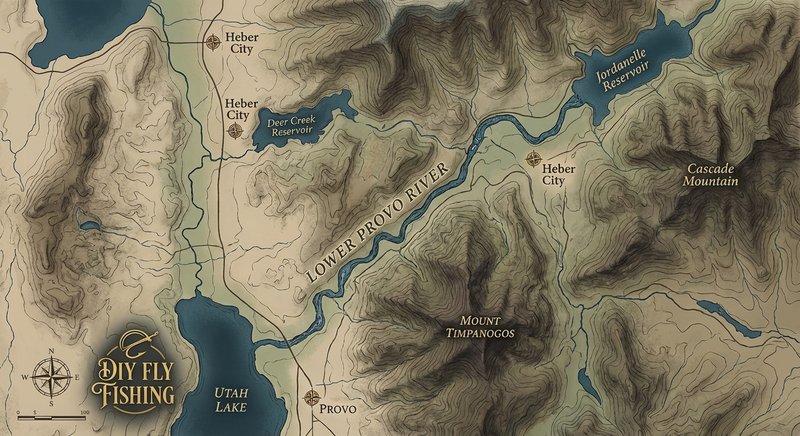
Lower Provo River
Fly fishing in Utah · Intermediate · Best seasons: Spring, Summer, Fall, Winter
Target Species
Brown Trout, Rainbow Trout
About This Water
Tailwater below Deer Creek Dam. Year-round fishing with trophy potential.
Fishing Recommendations
As an expert guide who has spent years navigating the nuances of the Wasatch Front’s tailwaters, I can tell you that the Lower Provo River is both a blessing and a challenge. Located just minutes from Orem and Provo, it is one of the most prolific trout factories in the West. Because it is a bottom-release tailwater (flowing from Deer Creek Reservoir), it stays cold in the summer and ice-free in the winter, providing a 365-day fishery.
Here is your comprehensive guide to mastering the Lower Provo.
🎣 Location Overview
The Lower Provo River flows through the breathtaking Provo Canyon, flanked by the towering limestone cliffs of Mount Timpanogos. What makes this water special is its insane biomass. The river is carpeted in Sowbugs and Scuds, allowing for a fish density that often exceeds 3,000 trout per mile.
The river characteristics vary from deep, slow-moving runs and "bucket" holes to classic riffle-pool sequences. It is a technical river; the trout here are highly educated and see thousands of flies a year. To be successful, you need delicate presentations and a solid understanding of bug life.
🐟 Target Species & Behavior
- Brown Trout: The dominant species. They are wild, hardy, and famously wary. You’ll find them tucked against the banks, under overhanging branches, or in the deep "guts" of the runs.
- Rainbow Trout: Often found in the faster, more oxygenated "riffle" water at the head of pools. While many are resident fish, the DWR does supplement certain sections.
Behavior: These fish are "micro-feeders." Because of the sheer volume of small crustaceans (Sowbugs), they don't have to move far to eat. They won't often chase a fly; you must put it right in their "lane."
📅 Best Times to Fish
- Spring (March – May): This is Blue Winged Olive (BWO) season. On cloudy days, the dry fly fishing is world-class. Mother’s Day Caddis hatches in May can also be spectacular.
- Summer (June – August): Famous for PMDs (Pale Morning Duns) and evening Caddis blizzards. Terrestrials (ants/beetles) become very effective against the banks in August.
- Fall (September – November): The Brown Trout spawn. Use caution to avoid stepping on redds (spawning beds). Fishing with egg patterns and BWO nymphs is highly productive.
- Winter (December – February): The "secret" season. Midges are the only game in town. Fishing can be excellent on sunny afternoons when the Midges hatch, bringing fish to the surface even in the snow.
Prime Window: Typically 10:00 AM to 4:00 PM in the winter, and early mornings or "the evening rise" in the heat of summer.
🪰 Recommended Flies & Techniques
Top Fly Patterns
- Sowbugs/Scuds (The Staples): Ray Charles (grey/pink), Firebead Sowbug, and Diamond Scuds (Size 18-22).
- Midges: Zebra Midges (black, red, olive), Mother’s Day Midge, and Griffith’s Gnat (Size 20-24).
- Mayflies: RS2s, Pheasant Tails, and Parachute Adams (Size 18-22).
- Caddis: Elk Hair Caddis and LaFontaine’s Sparkle Pupa (Size 16-18).
Effective Techniques
- Technical Nymphing: This is the bread and butter of the Provo. Most guides use a "Provo River Rig" (a variation of a bounce rig) or a standard indicator rig with very small weights.
- Dry Fly: Use long leaders (12ft+) and 6X or 7X fluorocarbon tippet. The fish are leader-shy.
- Streamers: Not the most common method here, but a small olive or black wooly bugger swung through deep holes on a rainy day can produce the biggest Browns in the river.
💡 Pro Tips & Local Knowledge
- The "Provo Bounce": Local experts often place their split shot below their bottom fly. This allows the flies to hover just inches off the rocky bottom where the sowbugs live without snagging as often.
- Mind the "Micro-Drag": The currents on the Lower Provo are complex. Even a tiny bit of drag on your line will cause a trout to refuse. Spend more time on your mending than your casting.
- Target the "Soft Water": Everyone fishes the big, obvious holes. Experienced guides look for "soft" pockets of water near the banks or behind small mid-stream boulders.
- Stealth Matters: The water is often crystal clear. Avoid wearing bright colors, and try not to splash when wading.
⚠️ Important Information
- Access: There are several public access points along Highway 189 in Provo Canyon. Popular spots include "The Diversion," "Olmstead," and the "Upper Falls" area.
- Regulations: The Lower Provo is generally under Standard Utah Fishing Regulations, but certain sections have specific rules regarding bait and limits. Always check the current Utah Fishing Guidebook. Most of the river is "Community Water," but catch-and-release is highly encouraged to maintain the quality of the fishery.
- The "Double-Tube" Factor: In July and August, the lower sections of the river become crowded with recreational tubers. If you want peace and quiet, fish the early mornings or the sections further up the canyon.
- Stay Off the Redds: In late fall, look for clean gravel patches. These are spawning beds. Stepping on them kills thousands of future trout. Please be a steward of the water.
Final Guide Advice: If the fishing is tough, go smaller and thinner. If you think you're fishing a small enough fly, go one size smaller. On the Lower Provo, a size 22 midge on 7X tippet is often the difference between a skunk and a 20-fish day.
Bug Hatches & Matching Flies
| Hatch | Type | Peak months | Time of day | Hook sizes | Matching flies |
|---|---|---|---|---|---|
| Midges Chironomidae | midge | January, February, March, December | All day (Peak late morning) | #18-24 | Zebra Midge #18-22, Griffith's Gnat #20-24, Mother's Day Midge #20-22 |
| Blue Winged Olive Baetis | mayfly | April, May, September, October | Late Morning/Afternoon | #18-22 | RS2 #20-22, Parachute Adams #18-22, Pheasant Tail Nymph #18-20 |
| Pale Morning Dun Ephemerella excrucians | mayfly | June, July, August | Morning/Early Afternoon | #16-18 | Split Case PMD #16-18, PMD Sparkle Dun #16-18, Last Chance Cripple #16-18 |
| Mother's Day Caddis Brachycentrus | caddis | May | Afternoon/Evening | #14-16 | Peeping Caddis #14-16, Elk Hair Caddis (Dark) #14-16, LaFontaine's Sparkle Pupa #14-16 |
| Spotted Sedge Hydropsyche | caddis | July, August, September | Evening | #14-18 | Goddard Caddis #14-16, Holy Grail #16-18, Soft Hackle Peacock #16-18 |
| Trico Tricorythodes | mayfly | August, September | Early Morning | #20-24 | Trico Spinner #20-24, Sunken Trico #22-24 |
| Buffalo Midge Diptera | midge | March, April | Afternoon | #10-14 | Brooks Sprout Midge #12-14, Gummy Midge #12-14 |
| Terrestrials Formicidae/Gryllidae | terrestrial | July, August, September | Afternoon | #12-18 | Cinnamon Ant #16-18, Parachute Hopper #12-14, Black Beetle #14-16 |