Lubbers Run
Fly fishing in New Jersey · advanced · Best seasons: spring, fall
Target Species
Brook Trout, Brown Trout
About This Water
Small Morris County stream with wild trout. Technical fishing requires careful approach.
Fishing Recommendations
Lubbers Run, located in Sussex County, New Jersey, is one of those "hidden in plain sight" streams that seasoned Garden State anglers cherish. While it may not have the fame of the nearby Musconetcong or the Pequest, it offers an intimate, technical fly fishing experience that rewards stealth and precision.
Here is your comprehensive guide to fishing Lubbers Run.
🎣 Location Overview
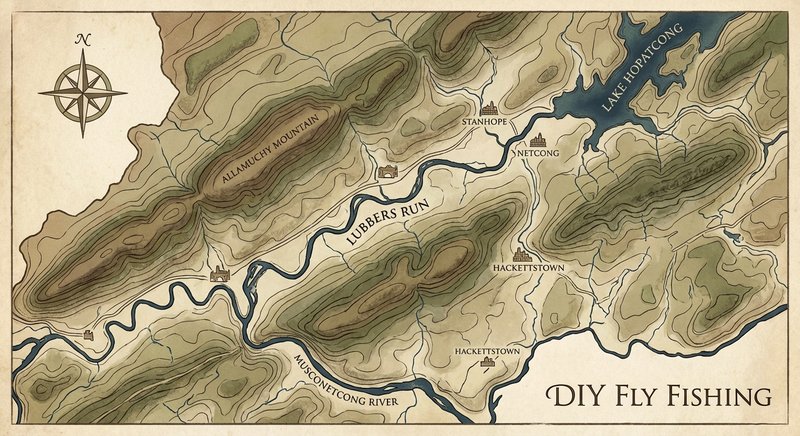
Lubbers Run is a classic North Jersey freestone stream and a primary tributary to the Musconetcong River. It flows through a mix of wooded ravines, marshy lowlands, and suburban pockets, primarily within Byram and Hopatcong Townships.
What makes Lubbers Run special is its intimate scale. This is "small water" fishing at its finest. The stream features a variety of water types: quick-moving riffles, deep undercut banks, and placid pools shaded by dense hemlocks and rhododendrons. It feels much more remote than its proximity to Interstate 80 would suggest. Anglers love it because it requires "hunting" fish rather than just casting to them, offering a sanctuary for those who prefer solitude over the crowded banks of the larger stocked rivers.
🐟 Target Species & Behavior
The stream is primarily managed as a put-and-take fishery, but its cold-water tributaries and shaded stretches allow for decent holdover potential.
- Brown Trout: These are the kings of Lubbers Run. The holdover browns become extremely wary and are usually found tucked deep under overhanging banks or behind large boulders. They are opportunistic feeders but will spook at the slightest shadow.
- Brook Trout: The NJ Division of Fish and Wildlife stocks brookies here heavily in the spring. You may also find small, wild "natives" in the upper reaches and feeder trickles. They are aggressive and will often strike at flashy attractors or bushy dry flies.
- Behavior: Because the water is relatively shallow and clear, fish here are "look up" oriented in the spring. During the fall, browns become more aggressive as they prepare for the spawn, often moving out of deep holes into the gravelly runs.
📅 Best Times to Fish
- Optimal Seasons:
- Spring (April – June): This is the prime window. The stream is freshly stocked, water levels are typically healthy, and the major hatches occur.
- Fall (Late September – November): Water temperatures drop back into the "sweet spot" (50–60°F). The fall foliage is stunning, and the trout become active again after the summer doldrums.
- Best Times of Day:
- Spring: Mid-morning to late afternoon. You want the sun to warm the water just enough to trigger insect activity.
- Fall: Late afternoon. The "golden hour" before dusk often sees a rise of Blue Winged Olives or midges.
- Prime Conditions: Fish Lubbers Run three days after a rainstorm. The water will have that "tannin tea" stain which provides cover for both you and the fish, making them less skittish.
🪰 Recommended Flies & Techniques
Top Fly Patterns
- Dry Flies:
- Elk Hair Caddis (Tan or Olive, Size 14-18): A staple for the heavy caddis presence.
- Adams/Parachute Adams (Size 16-20): The best generalist imitation for mayflies.
- Blue Winged Olive (BWO) (Size 18-22): Essential for overcast days and late autumn.
- Nymphs:
- Pheasant Tail (Size 16-20): Mimics almost every small mayfly nymph in the stream.
- Bead-head Hare’s Ear (Size 14-16): Great for the deeper "pocket water."
- Zebra Midge (Size 20-22): Deadly in the winter and early spring.
- Streamers:
- Woolly Bugger (Black or Olive, Size 8-12): Use these to probe the deep holes under bridges or fallen logs.
Techniques & Presentation
- The Bow-and-Arrow Cast: Given the dense canopy, you will often lack the room for a traditional backcast. Mastering the bow-and-arrow cast is essential for hitting tight spots.
- Dry-Dropper Rig: A fantastic way to cover Lubbers Run. Use a buoyant Elk Hair Caddis as your indicator and hang a small Pheasant Tail nymph 18 inches below it.
- Stealth is Key: Wear drab clothing (greens and browns). Approach the pools from downstream and stay low to the ground. If you can see the fish, they have likely already seen you.
💡 Pro Tips & Local Knowledge
- The Waterloo Stretch: The lower section near Waterloo Village (close to the confluence with the Musconetcong) is highly productive. The water here is slightly larger and carries more nutrients, supporting bigger fish.
- Wild Water: If you are looking for wilder fish, head upstream toward the headwaters near Wild West City. The water is smaller and the fish are tinier, but they are often brilliantly colored and far more rewarding.
- The "Caddis Blizzard": In late spring, Lubbers Run can have intense caddis hatches. If you see fish slashing at the surface, don't just drift your fly—give it a tiny twitch to mimic an emerging insect.
- Rod Choice: Leave your 9-foot 5-weight at home. A 7.5-foot 3-weight or 4-weight is the perfect tool for this stream. It allows for better maneuverability under the trees.
⚠️ Important Information
- Access: Much of Lubbers Run parallels Waterloo Road and Continental Drive. There are several pull-offs and small dirt lots. Always respect "Posted" signs, as some stretches flow through private backyards.
- Regulations:
- A valid New Jersey Fishing License and Trout Stamp are required for all anglers 16 and older.
- Lubbers Run is subject to Statewide General Trout Regulations. Be sure to check the NJ Fishing Digest for "Opening Day" dates and creel limits.
- Wading Safety: The stream bed can be slippery with "snot rocks" (algae). Felt soles (where legal) or studded rubber soles are highly recommended.
- Summer Caution: By July and August, the water can get very low and warm. Please carry a thermometer; if the water is over 70°F, stop fishing to prevent trout mortality.
Lubbers Run is a true "fisherman's stream"—it won't give up its secrets easily, but for the fly angler who values technique and tranquility, it is a North Jersey treasure. Tight lines!
Bug Hatches & Matching Flies
| Hatch | Type | Peak months | Time of day | Hook sizes | Matching flies |
|---|---|---|---|---|---|
| Blue Winged Olive Baetis | mayfly | April, May, September, October | Afternoon | #18-22 | BWO Sparkle Dun #18-22, RS2 #20-22, Pheasant Tail #18-20 |
| Hendrickson Ephemerella subvaria | mayfly | April, May | Afternoon | #12-14 | Hendrickson Dark #12-14, Red Quill #14, Hendrickson Nymph #12-14 |
| Grannom Caddis Brachycentrus | caddis | April, May | Morning/Afternoon | #14-16 | Elk Hair Caddis (Olive) #14-16, LaFontaine's Pupa #14-16, Peacock Caddis #16 |
| Sulfur Ephemerella invaria/dorothea | mayfly | May, June | Evening | #14-18 | Sulfur Parachute #16-18, Sulfur Emerger #16-18, Frenchie #16 |
| Light Cahill Stenacron interpunctatum | mayfly | June, July | Evening | #12-14 | Light Cahill #12-14, Cream Usual #14 |
| Tan Caddis Hydropsyche | caddis | May, June, July, August | Evening | #14-18 | X-Caddis (Tan) #14-18, Holy Grail #16, Soft Hackle Hare's Ear #14-16 |
| Trico Tricorythodes | mayfly | July, August, September | Morning | #22-26 | Trico Spinner #22-24, Zebra Midge #20-22 |
| Terrestrials Formicidae/Coleoptera | terrestrial | July, August, September | Mid-day/Afternoon | #12-18 | Black Foam Ant #16-18, Cricket #12, Beetle #14-16 |