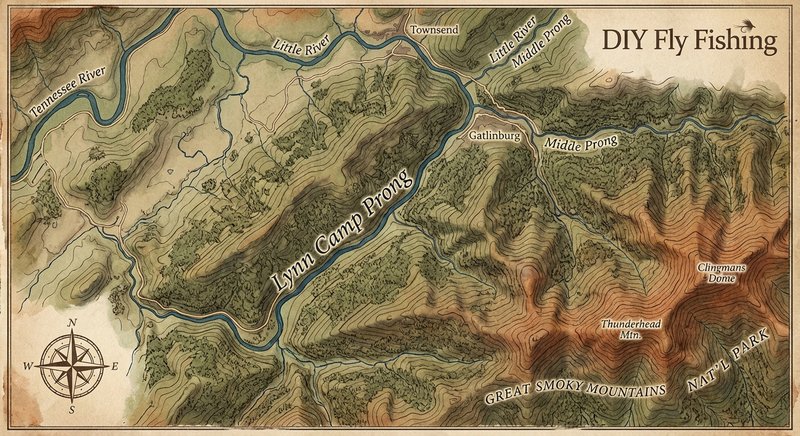
Lynn Camp Prong
Fly fishing in Tennessee · Advanced · Best seasons: Spring, Summer, Fall
Target Species
Brook Trout, Rainbow Trout
About This Water
Small Smokies stream with native brook trout in headwaters. Beautiful wilderness fishing.
Fishing Recommendations
Welcome to one of the crown jewels of the Great Smoky Mountains National Park (GSMNP). As your guide, I can tell you that Lynn Camp Prong is more than just a stream; it is a testament to successful conservation and a cathedral of Southern Appalachian fly fishing.
Located in the Tremont area near Townsend, TN, this stream offers some of the finest high-gradient freestone fishing in the Eastern United States.
🎣 Location Overview
Lynn Camp Prong is a quintessential mountain freestone stream. It is a major tributary of the Middle Fork of the Little River. What makes it special is its history: after a massive restoration project that concluded in 2015, Lynn Camp was reopened as a premier sanctuary for Southern Appalachian Brook Trout.
The water is characterized by high gradients, meaning you’ll find a relentless series of plunge pools, "pocket water," tight runs, and cascading waterfalls. The water is gin-clear, cold, and nutrient-poor, which dictates the aggressive but opportunistic feeding behavior of the fish. Anglers love it for the scenery—towering hemlocks and moss-covered boulders—and the chance to catch a "Smoky Mountain Grand Slam" (Brook, Rainbow, and Brown trout) in a single day.
🐟 Target Species & Behavior
- Southern Appalachian Brook Trout (Spec): These are the stars of the show. Found primarily in the upper reaches (above the Middle Prong junction), they are vibrant, feisty, and smaller (6–9 inches). They hold in the soft water at the head of pools and in tiny pockets behind rocks.
- Rainbow Trout: Found throughout the lower and middle sections. They are wild, incredibly fast, and hold in the swifter "bubble lines" and deeper plunge pools.
- Feeding Behavior: Because these streams are "infertile" (low mineral content), fish cannot afford to be picky. If it looks like food and the drift is natural, they will usually strike. They are "opportunistic surface feeders," meaning they spend much of their time looking up.
📅 Best Times to Fish
- Spring (Late March – May): This is the prime window. The Quill Gordon and March Brown hatches bring the stream to life. Water temperatures rise into the 50s, making fish much more active.
- Summer (June – August): While lower elevation streams get too warm, Lynn Camp stays cool. This is the season of Terrestrials. Fish early morning or late evening to avoid the midday sun and the occasional hiker.
- Fall (September – early November): My personal favorite. The Brook Trout take on incredible spawning colors (vibrant oranges and reds). The Isonychia hatch provides excellent dry fly action.
- Prime Conditions: Look for a stabilizing water level after a rain. If the water is "gin clear," you must be stealthy. If it has a slight "tannic stain" from a recent shower, the fishing can be legendary.
🪰 Recommended Flies & Techniques
Top Fly Patterns
- Dry Flies:
- Yellow Stimulator (Size 14-16): Mimics stoneflies and is easy to see in broken water.
- Parachute Adams (Size 16-20): The gold standard for any Smoky Mountain stream.
- Royal Wulff: High visibility and high buoyancy.
- Tennessee Wulff: A local favorite with green/brown bodies.
- Nymphs (Droppers):
- Pheasant Tail (Size 16-18): Best all-around nymph.
- Prince Nymph: Provides a bit of flash in dark pools.
- Terrestrials:
- Green Weenie: A local legend. It mimics a caddis larva or a caterpillar.
- Foam Beetles or Ants: Crucial in late summer.
Effective Techniques
- Dry-Dropper Rig: This is the most effective way to fish Lynn Camp. Use a buoyant dry fly (like a Stimulator) and hang a small nymph (like a Pheasant Tail) 12–18 inches below it on 5X or 6X tippet.
- High-Sticking: Because the currents are complex, keep as much fly line off the water as possible. Only your leader should be touching the surface to prevent "drag."
- The Stealth Approach: These fish are spooky. Never wade into a pool until you have fished the tail-out and the edges from the bank.
💡 Pro Tips & Local Knowledge
- The "Middle Prong" Hike: Park at the end of Tremont Road. The Lynn Camp Prong trail follows the stream. The further you hike up (past the first few waterfalls), the better the Brook Trout fishing becomes. Most tourists stop at the first waterfall; the best fishing starts half a mile beyond that.
- Wading Safety: The rocks in Lynn Camp are notoriously slippery. Felt-soled boots (where legal) or studs are highly recommended. A wading staff is a life-saver here.
- The "Green Weenie" Secret: If the fishing is slow, tie on a Green Weenie (a simple chartreuse chenille fly). In the Smokies, it is often the only thing that works when the "match the hatch" flies fail.
- Light Tackle: Use a 2-weight or 3-weight rod, 7–8 feet in length. The canopy is tight, and you don’t need long casts—you need accuracy and "bow-and-arrow" casts.
⚠️ Important Information
- Access: Drive through Townsend, TN, enter the Great Smoky Mountains National Park, and follow signs for Tremont. Follow Tremont Road to the very end (it becomes gravel). The trailhead for Middle Prong/Lynn Camp starts there.
- Regulations:
- A valid Tennessee or North Carolina fishing license is required.
- Single Hook, Artificial Lures Only: No bait is permitted.
- Size Limits: Check current GSMNP regulations, but generally, there is a 7-inch minimum for Brook and Rainbow trout (though many anglers choose 100% Catch & Release to preserve the resource).
- Bear Safety: This is black bear country. Keep your food stored properly in your vehicle and be aware of your surroundings, especially when fishing alone in the backcountry.
- Cell Service: Expect zero cell service once you turn onto Tremont Road. Download your maps or bring a physical map of the park.
Enjoy the "Specs," my friend. There is nothing quite like the blue halo of a Southern Appalachian Brookie caught in the shadows of Lynn Camp Prong. Tight lines!
Bug Hatches & Matching Flies
| Hatch | Type | Peak months | Time of day | Hook sizes | Matching flies |
|---|---|---|---|---|---|
| Quill Gordon Epeorus pleuralis | mayfly | March, April | Midday | #12-14 | Quill Gordon Dry #12-14, Quill Gordon Wet #12-14 |
| Blue Quill Paraleptophlebia adoptiva | mayfly | March, April | Late Morning to Afternoon | #16-18 | Blue Quill Dry #16-18, Pheasant Tail Nymph #16-18 |
| Yellow Sally Isoperla spp. | stonefly | May, June, July | Late Afternoon/Evening | #14-16 | Yellow Sally Stone #14-16, Little Yellow Stone Nymph #14-16 |
| Light Cahill Stenacron interpunctatum | mayfly | June, July | Evening | #12-14 | Light Cahill Dry #12-14, Gold Ribbed Hare's Ear #12-14 |
| Cinnamon Caddis Hydropsyche | caddis | May, June, September | Morning/Evening | #14-16 | Elk Hair Caddis (Tan) #14-16, Pupa Lace Caddis #14-16 |
| Blue Winged Olive Baetis spp. | mayfly | March, October, November | Overcast Afternoons | #18-22 | BWO Sparkle Dun #18-22, RS2 #20-22 |
| Terrestrials (Ants & Beetles) Formicidae / Coleoptera | terrestrial | June, July, August, September | All Day | #12-18 | Black Foam Ant #16-18, Crowe Beetle #14-16 |
| Green Drake Ephemera guttulata | mayfly | May, June | Evening | #10-12 | Green Drake Paradox #10-12, Coffin Fly #10-12 |
| Golden Stonefly Acroneuria spp. | stonefly | June, July | Morning/Evening | #8-12 | Stimulator (Orange/Yellow) #8-12, Girdle Bug #8-12 |