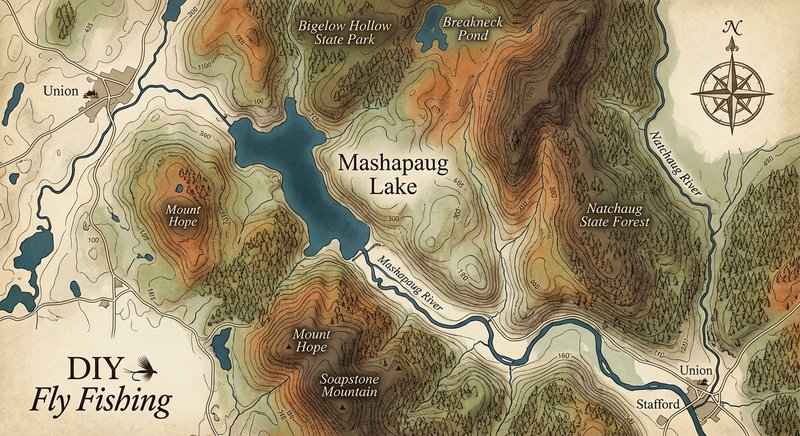
Mashapaug Lake
Fly fishing in Connecticut · Beginner · Best seasons: Spring, Summer, Fall
Target Species
Largemouth Bass, Pickerel, Panfish
About This Water
Tolland County lake with bass and panfish. Union area fishing.
Fishing Recommendations
Welcome to Mashapaug Lake in Union, Connecticut. As a guide, I consider this one of the "crown jewels" of the Nutmeg State. Located within Bigelow Hollow State Park and the Nipmuck State Forest, Mashapaug offers a wilderness experience that feels more like the Adirondacks or Maine than southern New England.
Here is your comprehensive fly fishing guide to navigating these pristine waters.
🎣 Location Overview
Mashapaug Lake is a 287-acre glacial lake known for its exceptional water clarity and rugged, undeveloped shoreline. Unlike many Connecticut lakes lined with houses, Mashapaug is surrounded by deep forest, rocky outcrops, and downed timber.
What makes it special for the fly angler is the variety of structure. You’ll find deep drop-offs, shallow "fingers" or coves, and massive submerged boulders. The water is relatively nutrient-poor (oligotrophic), meaning it is crystal clear. This transparency requires a stealthy approach and longer leaders than you might use in murkier ponds.
🐟 Target Species & Behavior
Largemouth Bass
The Largemouths here are healthy and strong. Because the water is so clear, they often hold slightly deeper than in weedy ponds. They patrol the edges of the weed beds and wait under the shadows of overhanging mountain laurels.
- Feed on: Golden shiners, crayfish, dragonfly nymphs, and frogs.
Chain Pickerel
Mashapaug has a robust population of "water wolves." They are ambush predators that sit perfectly still in the shallow vegetation or near fallen logs. They are highly aggressive toward flashy, fast-moving flies.
Panfish (Bluegill & Pumpkinseed)
The sunfish here are vibrant and plentiful. They congregate around the rocky shorelines and the boat launch area. They are the perfect target for dry-fly practice or for introducing a beginner to the sport.
📅 Best Times to Fish
- Spring (Late April – June): This is the prime window. As the shallows warm, bass move into the "fingers" of the lake to spawn and feed. The Pickerel are extremely active in the warming weed beds.
- Summer (July – August): Focus on the "Golden Hours"—dawn and dusk. During the heat of the day, fish move to the 10–15 foot depth range or under heavy overhead cover.
- Fall (September – October): As water temperatures drop, fish move shallow again for a pre-winter feeding binge. The "topwater bite" can be spectacular on overcast September days.
Prime Conditions: Overcast skies are your best friend at Mashapaug. The lack of sun reduces shadows and makes the fish much more confident in the clear water.
🪰 Recommended Flies & Techniques
Top Patterns
- For Bass:
- Dahlberg Diver (Frog or Blue/White): The classic "gurgle and dive" action is irresistible here.
- Gamechanger (White or Chartreuse): Mimics the lake's shiners perfectly.
- Woolly Bugger (Olive or Black, Size 4-6): The universal crayfish/leech imitator.
- For Pickerel:
- Flashy Bunny Leech: Use red/white or chartreuse. They love the movement.
- Clouser Minnow: Heavy eyes to get down deep along the drop-offs.
- For Panfish:
- BoogleBully or small foam poppers.
- Bead-head Prince Nymphs suspended under a dry fly (Dry-Dropper rig).
Techniques & Presentation
- The Stealth Approach: Because of the clarity, use a 9-foot 2X or 3X fluorocarbon leader. Long casts are essential to avoid spooking fish with the boat or float tube.
- Strip and Pause: When fishing streamers, use an erratic "strip-strip-pause" cadence. Bass often hit on the pause as the fly slowly sinks.
- Topwater: In the evening, cast a popper right against the rocky shoreline. Let the rings dissipate completely before your first twitch.
💡 Pro Tips & Local Knowledge
- Work the "Fingers": The northern end of the lake has several narrow coves (fingers). These areas warm up first in the spring and hold the highest concentration of Largemouth Bass.
- The "Toothy" Tax: If you are targeting Pickerel, use a 12-inch section of 20lb wire tippet or very heavy fluorocarbon (40lb+). Their needle-like teeth will slice through standard trout leaders instantly.
- Crayfish Magic: The lake is very rocky. If the surface action is slow, switch to a weighted crayfish pattern (claws-up design) and "crawl" it over the submerged rocks.
- Wind Management: Mashapaug is tucked between ridges, which can create a wind-tunnel effect. If the main body is too choppy for a fly line, tuck into the eastern shoreline for protection.
⚠️ Important Information
Access
- Boat Launch: There is a state-maintained boat launch at the southern end (Bigelow Hollow State Park). It is well-paved and has ample parking.
- Vessels: Electric motors only. This makes it a paradise for kayakers, canoeists, and float-tubers.
- Wading: Wading is difficult due to the steep drop-offs and rocky bottom; fishing from a small craft is highly recommended.
Regulations
- License: A valid Connecticut Fishing License is required (available online via CT DEEP).
- Limits: Follow statewide regulations for Bass and Pickerel. However, most serious fly anglers here practice Catch and Release to preserve the quality of the fishery.
- Park Fees: There is a parking fee for out-of-state vehicles during the summer months; CT-registered vehicles are usually free under the "Passport to the Parks" program.
Special Considerations
- Cell Service: It is very spotty in the hollow. Download your maps before you arrive.
- Safety: The lake gets deep quickly (up to 38 feet). Always wear a PFD, especially in a kayak or float tube.
Guide’s Final Word: Mashapaug is a "thinking angler's" lake. It won't always give up fish easily due to the clear water, but the quality of the fish and the beauty of the surroundings make it one of the best fly fishing experiences in New England. Tight lines!
Bug Hatches & Matching Flies
| Hatch | Type | Peak months | Time of day | Hook sizes | Matching flies |
|---|---|---|---|---|---|
| Chironomids Family Chironomidae | midge | April, May, September | All Day | #18-24 | Zebra Midge #18-22, Griffith's Gnat #20-24, Ice Bud #18-20 |
| Hex Hexagenia limbata | mayfly | June, July | Dusk/Night | #4-8 | Hexagenia Spinner #6-8, Hagen's Hex Nymph #4-8, Parachute Hex #6 |
| Speckled Dun Callibaetis spp. | mayfly | July, August, September | Morning/Afternoon | #12-16 | Callibaetis Spinner #14-16, Hare's Ear Nymph #12-16, Pheasant Tail #14-16 |
| Damselfly Suborder Zygoptera | terrestrial | June, July, August | Afternoon | #10-14 | Marabou Damsel Nymph #10-12, Adult Damsel #12-14 |
| Cinnamon Caddis Family Leptoceridae | caddis | June, July | Evening | #14-18 | Elk Hair Caddis (Tan) #14-16, LaFontaine's Deep Sparkle Pupa #14-18 |
| Scuds Order Amphipoda | terrestrial | April, May, October | All Day | #14-18 | Ray Charles #14-18, Scud (Olive/Orange) #14-16 |
| Terrestrial Ants/Beetles Formicidae / Coleoptera | terrestrial | July, August, September | Afternoon | #12-18 | Chernobyl Ant #8-12, Black Foam Ant #16-18, Joan Wulff's Royal Wulff #12-14 |
| Trico Tricorythodes spp. | mayfly | August, September | Morning | #20-24 | Trico Spinner #22-24, RS2 #20-22 |