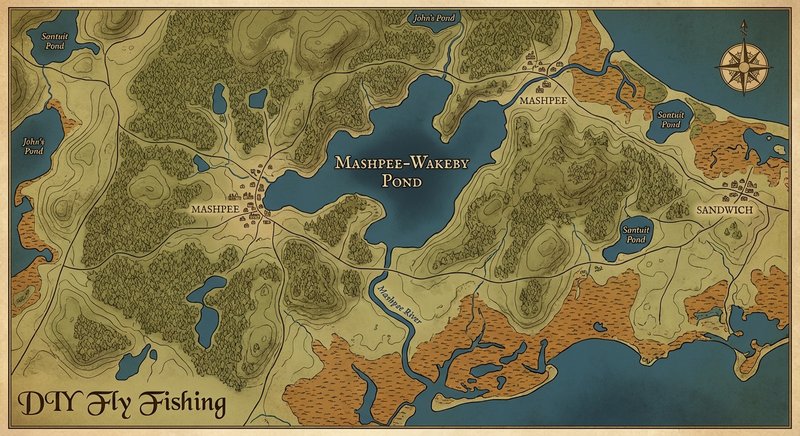
Mashpee-Wakeby Pond
Fly fishing in Massachusetts · Intermediate · Best seasons: Spring, Summer, Fall
Target Species
Largemouth Bass, Smallmouth Bass, Pickerel
About This Water
Cape Cod pond with bass and pickerel. Excellent fly fishing.
Fishing Recommendations
Welcome to one of the crown jewels of Cape Cod’s freshwater fishery. As a guide, I consider Mashpee-Wakeby Pond (technically two connected basins) to be one of the premier warm-water fly fishing destinations in Massachusetts. Covering over 700 acres, it offers a diverse ecosystem that mimics a "big water" experience while maintaining the charm of the Cape.
🎣 Location Overview
Mashpee-Wakeby is a classic "kettle hole" pond complex formed by glacial retreat. It is divided into two main lobes: the northern Wakeby Pond and the southern Mashpee Pond, connected by a wide, navigable channel.
What makes this water special for the fly angler is its structural diversity. You’ll find deep drop-offs (reaching over 60 feet), expansive sandy flats, dense lily pad fields, and shorelines cluttered with downed timber. The water is relatively clear compared to mainland ponds, allowing for sight-casting opportunities in the shallows during the spring and early summer. It is a world-class fishery for both size and quantity of bass.
🐟 Target Species & Behavior
Largemouth Bass
The "green trout" are the kings of the weedy shallows and woody debris. In Mashpee-Wakeby, they grow large by gorging on bluegill, yellow perch, and crayfish. They typically hold in the "slop"—the lily pads and weed edges—or tucked tight under overhanging trees.
Smallmouth Bass
Unlike many Cape ponds, Mashpee-Wakeby has a robust Smallmouth population. They prefer the cooler, deeper water and the rocky/sandy transitions. Look for them on the submerged points and the gravel bars where Wakeby and Mashpee meet. They are aggressive and provide a spectacular fight on a 6-weight or 7-weight fly rod.
Chain Pickerel
The "water wolves" are ubiquitous here. They inhabit the same weedy zones as the Largemouth but are often even more aggressive. They provide excellent action on days when the bass are sluggish. Note: Bring wire tippet or heavy fluorocarbon, as their teeth will shred standard leaders.
📅 Best Times to Fish
- Spring (Late April – June): This is the prime window. As the water warms into the 55–65°F range, fish move into the shallows to spawn. Pre-spawn (May) is your best chance at a trophy Largemouth.
- Summer (July – August): Focus on the "Low Light Windows." The midday sun drives fish deep or into the thickest cover. Target the first two hours of daylight and the "golden hour" before sunset for explosive topwater action.
- Fall (September – October): As water temperatures drop, fish become highly active again, feeding heavily for winter. Smallmouths move onto the points, and Largemouths patrol the dying weed lines.
🪰 Recommended Flies & Techniques
Top Patterns
- Topwater: Dahlberg Divers (Chartreuse/White), Umpqua’s Swimming Frog, and BoogleBugs (Size 4).
- Subsurface/Streamers: Game Changers (White or Yellow Perch patterns), Clouser Minnows (Chartreuse/White), and Woolly Buggers (Black or Olive, Size 2-6).
- Crayfish/Baitfish: Near-Nuff Crayfish and Murdich Minnows.
Techniques & Presentation
- The "Pop and Stop": When fishing poppers, the biggest mistake is moving the fly too fast. Pop it once, let the rings disappear, and wait. Most strikes occur while the fly is sitting dead still.
- Intermediates for Smallies: Use an intermediate sinking line to get a Murdich Minnow or Clouser down 5–10 feet over the rocky points. Use a "strip-strip-pause" retrieve to mimic a wounded baitfish.
- The Weed Guard is Mandatory: Ensure 90% of your flies have a stiff mono weed guard. You need to be able to throw your fly into the wood and pads without snagging.
💡 Pro Tips & Local Knowledge
- The "Choke Point": The channel connecting the two ponds creates a natural funnel. During a breeze, baitfish get pushed through this area, attracting both Smallmouth and Largemouth. It’s a high-percentage area to drift through.
- Target the "Ledges": Many anglers focus only on the shoreline. However, the biggest Smallmouths often hold on the secondary ledges where the water drops from 10 feet to 25 feet. A sinking tip line is your best friend here.
- Wind is Your Friend: A slight "Cape Cod chop" breaks up the surface and makes the fish less wary of your fly line. If it’s dead calm, you’ll need to lengthen your leader and cast more stealthily.
- The Herring Factor: Because this system is connected to the Mashpee River, there is a spring herring run nearby. While the herring don't enter the pond in massive numbers like other systems, the bass are "herring-aware." Large, 5–7 inch white/silver streamers can trigger massive strikes.
⚠️ Important Information
Access
- State Boat Ramp: Located off Fisherman's Landing (Mashpee side). There is excellent parking, but it fills up fast on summer weekends.
- Wading: Wading is limited due to private shorelines and thick vegetation. This pond is best fished from a boat, kayak, or stand-up paddleboard (SUP).
Regulations
- A valid Massachusetts Freshwater Fishing License is required for anyone 15 or older.
- Observe all state limits on bass (currently 5 fish, 12-inch minimum), though Catch and Release is strongly encouraged to preserve this high-quality fishery.
Safety
- Wind: Being a large, open body of water, it can get whitecaps quickly. If you are in a kayak, keep an eye on the forecast—paddling back across Wakeby against a 15mph south wind is a grueling task.
- Boater Traffic: In the summer, this is a popular lake for jet skis and tubers. To have the best fly fishing experience, be off the water by 10:00 AM or fish on weekdays.
Bug Hatches & Matching Flies
| Hatch | Type | Peak months | Time of day | Hook sizes | Matching flies |
|---|---|---|---|---|---|
| Chironomids (Midges) Family Chironomidae | midge | April, May, October | All Day | #18-24 | Zebra Midge #18-22, Griffith's Gnat #20-24, Ice Bud #18-20 |
| Speckled Spinner (Callibaetis) Callibaetis spp. | mayfly | May, June, September | Morning/Afternoon | #12-16 | Callibaetis Parachute #14-16, Hare's Ear Nymph #12-16, Callibaetis Cripple #14-16 |
| Damselflies Enallagma spp. | terrestrial | June, July | Mid-day/Afternoon | #10-14 | Marabou Damsel Nymph #10-12, Adult Damsel #12-14 |
| Caddisflies (Long-horned) Triaenodes spp. | caddis | June, July, August | Evening | #14-18 | Elk Hair Caddis #14-18, LaFontaine's Deep Sparkle Pupa #14-16 |
| Dragonflies Anisoptera | terrestrial | July, August | Afternoon | #4-8 | Dragonfly Nymph (Olive) #6-10, Mick-Hall Dragonfly Adult #8-10 |
| Scuds Gammarus spp. | mayfly | March, April, November | All Day | #14-18 | Ray Charles #14-18, Flashback Scud #14-16 |
| Water Boatmen Corixidae | terrestrial | September, October | Afternoon | #14-16 | Water Boatman #14-16 |
| Black Ants Formicidae | terrestrial | August, September | Afternoon | #16-20 | Black Foam Ant #16-20, Flying Ant #18 |