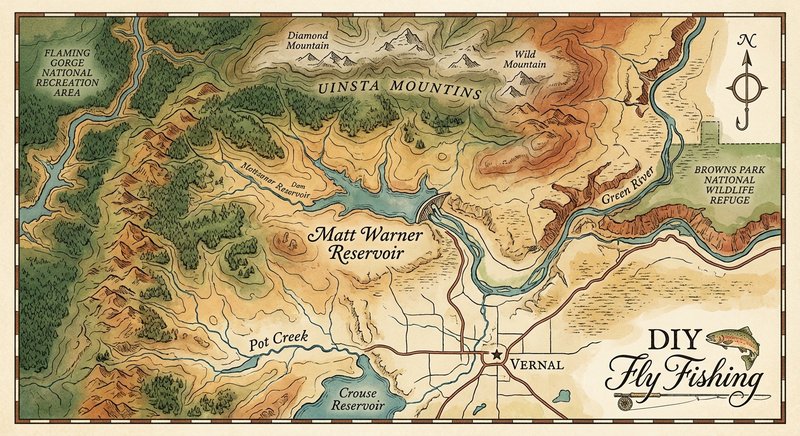
Matt Warner Reservoir
Fly fishing in Utah · Beginner · Best seasons: Summer, Fall
Target Species
Tiger Trout, Rainbow Trout
About This Water
Remote northeast Utah reservoir with tiger trout. Beautiful Brown's Park area.
Fishing Recommendations
Welcome to the high-country gem of the Diamond Mountain plateau. As your guide, I can tell you that Matt Warner Reservoir is one of the premier stillwater destinations in Northeastern Utah. Located about 40 miles north of Vernal at an elevation of nearly 8,000 feet, it offers an aesthetic mix of sagebrush steppe and alpine scenery.
What makes Matt Warner legendary among fly anglers isn't just the quantity of fish, but the size and aggression of the Tiger Trout.
🎣 Location Overview
Matt Warner is a mid-sized, fertile irrigation reservoir. Because it sits on the Diamond Mountain plateau, it is rich in nutrients, which translates to a massive biomass of insects and crustaceans.
The water is characterized by extensive weed beds that ring the shoreline, creating a "moat" of habitat for trout. The water is generally clear, though it can develop some algae in the late summer heat. Anglers love it because it offers a "big fish" experience in a relatively small, manageable piece of water. While you can fish from the bank, this is a float tube and kick-boat paradise.
🐟 Target Species & Behavior
- Tiger Trout: These are the stars of the show. A sterile hybrid between a Brook Trout and a Brown Trout, they possess the aggression of a Brown and the beauty of a Brookie. They are highly predatory. They hold along the edges of weed lines and "patrol" for smaller fish and large insects.
- Rainbow Trout: These fish are the "bread and butter" of the reservoir. They tend to be more nomadic than the Tigers, cruising the open lanes between weed beds and feeding heavily on midges and scuds.
Feeding Behavior: In this reservoir, trout are primarily "bottom-up" feeders. They gorge on the massive populations of Scuds (freshwater shrimp) and Damsel Fly larvae. When the sun is high, they retreat to the deeper channels; during low light, they move into the shallow "pockets" in the weeds.
📅 Best Times to Fish
Optimal Seasons
- Summer (June – August): This is the peak of insect activity. June is fantastic for the Damsel Fly hatch. By July and August, you’ll want to focus on the early mornings and late evenings as surface temperatures rise.
- Fall (September – October): My personal favorite. As the water cools, the Tiger Trout go into a "feeding frenzy" to bulk up for winter. The weed beds begin to die back, making it easier to fish streamers without snagging.
Prime Windows
- The "Golden Hour": The 60 minutes before sunset is magical here. The wind usually dies down, and the Tigers move into the shallows to ambush baitfish.
- Overcast Days: Tigers are light-sensitive. A cloudy, "fishy" day will keep the big predators active in the top 5 feet of the water column all day long.
🪰 Recommended Flies & Techniques
Top Fly Patterns
- Scuds (Size 12–16): Olive, Orange, or Pink. The "Diamond Mountain Scud" is a staple.
- Damsel Nymphs (Size 10–14): Olive Marabou patterns with bead heads.
- Balanced Leech (Size 8–12): Black/Red or Olive. Essential for fishing under an indicator.
- Soft Hackle Streamers: Small olive or white streamers that mimic fathead minnows.
- Chironomids (Size 14–18): "Zebra Midges" in black/silver or red/silver for the Rainbows.
Effective Techniques
- The "Strip-Pause" Streamer Retrieve: Use an intermediate sinking line with a Wooly Bugger or a small baitfish pattern. Cast toward the weed edges, let it sink, and use short, erratic strips. Tigers often hit on the "pause."
- Indicator Nymphing: Suspend a Scud 12 inches off the bottom or a Balanced Leech 4–6 feet deep. This is lethal for Rainbows when the wind creates a "chop" on the water, giving the flies natural movement.
- Damsel Migration: In late June/early July, the Damsel nymphs swim toward the shore to hatch. Cast an unweighted nymph parallel to the weeds and use a slow, rhythmic "hand-twist" retrieve.
💡 Pro Tips & Local Knowledge
- Work the "V-Channels": Look for lanes or "V" shapes in the weed beds. These are the highways that Tiger Trout use to ambush prey. If you find a gap in the weeds, stay there—the fish will eventually cruise through.
- The "Tiger Twitch": Tiger trout are notorious followers. If you see a flash behind your fly, don't stop stripping! Speed it up or give it a sharp twitch. They are triggered by the "flight" response of their prey.
- Bring a 6-Weight: While a 5-weight is standard, the winds on Diamond Mountain can be fierce. A 6-weight rod helps you punch through the wind and handle the 20+ inch Tigers you’re likely to hook.
- Don't Forget the Scuds: If the fishing is slow, go to an orange scud. Many of the scuds in Matt Warner turn orange when they die or are stressed, and the trout key in on that high-visibility color.
⚠️ Important Information
Access
- Roads: Access is via Diamond Mountain Road. It is a well-maintained dirt road, but it can become impassable for 2WD vehicles after heavy rain. Always check the weather.
- The Plateau: It is remote. There is no cell service at the reservoir. Ensure you have a full tank of gas and a spare tire before leaving Vernal.
Regulations & Permits
- License: A valid Utah Fishing License is required.
- Limits: Check the current Utah Fishing Guidebook, as Matt Warner sometimes has specific limits on the number of trout you can keep to help manage the Tiger Trout population. (Most guides recommend 100% Catch & Release for Tigers to maintain the trophy quality).
Special Considerations
- Water Levels: This is an irrigation reservoir. By late August, the water level can drop significantly. Early summer offers the most "fishable" shoreline.
- Bug Spray: The mosquitoes on Diamond Mountain can be legendary in July. Come prepared!
Tight lines, and enjoy the hunt for those Tigers!
Bug Hatches & Matching Flies
| Hatch | Type | Peak months | Time of day | Hook sizes | Matching flies |
|---|---|---|---|---|---|
| Chironomids Chironomidae | midge | May, June, September | All Day | #12-22 | Zebra Midge #16-20, Ice Cream Cone #12-16, Griffith's Gnat #18-22 |
| Callibaetis (Speckled Duns) Callibaetis | mayfly | June, July, August | Morning/Afternoon | #12-16 | Parachute Adams #14-16, Hare's Ear Nymph #12-16, Callibaetis Spinner #14-16 |
| Damselflies Enallagma | terrestrial | June, July | Morning/Afternoon | #10-12 | Marabou Damsel #10-12, Adult Damsel #12 |
| Scuds Gammarus | terrestrial | May, June, October | All Day | #12-16 | Ray Charles #14-16, Flashback Scud #12-16 |
| Traveling Sedge Hesperophylax | caddis | July, August | Evening | #8-12 | Goddard Caddis #10-12, Mikulak Sedge #8-10 |
| Water Boatmen Corixidae | terrestrial | September, October | Afternoon | #14-16 | Water Boatman #14-16, Prince Nymph #14-16 |
| Terrestrial Beetles and Ants Coleoptera/Hymenoptera | terrestrial | August, September | Afternoon | #12-18 | Black Foam Ant #14-18, Foam Beetle #12-14 |
| Dragonflies Anisoptera | terrestrial | July, August | Morning/Afternoon | #4-8 | Dragonfly Nymph #6-10, Woolly Bugger (Olive) #6-10 |