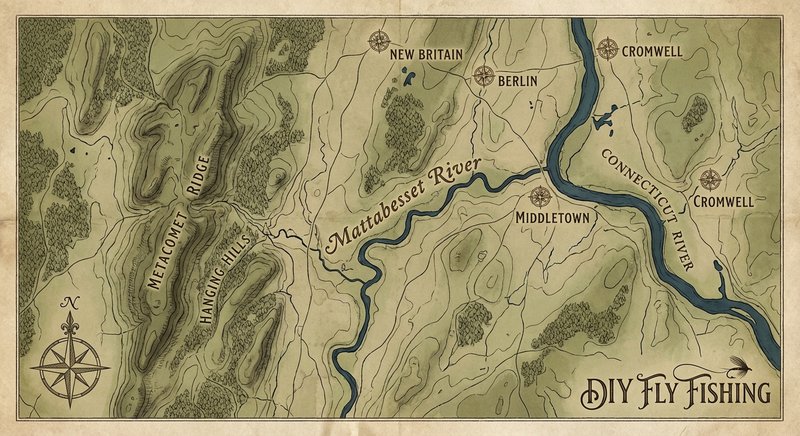
Mattabesset River
Fly fishing in Connecticut · Beginner · Best seasons: Spring, Fall
Target Species
Brown Trout, Rainbow Trout
About This Water
Hartford County stream with trout. Suburban fishing near Hartford.
Fishing Recommendations
The Mattabesset River is a unique and often overlooked gem in Central Connecticut. While many anglers flock to the Farmington or the Housatonic, the Mattabesset offers a more intimate, "neighborhood" fishing experience. It winds through Hartford and Middlesex counties, transitioning from a narrow stream to a broader, slower-moving river before joining the Connecticut River.
Here is your comprehensive guide to fly fishing the Mattabesset.
🎣 Location Overview
The Mattabesset is a "lowland" river. Unlike the rocky, high-gradient streams of the Berkshires, the Mattabesset is characterized by sandy bottoms, deep undercut banks, and sections of slow, meandering water interspersed with gravelly riffles.
What makes it special is its accessibility and the "urban wild" feel. It flows through suburban landscapes, yet maintains surprisingly good pocket water and deep pools that hold fish. It is primarily a "put-and-take" fishery stocked by the CT DEEP (Department of Energy and Environmental Protection), though some holdover fish can be found in the deeper, cooler holes during mild years.
🐟 Target Species & Behavior
- Rainbow Trout: These are the primary targets in the spring. They tend to be aggressive and will hold in the faster-moving riffles and at the "heads" of pools where oxygen levels are higher.
- Brown Trout: Browns in the Mattabesset are more secretive. They prefer the "tail-outs" of pools, under hanging brush, or tight against the undercut banks. As the water warms, they move into the deepest shadows they can find.
- Secondary Species: You will likely encounter Fallfish (which can be quite large and fun on a dry fly) and the occasional Smallmouth Bass in the lower reaches as the river nears the Coginchaug confluence.
📅 Best Times to Fish
The Mattabesset is a seasonal fishery. Because it is a lowland river, it warms up significantly in the summer, making trout fishing unethical and unproductive from July through August.
- Spring (April – Early June): This is the prime window. Following the spring stockings, the river is teeming with fish. The water levels are usually high, and the fish are hungry.
- Fall (Late September – November): The state often performs a secondary stocking in the fall. As temperatures drop, the remaining fish become active again.
- Time of Day: In the spring, midday is excellent as the sun warms the water slightly, triggering insect activity. In the fall, focus on the late afternoon "golden hour."
🪰 Recommended Flies & Techniques
Top Fly Patterns
- Nymphs:
- Pheasant Tail (Size 14-18): A staple for mimicking the small mayfly nymphs found here.
- Hare’s Ear (Size 12-16): Great for the murkier water often found after rain.
- Zebra Midge (Size 18-22): Essential for when the fish are being finicky in slower pools.
- Dry Flies:
- Elk Hair Caddis (Size 14-16): The go-to during the late afternoon caddis hatches.
- Adams (Size 16): The best general imitation for the various mayflies.
- Streamers:
- Woolly Bugger (Black or Olive, Size 8-10): Extremely effective in the Mattabesset’s deeper holes, especially for aggressive Rainbows.
Techniques & Presentation
- Indicator Nymphing: This is the most productive method. Use a light indicator and enough split shot to get your fly near the bottom. The Mattabesset has many "micro-seams"—pay close attention to where slow water meets fast water.
- Swinging Streamers: Because of the undercut banks, swinging a streamer across the current and letting it "hang" near the bank can entice a territorial Brown trout.
- The "Stealth" Dry Fly: The water can be glassy in the pools. Use a long leader (9ft to 12ft) and 5x or 6x tippet to avoid spooking fish in the slower sections.
💡 Pro Tips & Local Knowledge
- Focus on the Berlin/New Britain Stretch: The sections near the Berlin Turnpike and downstream through Cromwell offer some of the best-stocked water. Look for bridge abutments; these create deep scours that hold fish all season.
- Read the Bubbles: In the slower sections, look for "bubble lines." These lines indicate the conveyor belt of food. If you find a bubble line moving toward a downed log, that is your target.
- The "Post-Rain" Window: The Mattabesset can get slightly turbid (cloudy) after a rain. Don't let this discourage you. This is the best time to throw larger, dark-colored streamers. The fish feel more secure in the cloudy water and are more likely to strike.
- Check the Flow: Always check the USGS gauge for the Mattabesset. If it’s spiking, the river can become dangerous and unfishable quickly due to its suburban runoff.
⚠️ Important Information
- Access: Much of the river runs through private property or behind commercial zones. Always look for DEEP "Public Fishing Area" signs. Popular access points include areas near Route 372 and various park-and-ride or trail crossings in Berlin.
- Regulations: The Mattabesset is subject to standard Connecticut inland fishing regulations. You must have a Connecticut Fishing License and a Trout & Salmon Stamp.
- Wading Safety: The bottom is often sandy but can be silty and "mucky." Be careful not to get stuck in deep silt, and watch for submerged shopping carts or debris—a common hazard in suburban rivers.
- Catch and Release: While many anglers keep their limit, we highly recommend catch and release for any fish that appear to have "held over" from the previous season to help maintain the population.
Tight lines, and enjoy the unique charm of the Mattabesset!
Bug Hatches & Matching Flies
| Hatch | Type | Peak months | Time of day | Hook sizes | Matching flies |
|---|---|---|---|---|---|
| Blue-Winged Olive Baetis | mayfly | April, May, September, October | Midday | #18-22 | RS2 #20-22, BWO Parachute #18-22 |
| Grannom Caddis Brachycentrus | caddis | April, May | Morning/Afternoon | #14-16 | Peacock Caddis #14-16, Deep Sparkle Pupa #14-16 |
| Sulphur Ephemerella invaria/dorothea | mayfly | May, June | Evening | #14-18 | Sulphur Parachute #16-18, Pheasant Tail #14-18 |
| Spotted Sedge Hydropsyche | caddis | May, June, July, August | Evening | #14-18 | Elk Hair Caddis (Tan) #14-18, LaFontaine's Emerger #16 |
| Light Cahill Stenacron interpunctatum | mayfly | June, July | Late Evening | #12-14 | Light Cahill #12-14, Hare's Ear #12-14 |
| Trico Tricorythodes | mayfly | July, August, September | Early Morning | #22-26 | Trico Spinner #22-24, Zebra Midge #22 |
| Ants and Beetles Formicidae/Coleoptera | terrestrial | July, August, September | All Day | #12-18 | Black Foam Ant #16-18, Crowe Beetle #14-16 |
| Common Midge Chironomidae | midge | January, February, March, December | Midday | #18-24 | Griffith's Gnat #18-22, Black Beauty #20-24 |
| White Miller Ephoron leukon | mayfly | August | Late Evening | #12-14 | White Wulff #12-14, White Miller Parachute #14 |