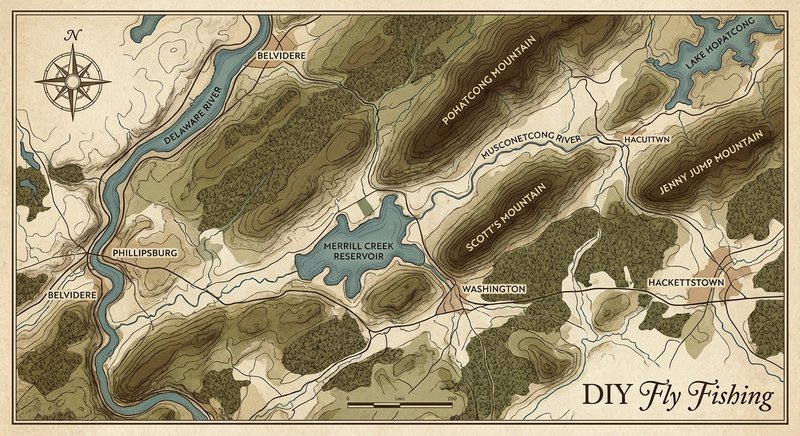
Merrill Creek Reservoir
Fly fishing in New Jersey · intermediate · Best seasons: spring, fall, winter
Target Species
Brown Trout, Rainbow Trout, Lake Trout
About This Water
Warren County reservoir with trophy potential. Cold, deep water supports trout year-round.
Fishing Recommendations
Merrill Creek Reservoir is a crown jewel of New Jersey angling. Located in Warren County, this 650-acre man-made reservoir is unique because of its incredible depth (over 200 feet) and its status as a cold-water refuge. It is one of the few places in the Mid-Atlantic where you can target self-sustaining populations of Lake Trout in a tranquil, "electric-motors-only" environment.
As a guide, I look at Merrill Creek as a "mini-Great Lake." It’s clear, deep, and requires a technical approach to reach the fish, but the rewards are some of the heaviest trout in the state.
🎣 Location Overview
Merrill Creek is an oligotrophic (low nutrient, high oxygen) reservoir designed to provide replacement water for power plants during droughts. Because of its depth and water quality, it stays cold year-round.
What makes it special is the peace and quiet. Gas motors are strictly prohibited, meaning you won't be fighting wake from jet skis or bass boats. For the fly angler, it offers a serene, almost wilderness-like experience. The shoreline is rugged and forested, with steep drop-offs that allow trout to cruise surprisingly close to the banks during the cooler months.
🐟 Target Species & Behavior
- Lake Trout (Lakers): These are the kings of the reservoir. They are wild-spawned and favor the deepest, coldest layers. In the spring and fall, they move into the 10–30 foot range. They are piscivorous, primarily targeting Alewives.
- Brown Trout: Known for being elusive and "smart," the Browns here grow large by foraging on baitfish. They often patrol the rocky shorelines and submerged timber.
- Rainbow Trout: These are frequently stocked and tend to be more opportunistic. You’ll find them higher in the water column than the Lakers, often rising for midge hatches on calm winter or spring mornings.
- Behavior: Most fish here are "pelagic," meaning they follow the schools of alewives. If you find the bait on your fishfinder, the trout are nearby.
📅 Best Times to Fish
- Spring (April – Early June): This is the prime window. As the ice melts and the water warms slightly, trout move into the shallows. You can catch them within 15 feet of the surface.
- Fall (October – November): Lake Trout move toward the rocky shoals and the dam face to spawn. This is your best chance to hook a trophy Laker on a fly rod.
- Winter (December – March): As long as the reservoir isn't frozen, the "winter's bite" is excellent. The trout are comfortable at all depths because the water temperature is uniform.
- Time of Day: Light penetration is high in this clear water. First light and the last 90 minutes of sunset are the "golden hours." Overcast, drizzly days are significantly more productive than bright, sunny days.
🪰 Recommended Flies & Techniques
Streamer Fishing (Top Producer)
Since the primary forage is Alewives, large, silver/white streamers are a must.
- Patterns: Game Changers (White/Pearl), Clouser Minnows (Blue/White), Sex Dungeon (White or Olive), and Zonkers.
- Technique: Use a Type 5 or Type 7 sinking line. Cast toward the shore or over submerged points, let it sink for 10–20 seconds, and use a fast, erratic strip to mimic a wounded baitfish.
Nymphing & Midges
- Patterns: Zebra Midges (#18-22), Brassies, and Griffith’s Gnats.
- Technique: On calm winter or early spring days, you will see Rainbows dimpling the surface. Use a long leader (12–15 feet) and a 5-weight rod. Suspend a midge 3–5 feet under a small indicator or fish a dry-drop rig.
The "Booby Fly" Technique
- Pattern: Booby Fly (a fly with large foam eyes).
- Technique: Use a heavy sinking line and a very short leader (2 feet). The heavy line sits on the bottom, but the buoyant fly hovers just above the rocks. This is deadly for Lake Trout sitting on the bottom in 20–30 feet of water.
💡 Pro Tips & Local Knowledge
- The Dam Face: The rip-rap (large rocks) along the dam is a magnet for fish. It holds crawfish and provides structure for spawning Lakers in the fall.
- The "Inlet" Area: Watch the water levels; when water is being pumped in, the oxygen and movement attract active feeders.
- Wind is your Friend: A slight chop on the water breaks up the light and makes the fish less spooky. If the water is glass-calm, you must use longer, thinner leaders (6x or 7x for midges).
- Shore Access: While a boat/kayak is best, there is a trail around the reservoir. Focus on the steep points where the water drops off quickly into 40+ feet. If you can reach that drop-off with a cast, you're in the game.
⚠️ Important Information
- Permits: You need a valid New Jersey Fishing License and a Trout Stamp.
- Boating: Electric motors only. There is a well-maintained boat ramp. Note that Merrill Creek has strict hours (usually sunrise to sunset); check the gate times at the visitor center.
- Wading: Be careful. The banks are steep and the bottom can be slippery and drop off instantly.
- Catch & Release: While there are keeper sizes, the Lake Trout population is a fragile resource. Practicing catch and release, especially for the larger "breeders," is highly encouraged by the local community.
- Check the Weather: Because it sits on a ridge, Merrill Creek can get very windy very fast. A small electric-powered boat can struggle if the wind kicks up from the Northwest.
Guide’s Final Word: Bring your heaviest sinking lines and your biggest white streamers. Merrill Creek is a game of patience, but when that line goes tight, it’s often the fish of a lifetime.
Bug Hatches & Matching Flies
| Hatch | Type | Peak months | Time of day | Hook sizes | Matching flies |
|---|---|---|---|---|---|
| Chironomids (Midges) Chironomidae | midge | March, April, October, November | All Day | #18-24 | Zebra Midge #18-22, Griffith's Gnat #20-24, Palomino Midge #20-22 |
| Damselflies Enallagma spp. | terrestrial | June, July, August | Morning/Afternoon | #10-14 | Marabou Damselfly Nymph #10-12, Adult Damsel #12-14 |
| Light Cahill Stenacron canadense | mayfly | May, June | Evening | #12-16 | Light Cahill #12-16, Gold Ribbed Hare's Ear #14-16 |
| Cinnamon Caddis Hydropsyche spp. | caddis | June, July, August | Evening/Night | #14-18 | Elk Hair Caddis (Tan) #14-18, LaFontaine's Deep Sparkle Pupa #14-16 |
| Black Carpenter Ants Camponotus pennsylvanicus | terrestrial | May, June, August | Afternoon | #12-16 | Black Foam Ant #12-16, Chernobyl Ant #10-14 |
| Scuds Gammarus pseudolimnaeus | crustacean | April, May, September, October | All Day | #14-18 | Ray Charles #14-18, Olive Scud #14-16 |
| Japanese Beetles Popillia japonica | terrestrial | July, August | Afternoon | #12-14 | Coffee's Sparkle Beetle #12-14, Foam Beetle #12-14 |
| White Mayfly (White Curse) Ephoron leukon | mayfly | August, September | Late Evening | #12-14 | White Wulff #12-14, Ephoron Spinner #12-14 |