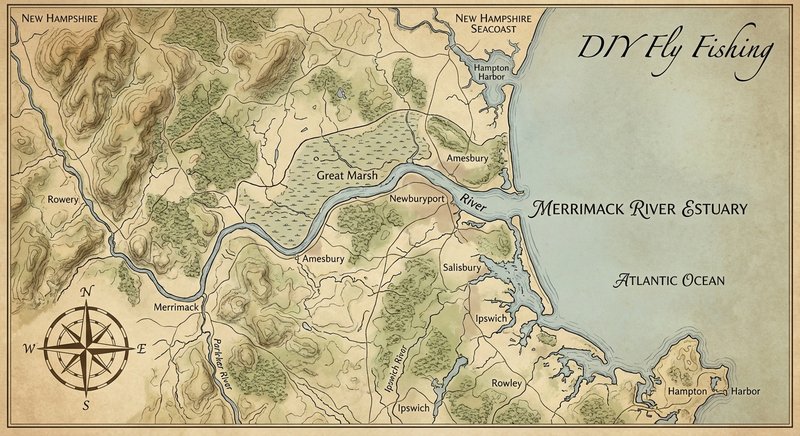
Merrimack River Estuary
Fly fishing in Massachusetts · Intermediate · Best seasons: Spring, Summer, Fall
Target Species
Striped Bass, Bluefish, American Shad
About This Water
Newburyport area with striped bass. Plum Island access.
Fishing Recommendations
Tighten your drag and check your knots—you’re heading to one of the most dynamic and productive saltwater fly fishing destinations in the Northeast. The Merrimack River Estuary, where the massive freshwater output of the Merrimack meets the Atlantic Ocean at Newburyport and Salisbury, is a "fish factory" fueled by immense tidal movement and a staggering amount of bait.
Here is your guide to mastering the Merrimack Estuary.
🎣 Location Overview
The Merrimack River Estuary is defined by its power. Draining a massive watershed, the river pushes a tremendous volume of water through a narrow mouth guarded by two stone jetties. What makes this area legendary is Joppa Flats—a vast, shallow expanse of eelgrass and mudflats that floods with the tide, creating a massive dining room for predators.
Anglers love it because it offers two distinct experiences: "The Mouth," which is heavy-water, big-game fishing with fast sinking lines, and "The Flats," which offers some of the best shallow-water sight-casting for Striped Bass in New England. The 8-to-10-foot tidal range means the landscape changes hourly, keeping the fishing fast-paced and technical.
🐟 Target Species & Behavior
Striped Bass (Stripers)
The star of the show.
- Behavior: They move in with the tide to forage on the flats and retreat to the deep river channels or the ocean as the tide drops.
- Feeding: They focus on "Sand Eels" (the primary forage here), silversides, river herring, and green crabs. On the flats, they "tail" like redfish or cruise in mere inches of water.
American Shad
Known as the "Poor Man's Salmon," these are a rite of spring.
- Behavior: They enter the river in massive schools to spawn in freshwater. They don't feed much once in the river, but they strike out of aggression or instinct.
- Holding: They hug the bottom in deep runs and eddies where the current is slightly broken.
Bluefish
The "Yellow-eyed Devils" usually arrive when the water warms in mid-summer.
- Behavior: Highly aggressive and nomadic. They often surface-feed in the "washing machine" of the river mouth.
- Feeding: Anything that moves. They will shred expensive fly lines and flies, so wire bite tippet is mandatory.
📅 Best Times to Fish
- Spring (May - June):
- May: The Shad run peaks (mid-May).
- Late May/June: The "Fresh" Stripers arrive. This is the prime window for big "cows" chasing river herring.
- Summer (July - August): Best for Joppa Flats sight-fishing on early morning flood tides. Bluefish become more prevalent in the mouth and just offshore.
- Fall (September - October): The "Fall Run." Fish are migrating south and feeding heavily. This is when you’ll see massive "blitzes" at the mouth of the river.
The "Magic" Window: The incoming tide is generally preferred for the flats (bringing cool, clear ocean water). However, the outgoing tide at the river mouth creates a "bait buffet" as everything is flushed out of the estuary. Low light (dawn/dusk) is critical for shallow water success.
🪰 Recommended Flies & Techniques
For Striped Bass
- Flies:
- The Sand Eel Special: Mushmouths, Jiggies, and Flatwings in olive/white or chartreuse/white (size 1/0–3/0).
- The Flats: Clouser Minnows (chartreuse/white) and Crab patterns for tailing fish.
- Topwater: Bob’s Banger or Gurgler (especially at dawn).
- Technique: On Joppa Flats, use a floating line and long leaders (9-12 ft). In the main river channel or the Mouth, you need a fast-sinking integrated line (250-400 grain) to get the fly down 10-20 feet in the heavy current.
For American Shad
- Flies: "Shad Darts" or small, flashy weighted flies (size 4-8) in pink/white, orange/chartreuse, or gold.
- Technique: Use a sink-tip line. Cast across and slightly upstream, let it sink deep, and use a "swing" technique similar to steelhead fishing. A slow, rhythmic strip at the end of the swing often triggers a strike.
For Bluefish
- Flies: Large, durable Deceivers or Poppers.
- Technique: Fast, erratic retrieves. If you see a "blitz," cast into the edges of the white water. Use 30lb wire leader or you will lose your fly on the first hit.
💡 Pro Tips & Local Knowledge
- The "Joppa Shuffle": If wading the flats, shuffle your feet to avoid stepping on stingrays (rare but present) and to avoid getting stuck in soft mud.
- The Mouth is Dangerous: The current at the Merrimack mouth is no joke. If you are in a boat or kayak, be extremely wary of the "standing waves" that occur when an outgoing tide meets an onshore wind. Many boats have been flipped here.
- Find the "Drop": As the tide drains off Joppa Flats, fish the small channels or "guts" where the water pours back into the main river. Bass will station there like trout in a stream, waiting for a conveyor belt of bait.
- Night Fishing: Many local experts only fish at night. Stripers lose their spookiness and move into very shallow water near the bridge pilings (Route 1 and I-95 bridges).
⚠️ Important Information
- Access:
- Cashman Park (Newburyport): Great boat ramp and public pier.
- Plum Island (Salisbury/Newbury): Public beaches offer excellent surf casting near the jetties.
- Deer Island: Located under the Chain Bridge, this offers good shore access for Shad in the spring.
- Regulations:
- A Massachusetts Saltwater Fishing Permit is required for Stripers and Blues.
- Striped Bass are highly regulated (currently a narrow "slot limit" for keepers). Most fly anglers practice 100% catch and release.
- Gear Note: Use an 8-weight or 9-weight rod for general use. If you are targeting big fish at the Mouth with heavy sinking lines, a 10-weight is not overkill. Always rinse your gear with freshwater; the Merrimack is high-salinity and will corrode reels quickly.
Guide’s Final Word: The Merrimack is a "thinking man's" fishery. Don't just cast blindly—watch the birds, watch the tide, and match the size of your fly to the sand eels. Do that, and you'll have a career day on the water.
Bug Hatches & Matching Flies
| Hatch | Type | Peak months | Time of day | Hook sizes | Matching flies |
|---|---|---|---|---|---|
| Cinder Worm Alitta succinea | terrestrial | May, June | Late Afternoon/Evening | #2-6 (long) | V-Rib Cinder Worm #4-6, Gamechanger Worm #2-4 |
| Blue Winged Olive Baetis spp. | mayfly | April, May, September, October | Midday | #18-22 | RS2 #20-22, Parachute Adams #18-22 |
| Spotted Sedge Hydropsyche | caddis | June, July | Evening | #14-16 | Elk Hair Caddis #14-16, Pupa Sparkle Caddis #14-16 |
| Midge Chironomidae | midge | March, April, October, November | Morning/Afternoon | #20-24 | Zebra Midge #20-24, Griffith's Gnat #20-22 |
| Grass Shrimp Palaemonetes pugio | terrestrial | June, July, August | All Day | #4-8 | Razzle Dazzle Shrimp #6-8, EP Grass Shrimp #4-6 |
| Trico Tricorythodes | mayfly | July, August, September | Early Morning | #22-26 | Trico Spinner #22-24, Trico Emerger #22-26 |
| March Brown Maccaffertium vicarium | mayfly | May, June | Afternoon | #10-12 | March Brown Wet Fly #10-12, March Brown Parachute #10-12 |
| Salt Marsh Mosquito Aedes sollicitans | terrestrial | July, August | Evening | #18-22 | Mosquito #18-22 |