Metedeconk River
Fly fishing in New Jersey · beginner · Best seasons: spring
Target Species
Rainbow Trout, Brown Trout
About This Water
Ocean County stream with spring trout stocking. Easy access through local parks.
Fishing Recommendations
As an expert guide who has spent plenty of time navigating the unique tea-colored waters of the Garden State, I can tell you that the Metedeconk River is one of the most interesting "coastal plain" trout fisheries in the Northeast.
While New Jersey is famous for the rocky freestone streams of the north (like the Musconetcong or Ken Lockwood Gorge), the Metedeconk offers a completely different experience. It is a lowland, sandy-bottomed river influenced by the Pine Barrens, offering a technical but rewarding challenge for the fly angler.
🎣 Location Overview
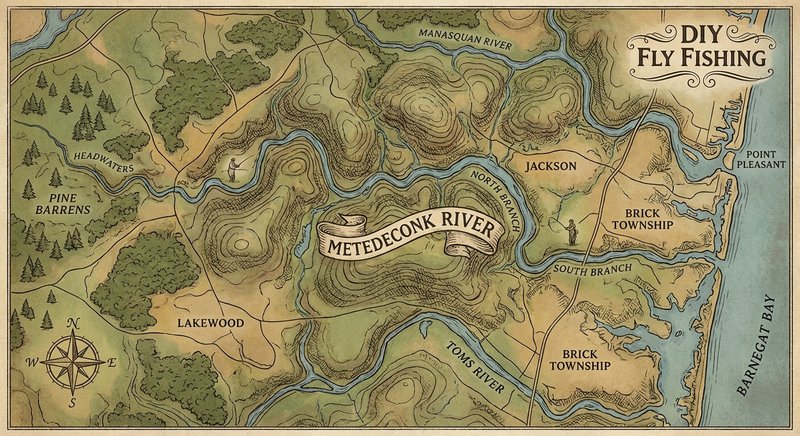
The Metedeconk River, specifically the North Branch, is a hidden gem located in Ocean County near Lakewood and Howell. What makes this river special is its "tannic" water—a tea-colored hue caused by dissolved organic matter from the surrounding pine forests and wetlands.
The river is characterized by a low gradient, sandy substrate, and an abundance of "woody debris" (fallen logs and sweepers). Unlike mountain streams with boulders and pocket water, the Metedeconk relies on undercut banks and deep outside bends for structure. It feels intimate, quiet, and surprisingly wild despite being located in a suburban corridor.
🐟 Target Species & Behavior
The Metedeconk is primarily a stocked fishery, but it features a Year-Round Trout Conservation Area (TCA) where fish have a chance to hold over and become "wilder" in their behavior.
- Rainbow Trout: These are the primary targets following the spring stocking. They tend to hold in the swifter sections of the runs and are generally more aggressive toward bright flies.
- Brown Trout: The "kings" of the Metedeconk. Browns love the tannic water and the heavy overhead cover provided by fallen timber. They are notorious for tucking deep under banks during the day and coming out to hunt during low-light conditions.
- Behavior: Because the bottom is sandy, there isn't much "perch" space. Fish will hold almost exclusively near wood or in the deeper "holes" carved out by the current in river bends.
📅 Best Times to Fish
Optimal Seasons
- Spring (April – June): This is the undisputed prime time. The NJ Division of Fish and Wildlife stocks heavily starting in April. The water temperatures stay cool enough for active feeding through mid-June.
- Best Time of Day:
- Early Morning: Best for streamer fishing and targeting those wary brown trout.
- Late Afternoon/Dusk: This is when the classic spring hatches occur, and the surface action picks up.
Prime Windows
Watch the USGS gauges. After a light rain, the water gets slightly darker, but not muddy. This is the perfect "stealth" window where the trout feel comfortable moving out from under the logs to feed.
🪰 Recommended Flies & Techniques
Top Fly Patterns
- Dry Flies:
- Hendrickson (Sizes 12-14): Late April.
- Sulphurs (Sizes 16-18): Throughout May.
- Elk Hair Caddis (Tan/Olive, Sizes 14-16): A staple for the Metedeconk.
- Nymphs:
- Bead-head Pheasant Tail (Sizes 14-18): Mimics almost anything in the drift.
- Gold-Ribbed Hare’s Ear: Works exceptionally well in the darker, tannic water.
- Squirmy Wormies/Mop Flies: Don't be a purist—after a spring rain, these are deadly here.
- Streamers:
- Black or Olive Woolly Buggers (Sizes 8-10): The dark silhouette stands out perfectly against the tea-colored water.
Effective Techniques
- The "Wood-Poking" Nymph Drift: In a sandy river, insects live on the logs. Drift your nymph as close to submerged wood as possible without snagging.
- Streamer Stripping: Cast your streamer across to the opposite bank, let it sink into the undercut, and strip it back aggressively.
- Dapping: The banks are often overgrown. Sometimes the best "cast" is simply poking your rod through the brush and dropping a fly onto the surface.
💡 Pro Tips & Local Knowledge
- The "TCA" Stretch: Focus your efforts on the Trout Conservation Area located in the Pine Park/Georgia Wright area. This stretch has gear restrictions (artificial lures/flies only) which keeps the fish population higher and the pressure slightly more manageable.
- Stealth is Key: Because the river is sandy and often slow-moving, trout are very sensitive to vibrations. Wade slowly and try to stay out of the water whenever possible.
- Polarized Glasses are Mandatory: The tannic water makes it hard to see the bottom. Amber or copper-colored polarized lenses are best for "cutting" through the tea-colored tint to spot submerged logs and holding fish.
- Watch for "Suckers": In the spring, you will see large White Suckers spawning. Trout will often sit directly behind them to pick up stray eggs or disturbed nymphs.
⚠️ Important Information
- Regulations: Ensure you have a valid New Jersey Fishing License and a Trout Stamp.
- TCA Rules: In the Trout Conservation Area (North Branch), there is a daily limit of one fish (minimum 15 inches) during most of the year, but it is catch-and-release only during the spring pre-stocking period. Always check the current NJ Freshwater Fishing Digest.
- Access: Key access points include Bennett's Mills Road and the Pine Park area in Lakewood. Be respectful of private property borders, as the river weaves through residential areas.
- Ticks & Mud: The banks of the Metedeconk can be incredibly muddy, and the Jersey Shore area is "Tick Central" in the spring. Wear high-quality waders and use Permethrin on your gear.
The Metedeconk isn't a river that gives up its secrets easily, but for the angler who learns to read the wood and the sand, it offers some of the most rewarding fly fishing in Southern New Jersey. Tight lines!
Bug Hatches & Matching Flies
| Hatch | Type | Peak months | Time of day | Hook sizes | Matching flies |
|---|---|---|---|---|---|
| Blue Winged Olive Baetis spp. | mayfly | April, May, September, October | Mid-day/Afternoon | #18-22 | RS2 #20-22, BWO Sparkle Dun #18-20, Pheasant Tail #18-20 |
| Hendrickson Ephemerella subvaria | mayfly | April, May | Afternoon | #12-14 | Hendrickson Parachute #12-14, Red Quill #14, Hendrickson Wet Fly #12-14 |
| Grannom Caddis Brachycentrus | caddis | April | Morning/Afternoon | #14-16 | LaFontaine's Deep Sparkle Pupa #14-16, Elk Hair Caddis (Dark) #14-16, Peacock Caddis #16 |
| Sulphur Ephemerella invaria/dorothea | mayfly | May, June | Evening | #14-18 | Sulphur Parachute #16-18, Sulphur Emerger #14-16, Pheasant Tail #16-18 |
| Light Cahill Stenacron canadense | mayfly | June, July | Evening/Dusk | #12-14 | Light Cahill Dry #12-14, Cream Usual #14, Gold Ribbed Hare's Ear #12-14 |
| Tan Caddis Hydropsyche | caddis | May, June, September | Evening | #14-16 | Elk Hair Caddis (Tan) #14-16, Soft Hackle Hare's Ear #14-16, Green Weenie #14-16 |
| Trico Tricorythodes spp. | mayfly | July, August | Early Morning | #22-26 | Trico Spinner #22-24, Griffith's Gnat #22-24 |
| Midges Chironomidae | midge | January, February, March, December | Mid-day | #18-24 | Zebra Midge #18-22, Morgan's Midge #20-22, Mercury Midge #20-24 |
| Terrestrials Formicidae / Coleoptera | terrestrial | July, August, September | All Day | #12-18 | Black Foam Beetle #14-16, Cinnamon Ant #16-18, Dave's Hopper #12 |