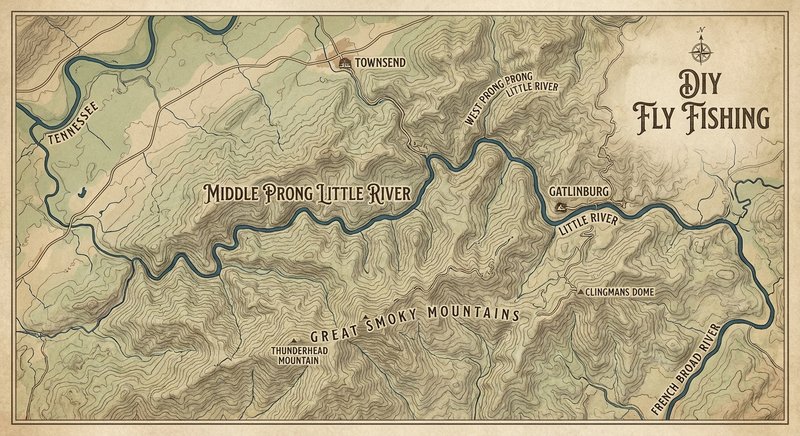
Middle Prong Little River
Fly fishing in Tennessee · Intermediate · Best seasons: Spring, Summer, Fall
Target Species
Rainbow Trout, Brown Trout
About This Water
Tremont area stream with wild trout. Popular but quality fishing in the Smokies.
Fishing Recommendations
Welcome to the Great Smoky Mountains National Park (GSMNP). As your guide, I can tell you that the Middle Prong of the Little River—locally known as "Tremont"—is widely considered one of the finest wild trout streams in the Eastern United States.
The Middle Prong is famous for its "stair-step" pool-and-drop gradient and its incredible accessibility. It offers some of the most classic "mountain brook" fly fishing scenery you will ever encounter.
🎣 Location Overview
The Middle Prong is formed by the confluence of Lynn Camp Prong and Thunderhead Prong at the Tremont Institute. This is a high-gradient, freestone stream characterized by large boulders, plunging waterfalls, and crystal-clear "Smoky Mountain Gin" water.
What makes it special is the biomass. Because of the limestone influence in some of its headwaters, the Middle Prong is more fertile than many other acidic streams in the park. This leads to higher fish counts per mile. It is a quintessential pocket-water fishery where you are rarely more than ten feet away from a potential trout lie.
🐟 Target Species & Behavior
- Rainbow Trout: The dominant species. They are wild, vibrant, and incredibly opportunistic. In the Middle Prong, they are "fast-water" fish. They hold in the "cushion" in front of rocks, in the seams of pocket water, and at the heads of pools.
- Brown Trout: More elusive and found primarily in the lower sections (below the Tremont Institute) and in the deeper, darker undercut banks or beneath large boulders. They are most active during low-light conditions or after a heavy rain.
- Southern Appalachian Brook Trout: While your focus is Rainbows and Browns, if you hike high enough into the Lynn Camp Prong (the headwaters), you will find the native "spec" or Brookie.
Behavior: These fish are wild, not stocked. They are wary of shadows and vibrations but aggressive toward food. Because the water is nutrient-poor compared to a spring creek, they cannot afford to let a meal pass by.
📅 Best Times to Fish
Optimal Seasons
- Spring (March – June): This is the "Golden Era." As water temps hit 50-55°F, the hatches begin. April is arguably the best month of the year for dry fly action.
- Summer (July – August): Great fishing, but you must go early or late. Focus on the higher elevations where the canopy provides shade and the water stays cooler. Terrestrial fishing (beetles/ants) is peak now.
- Fall (September – November): The Brown trout become aggressive as they prepare for the spawn. The cooling water reinvigorates the Rainbows. The colors of the Smokies make this the most scenic time to be on the water.
Best Times of Day
- Spring/Fall: 10:00 AM – 4:00 PM (Waiting for the water to warm slightly).
- Summer: Dawn until 11:00 AM, then again from 6:00 PM until dark.
🪰 Recommended Flies & Techniques
Top Fly Patterns
- Dry Flies:
- Yellow Stimulator (Size 14-16) - The "go-to" attractor.
- Parachute Adams (Size 14-18) - Mimics almost any mayfly.
- Yellow Hammer - A local traditional pattern that is deadly here.
- Elk Hair Caddis (Tan/Olive, Size 14-16).
- Nymphs:
- Pheasant Tail (Size 16-18) - Gold ribbed.
- Prince Nymph (Size 14-16) - Great for the faster runs.
- Green Weenie - A Smoky Mountain staple (mimics a sawfly larva).
- Terrestrials:
- Black Foam Ants and Beetles (Size 16-18) during July and August.
Effective Techniques
- Dry-Dropper: This is the most effective way to fish the Middle Prong. Hang a small weighted nymph 18–24 inches below a buoyant dry fly (like a Stimulator).
- High-Sticking: Due to the complex currents and boulders, long casts are your enemy. Keep as much fly line off the water as possible to avoid drag.
- Tight-Line Nymphing: In the deeper plunge pools, stripping away the indicator and feeling for the "tick" is highly effective.
💡 Pro Tips & Local Knowledge
- Sneak and Peek: The water is exceptionally clear. If you can see the fish, they have likely already seen you. Wear earthy tones (greens/browns), stay low, and always fish upstream.
- Focus on the "Bubble Line": Food travels down the bubbles. If your fly isn't in the bubbles, it’s not in the "kitchen."
- The "One-Cast" Rule: In pocket water, if you don't get a hit in the first three good drifts, move to the next pocket. These fish decide instantly.
- Upper Tremont Road: The gravel road follows the river for miles. This allows you to "spot" water from the road, but the best fishing is often a 5-minute scramble down the bank away from the most obvious pull-outs.
⚠️ Important Information
- Permits: You need a valid Tennessee or North Carolina state fishing license. No special trout stamp is required within the National Park boundaries.
- Regulations: Single hook, artificial lures only. No bait is permitted. There is a 7-inch minimum size limit for keeping trout, though most anglers here practice 100% catch and release to preserve the wild strains.
- Safety: The rocks in the Middle Prong are notoriously "greasy." Felt-soled boots or studs are highly recommended. Watch for falling water levels in late summer and sudden "flashiness" during heavy thunderstorms.
- Wildlife: This is prime Black Bear habitat. Keep your snacks sealed and be aware of your surroundings, especially when fishing alone in the backcountry stretches.
Guide's Final Word: The Middle Prong isn't about trophy size; it's about the purity of the pursuit. You are casting to wild fish in one of the oldest mountain ranges on earth. Slow down, watch the water, and enjoy the rhythm of the Smokies.
Bug Hatches & Matching Flies
| Hatch | Type | Peak months | Time of day | Hook sizes | Matching flies |
|---|---|---|---|---|---|
| Quill Gordon Epeorus pleuralis | mayfly | February, March | Mid-day | #12-14 | Quill Gordon Dry #12-14, Quill Gordon Nymph #12-14 |
| Blue Quill Paraleptophlebia | mayfly | March, April | Mid-day to Afternoon | #16-18 | Blue Quill Dry #16-18, Parachute Adams #16-18 |
| March Brown Maccaffertium vicarium | mayfly | April, May | Afternoon | #10-14 | March Brown Dry #10-12, Hare's Ear Nymph #12-14 |
| Yellow Sally Isoperla | stonefly | May, June, July | Late Afternoon/Evening | #14-16 | Yellow Stimulator #14-16, Little Yellow Stone Nymph #14-16 |
| Cinnamon Caddis Hydropsyche | caddis | May, June, August | Evening | #14-18 | Elk Hair Caddis (Tan) #14-16, Holy Grail Caddis #14-16 |
| Light Cahill Stenacron / Stenonema | mayfly | June, July | Evening | #12-14 | Light Cahill Dry #12-14, Cream Variant #14 |
| Blue Winged Olive Baetis | mayfly | March, October, November | Mid-day/Overcast days | #18-22 | BWO Sparkle Dun #18-20, Pheasant Tail (Soft Hackle) #18-20 |
| Golden Stonefly Acroneuria | stonefly | June, July | Evening/Night | #6-10 | Golden Stone Nymph #8-10, Golden Stimulator #8-12 |
| Terrestrials (Ants and Beetles) Formicidae / Coleoptera | terrestrial | July, August, September | All day | #12-18 | Black Foam Beetle #14-16, Cinnamon Flying Ant #16-18 |