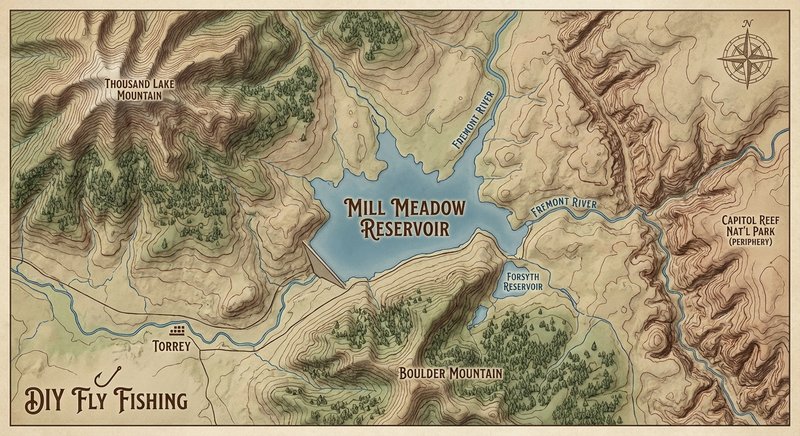
Mill Meadow Reservoir
Fly fishing in Utah · Beginner · Best seasons: Summer, Fall
Target Species
Rainbow Trout, Brown Trout
About This Water
Small reservoir near Fremont River. Rainbow trout in scenic setting.
Fishing Recommendations
Mill Meadow Reservoir is one of central Utah’s most consistent "sleeper" fisheries. Located at an elevation of approximately 7,700 feet in the Fishlake National Forest, it sits just downstream from Forsyth Reservoir and serves as a vital catchment for the Fremont River. While many anglers bypass it on their way to the more famous Fish Lake, those in the know find Mill Meadow to be a productive, scenic, and technically rewarding destination for high-country trout.
🎣 Location Overview
Mill Meadow Reservoir is a classic mountain impoundment characterized by its crystal-clear water and stunning backdrop of red rock cliffs and alpine timber. It is primarily fed by the Fremont River, which brings in cold, oxygenated water and a steady supply of nutrients.
What makes Mill Meadow special is its dual nature: it offers both the accessibility of a reservoir and the technical challenge of a tailwater-style ecosystem. The reservoir is deep enough to stay cool through the summer, yet shallow enough around the margins to support massive insect life. Anglers love it because it produces remarkably healthy, hard-fighting fish that are often more willing to take a fly than their cousins in the more pressured waters of the Wasatch Front.
🐟 Target Species & Behavior
The reservoir is primarily managed for Rainbow Trout and Brown Trout, though you may occasionally encounter Splake or Yellow Perch.
- Rainbow Trout: These are the most common residents. They tend to cruise the mid-water columns in schools. During the summer, they hover near the thermocline but will move into the shallows during the "magic hour" of dusk to feed on midge or mayfly hatches.
- Brown Trout: The "kings" of Mill Meadow. These fish are more solitary and territorial. They are often found near structure—submerged boulders, the dam face, or the old river channel. In the fall, they become highly aggressive as they prepare to move toward the Fremont River inlet to spawn. They are piscivorous (fish-eaters) once they reach 14+ inches.
📅 Best Times to Fish
Optimal Seasons
- Summer (Late June – August): This is the time for dry fly enthusiasts. The water temperature is perfect, and the hatches are consistent.
- Fall (September – early November): This is arguably the trophy season. As the water cools, the large Browns move into the shallows and toward the inlet. The crowds thin out, and the fish feed heavily before winter.
Prime Windows
- Early Morning (Sunrise to 10:00 AM): The water is usually glass-calm, making it perfect for spotting "ring" rises.
- Late Evening (6:00 PM to Dusk): The "Evening Rise" at Mill Meadow can be spectacular, with fish gorging on midges and caddis.
- Overcast Days: On cloudy days, the Browns lose their wariness and will cruise the shorelines all day long.
🪰 Recommended Flies & Techniques
Top Fly Patterns
- Dry Flies: Parachute Adams (#14-18), Callibaetis Sparkle Dun (#14-16), Elk Hair Caddis (Tan, #14-16), and Griffith’s Gnat (#18-22) for midge clusters.
- Nymphs: Zebra Midge (Red or Black, #18-20), Gold-Ribbed Hare’s Ear (#14-16), and Prince Nymphs (#14).
- Streamers: This is a streamer-heavy lake. Use Woolly Buggers (Olive, Black, or White/Silver for minnow imitation), Gold Bead-head Leech patterns, and Sculpzilla for the bigger Browns.
Effective Techniques
- The Indicator Rig: Hang a Zebra Midge 4–6 feet under a small indicator. This is deadly along the weed edges.
- The "Slow Strip": Using an intermediate sinking line, cast a leech or bugger toward the shore and use a slow, 3-inch rhythmic strip. This mimics the swimming motion of a damselfly nymph or a small baitfish.
- Dry-Dropper: In the summer, use a high-visibility hopper or large Adams as your "bobber" with a small unweighted pheasant tail hanging 18 inches below it.
💡 Pro Tips & Local Knowledge
- The Inlet Hotspot: The area where the Fremont River enters the reservoir is the most productive spot on the lake. Fish stack up here for the oxygen and the "conveyor belt" of food coming from the river.
- The Dam Face: If the sun is high and the fish have gone deep, fish the dam face with a sinking line. The rocky crevices hold crawfish and leeches, which are staples for the larger Brown Trout.
- Watch the Wind: Mill Meadow can get breezy in the afternoon. Instead of packing up, fish the "windward" shore. The wind pushes plankton and insects against that bank, and the trout follow the food.
- Float Tube Advantage: While shore fishing is accessible, a float tube or kayak allows you to reach the drop-offs and old river channel that are just out of reach for shore casters.
⚠️ Important Information
- Access: Access is easy via UT-72. There is a boat ramp on the north side and plenty of turn-outs for shore access.
- Regulations: Mill Meadow falls under general Utah state fishing regulations, but always check the current Utah Fishing Proclamation before heading out, as limits and bait restrictions can change annually.
- Water Levels: Because this is an irrigation reservoir, water levels can drop significantly in late August. If the water is extremely low, focus all your efforts on the deep channel near the dam.
- Supplies: The nearby towns of Loa and Fremont have basic supplies, but for specialized fly gear, you’ll want to gear up in Richfield or bring everything with you.
Guide’s Final Thought: If you want a 20-inch Brown Trout on a streamer in a high-mountain setting with half the crowds of the Provo River, Mill Meadow in October is your destination. Pack a jacket—even in July, the desert mountain air gets chilly once the sun drops!
Bug Hatches & Matching Flies
| Hatch | Type | Peak months | Time of day | Hook sizes | Matching flies |
|---|---|---|---|---|---|
| Chironomids (Midges) Chironomidae | midge | April, May, June, September | All Day | #12-22 | Zebra Midge #16-20, Ice Cream Cone #12-16, Griffith's Gnat #18-22 |
| Callibaetis (Speckled Duns) Callibaetis | mayfly | June, July, August | Late Morning/Afternoon | #12-16 | Callibaetis Spinner #14-16, Hare's Ear Nymph #12-16, Mercer's Missing Link #14-16 |
| Damselflies Enallagma | terrestrial | June, July | Morning/Afternoon | #10-14 | Marabou Damsel #10-12, Adult Damsel #12-14, Braided Butt Damsel #12-14 |
| Scuds (Freshwater Shrimp) Gammarus lacustris | midge | April, May, October, November | All Day | #12-18 | Ray Charles #14-18, Orange Scud #12-16, Flashy Scud #14-16 |
| Grasshoppers Orthoptera | terrestrial | July, August, September | Afternoon | #8-12 | Parachute Hopper #10-12, Dave's Hopper #8-12, Morrish Hopper #10-12 |
| Water Boatmen Corixidae | terrestrial | September, October | Afternoon | #14-18 | Water Boatman #14-16, Prince Nymph (Small) #16-18 |
| Little Tan Caddis Psychoglypha | caddis | July, August | Evening | #14-18 | Elk Hair Caddis #14-18, LaFontaine's Sparkle Pupa #16-18 |
| Dragonflies Anisoptera | terrestrial | July, August | Morning/Afternoon | #6-10 | Gummi Bugger #8-10, Dragonfly Nymph #6-10 |