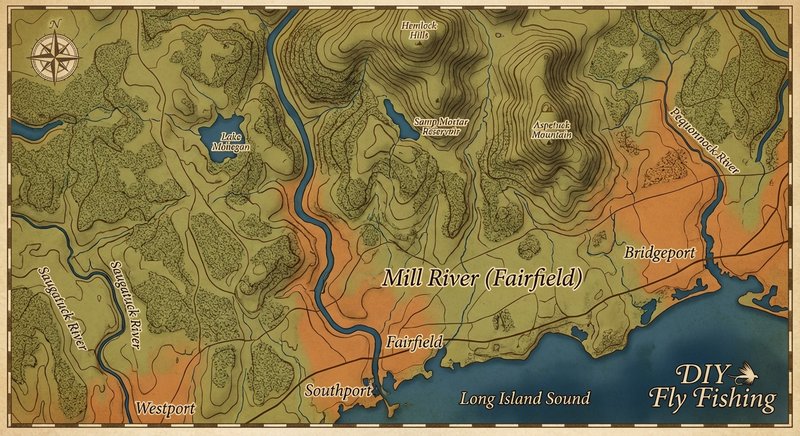
Mill River (Fairfield)
Fly fishing in Connecticut · Intermediate · Best seasons: Fall, Winter
Target Species
Sea-Run Brown Trout, Brown Trout
About This Water
Fairfield County stream with sea-run brown trout. Fall fishing.
Fishing Recommendations
The Mill River in Fairfield, Connecticut, is a unique coastal gem. While many anglers overlook suburban streams, the Mill is a designated Class 1 Wild Trout Management Area (WTMA), offering a rare opportunity to hunt for both resident wild browns and the elusive "Unicorn of the Northeast": the Sea-Run Brown Trout.
As your guide, here is the breakdown for tackling this technical and rewarding fishery.
🎣 Location Overview
The Mill River is a short but productive coastal stream that flows through Fairfield before emptying into Long Island Sound at Southport Harbor. What makes it special is its Class 1 WTMA status, meaning it is managed specifically for wild trout with strict "Catch and Release" regulations.
The river transitions from a classic New England stream with riffles and pools in its upper reaches to a tidally influenced estuary in its lower section. It is a "pocket water" fishery—expect tight quarters, overhanging trees, and very clear water. Anglers love it because it offers a true "wild" experience just minutes away from the hustle of Fairfield County.
🐟 Target Species & Behavior
- Resident Brown Trout: These are 100% wild, born-and-bred fish. They are typically 7–12 inches, though 15-inchers exist. They are incredibly "spooky" and have a high IQ due to the clear water and frequent pressure.
- Sea-Run Brown Trout: These are fish that have migrated to the salt to forage on high-protein baitfish before returning to the river. They are larger (often 16–22+ inches), chrome-colored, and exceptionally strong.
- Behavior: In the fall and winter, resident fish hold in deeper wintering holes or behind current breaks. Sea-runs move up from the estuary following tidal surges and cooler water temps, often holding in the lower river's deeper "guts" or under heavy woody debris.
📅 Best Times to Fish
- Fall (Late September – November): This is the prime window. As water temperatures drop, resident browns become aggressive ahead of the spawn, and the sea-run trout begin their push upstream from the Sound.
- Winter (December – February): This is "Midge Season." The Mill stays slightly warmer than inland rivers due to its coastal proximity. Fish will be lethargic, so focus on the warmest part of the day (11 AM – 3 PM).
- Prime Conditions: Overcast, drizzly days are best. Low-light periods (dawn and dusk) are essential if you are targeting large sea-run browns, as they are notorious for being nocturnal hunters.
🪰 Recommended Flies & Techniques
Nymphing (The Bread and Butter)
Since the river is small, Tight-Line (Euro) Nymphing or a very small indicator rig is most effective.
- Zebra Midges: Sizes 18–22 in black or red.
- Scuds: Sizes 16–18 in pink or olive. Coastal rivers are full of crustaceans.
- Pheasant Tails: Sizes 16–20 (unweighted or slim profiles).
Streamers (For the Sea-Runs)
If you want the "big one," you have to swing or strip streamers.
- Wooly Buggers: Size 8–10 in Olive or Black.
- Mickey Finn: A classic New England pattern that mimics small baitfish.
- White Marabou Streamers: To mimic the silversides and mummichogs found in the estuary.
Presentation Tips
- Stealth: This is the most important "technique." Wear drab clothing. Kneel when approaching a pool. Do not "line" the fish with your fly line.
- The Swing: When fishing the lower river for sea-runs, cast across and let the fly swing through the tail of the pool. Sea-runs often strike out of aggression at the end of the swing.
💡 Pro Tips & Local Knowledge
- Focus on the WTMA: The best wild trout water is located between Samp Mortar Reservoir and Southport Harbor. Specifically, the stretch near Congress Street and the Wildflower Preserve offers excellent structure.
- The "Tidal Push": For the lower river, pay attention to the tides. As the tide comes in, it pushes "cooler" (in fall) or "warmer" (in winter) salt water into the system, often triggering a bite.
- The Log Jam Factor: The Mill is full of fallen timber. While frustrating for beginners, experienced guides know the biggest fish live under the wood. Use a heavier tippet (4X) if you are targeting the wood to ensure you can pull the fish out.
- Small Water, Small Rods: A 7.5ft to 8.5ft 3-weight or 4-weight rod is ideal here. Anything longer will get caught in the trees.
⚠️ Important Information
- Regulations: The Mill River WTMA (Class 1) is Catch and Release Only, Year-Round. You must use barbless hooks. Using bait is strictly prohibited.
- Access:
- Congress Street: Limited parking near the bridge.
- Mill Hollow Park/Southport: Good access points for the lower river.
- Buckley’s Pond area: Check local signage for parking restrictions, as Fairfield is strict about street parking.
- Permits: A valid Connecticut Fishing License and a Trout & Salmon Stamp are required.
- Special Consideration: Be mindful of private property. Much of the Mill flows through residential backyards. Stay in the riverbed (below the high-water mark) to remain legal and respectful.
Guide’s Final Word: The Mill River is not a place where you go to catch 50 fish. It is a place where you go to test your stealth and presentation. If you land a wild brown here, it's a badge of honor; if you hook a sea-run, it’s a memory for a lifetime. Tight lines!
Bug Hatches & Matching Flies
| Hatch | Type | Peak months | Time of day | Hook sizes | Matching flies |
|---|---|---|---|---|---|
| Blue Winged Olive Baetis | mayfly | April, May, September, October | Mid-day/Afternoon | #18-22 | BWO Sparkle Dun #18-20, Pheasant Tail #18-22, RS2 #20-22 |
| Hendrickson Ephemerella subvaria | mayfly | April, May | Afternoon | #12-14 | Hendrickson Pink Lady #14, Red Quill #12-14, Hendrickson Wet Fly #12-14 |
| Sulphur Ephemerella invaria/dorothea | mayfly | May, June | Evening | #14-18 | Sulphur Parachute #16-18, CDC Sulphur Emerger #16-18, Sulphur Nymph #14-16 |
| Tan Caddis Hydropsyche | caddis | May, June, July | Evening/Dusk | #14-18 | Elk Hair Caddis (Tan) #14-16, LaFontaine's Deep Sparkle Pupa #14-18, Iris Caddis #16 |
| Trico Tricorythodes | mayfly | July, August, September | Early Morning | #22-26 | Trico Spinner #22-24, Griffith's Gnat #20-24 |
| Light Cahill Stenacron canadense | mayfly | June, July | Late Evening | #12-14 | Light Cahill Dry #12-14, Cream Usual #14 |
| Zebra Midge Chironomidae | midge | January, February, March, December | All Day | #18-24 | Zebra Midge (Black/Silver) #18-22, Morgan's Midge #20-24 |
| Terrestrials Formicidae/Coleoptera | terrestrial | July, August, September | Late Morning/Afternoon | #12-18 | Black Foam Ant #16-18, Crowe Beetle #14-16, Dave's Hopper #12 |