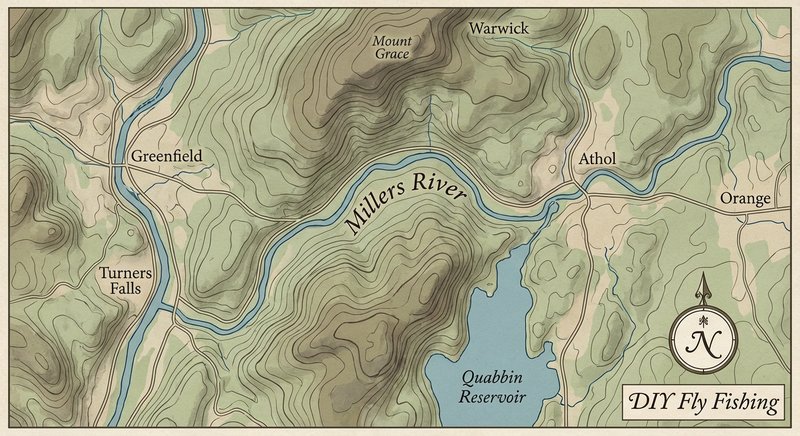
Millers River
Fly fishing in Massachusetts · Beginner · Best seasons: Spring, Summer, Fall
Target Species
Smallmouth Bass, Brown Trout, Rainbow Trout
About This Water
North-central Massachusetts river with smallmouth bass and trout. Good float fishing.
Fishing Recommendations
The Millers River in North-Central Massachusetts is one of the most storied and resilient trout streams in New England. Once a victim of the industrial revolution, the Millers has undergone a remarkable recovery and is now a premier destination for fly anglers seeking a "big water" feel in a state known for smaller brooks. It is a freestone river characterized by diverse water types, from plunging pocket water to long, glassy pools.
🎣 Location Overview
The Millers River flows from Ashburnham down to the Connecticut River at Millers Falls. What makes it special is its rugged, western-style character. It is wider than most Massachusetts streams, requiring longer casts and better line control.
The river is divided into several sections, but the most popular water lies between South Royalston and Erving. Here, the river flows through state forests and deep valleys, offering a sense of wilderness. The bottom is primarily cobble and large boulders, creating classic holding water. It is known for its excellent hatches and a surprising population of holdover trout that grow large and powerful in the river's heavy currents.
🐟 Target Species & Behavior
- Brown Trout: The "kings" of the Millers. While many are stocked, the river has a significant population of holdover browns that become highly piscivorous (fish-eating). They hold in deep undercut banks and behind the largest boulders.
- Rainbow Trout: Generally found in the faster oxygenated riffles and at the heads of pools. They are aggressive and are often the primary targets during the heavy spring and fall stockings.
- Smallmouth Bass: As the water warms in the summer, the lower Millers (below Orange) becomes a world-class Smallmouth fishery. These fish are "river-strong," holding in the tailouts of pools and near woody debris. They feed heavily on crayfish and hellgrammites.
📅 Best Times to Fish
- Spring (Mid-April – June): This is the prime window for trout. The river is high but settles into a rhythmic hatch cycle. Late May is the "Golden Hour" for the Millers when the Hendrickson and Caddis hatches are in full swing.
- Summer (July – August): Trout fishing becomes localized to the colder tributaries (like the Otter River confluence or Bear’s Den) as the main stem warms. This is the peak for Smallmouth Bass, which thrive in the 70°F+ water.
- Fall (September – November): The "Second Season." As water temperatures drop, trout become active again. This is the best time to target large, aggressive Brown Trout looking to bulk up before winter or spawn.
Best Times of Day:
- Spring: Mid-day (11 AM – 4 PM) as the water warms and insects activate.
- Summer: Early morning and late evening (Smallmouth are most active at dusk).
- Fall: Morning and late afternoon.
🪰 Recommended Flies & Techniques
Dry Flies
- Hendrickson (Sizes 12-14): Late April/Early May. Essential.
- Tan/Olive Caddis (Sizes 14-18): Consistent throughout the season.
- Isonychia (Size 10-12): A Millers staple in late summer and fall. These "Iso" nymphs swim to the bank, so fish these near the edges.
- Stimulators (Sizes 8-12): Great for the pocket water sections in South Royalston.
Nymphs
- Pat’s Rubber Legs (Sizes 6-10): In coffee or black. The Millers has a massive population of Golden Stoneflies.
- Pheasant Tail & Prince Nymphs (Sizes 14-18): Standard producers.
- Hellgrammite Patterns: Essential for summer Smallmouth and large trout.
Streamers
- Woolly Buggers (Black/Olive): A universal constant here.
- Kelly Galloup Style Streamers: If you are hunting trophy browns in the deep pools near Erving, go big.
Techniques
- High-Stick Nymphing: Because of the complex currents and boulders, "Euro" or high-stick nymphing is extremely effective to avoid drag.
- Swing the Wet Fly: The Millers is a classic river for swinging soft hackles during a caddis hatch.
- The "Twitch": When fishing Smallmouth in the summer, use a "strip-strip-pause" retrieve with a crayfish pattern along the bottom.
💡 Pro Tips & Local Knowledge
- The Bear’s Den: This is the most famous stretch (located in Athol/New Salem). It is a Catch-and-Release Only area. It features dramatic drops and deep holes. It holds fish year-round but can get crowded on weekends.
- Watch the Flow: The Millers is prone to "blowing out" after heavy rain. Check the USGS gauge at Erving. If it’s over 1,000 CFS, it’s difficult and dangerous to wade. The "sweet spot" for wading is typically between 300 and 600 CFS.
- The "Other" Smallmouth: Don't ignore the slow water right in the town of Orange. Many fly anglers skip it, but the Smallmouth fishing there is arguably some of the best in the state.
- Stealth Matters: Despite its size, the Millers can run very clear. Long leaders (9-12 feet) are often necessary for the flatter pools.
⚠️ Important Information
- Access: Much of the river is bordered by the Millers River Wildlife Management Area. There is excellent access along Rt. 2A and South Royalston Rd.
- Regulations:
- Bear’s Den Section: Catch and Release only (check current MA Division of Fisheries and Wildlife abstracts for specific boundary markers).
- Main Stem: Mostly general regulations, but always check for the specific "Catch and Release" zones which have changed in recent years to protect the fishery.
- Safety: The rocks in the Millers are notoriously slippery—often referred to as "greased bowling balls." Studded wading boots and a wading staff are highly recommended.
- Permit: A valid Massachusetts Freshwater Fishing License is required for everyone 15 and older. These can be purchased online via the MassFishHunt website.
Bug Hatches & Matching Flies
| Hatch | Type | Peak months | Time of day | Hook sizes | Matching flies |
|---|---|---|---|---|---|
| Blue-Winged Olive Baetis / Acerpenna | mayfly | April, May, September, October | Mid-day/Afternoon | #18-22 | RS2 #18-22, Parachute BWO #18-22, WD-40 #20-22 |
| Hendrickson Ephemerella subvaria | mayfly | April, May | Afternoon | #12-14 | Red Quill #12-14, Hendrickson Nymph #12-14, Snowshoe Emerger #12-14 |
| Grannom Caddis Brachycentrus | caddis | April, May | All Day | #14-16 | Peacock Caddis #14-16, Deep Sparkle Pupa #14-16 |
| March Brown Maccaffertium vicarium | mayfly | May, June | Afternoon | #10-12 | March Brown American #10-12, Gold Ribbed Hare's Ear #10-12 |
| Light Cahill Stenonema / Stenacron | mayfly | June, July | Evening | #12-14 | Light Cahill #12-14, Cream Usual #12-16 |
| Isonychia (Slate Drake) Isonychia bicolor | mayfly | June, September | Late Afternoon/Evening | #10-12 | Iso Parachute #10-12, Prince Nymph #10-14, Zug Bug #10-12 |
| White Fly Ephoron leukon | mayfly | August | Evening/Dusk | #12-14 | White Wulff #12-14, Ephoron Spinner #12-14 |
| Trico Tricorythodes | mayfly | July, August, September | Early Morning | #20-24 | Trico Spinner #20-24, Trico Nymph #22-24 |
| Spotted Sedge Hydropsyche | caddis | May, June, July | Evening | #14-18 | Elk Hair Caddis #14-18, LaFontaine's Emergent Pupa #14-16 |
| Giant Golden Stonefly Acroneuria | stonefly | June, July | Morning/Evening | #6-10 | Golden Stone Nymph #6-10, Pat's Rubber Legs #8-12 |