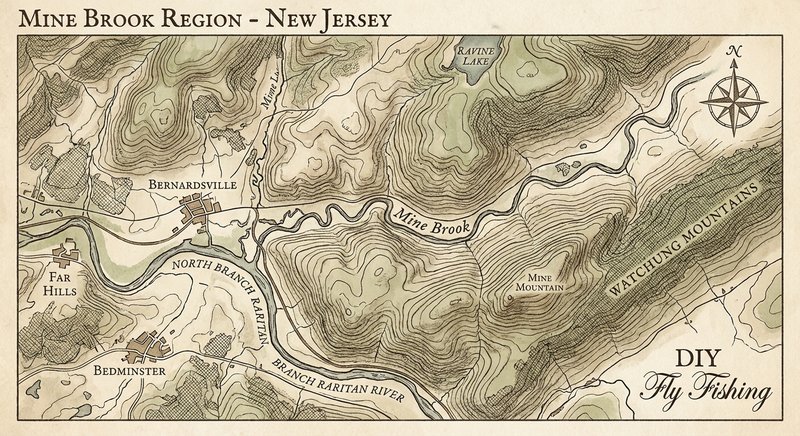
Mine Brook
Fly fishing in New Jersey · intermediate · Best seasons: spring, summer
Target Species
Brook Trout
About This Water
Somerset County stream with native brook trout. Headwaters offer small stream adventure.
Fishing Recommendations
Mine Brook, winding through the rolling hills of Somerset County near Bernardsville and Far Hills, is one of New Jersey’s hidden gems. While many anglers flock to the larger North Branch of the Raritan, Mine Brook offers a more intimate, "blue-ribbon" style experience for those who appreciate small-stream tactics and wild, native fish.
Here is your comprehensive guide to fly fishing Mine Brook, New Jersey.
🎣 Location Overview
Mine Brook is a high-quality tributary of the North Branch of the Raritan River. It is classified by the NJ Division of Fish and Wildlife as Trout Production (TP) water, meaning it possesses the water quality and habitat necessary to support the natural reproduction of trout.
What makes Mine Brook special is its "English Chalkstream" feel in certain stretches, contrasted by rugged, rocky pocket water in others. It is a narrow, intimate stream, often heavily canopy-covered, requiring precision and stealth. Anglers love it because it feels a world away from the suburban bustle, offering a chance to catch New Jersey’s only native salmonid—the Eastern Brook Trout—in a wild state.
🐟 Target Species & Behavior
The primary draw here is the Wild Brook Trout. While you may occasionally find a wild Brown Trout or a "dropout" Rainbow from the main stem, the Brookies are the kings of this creek.
- Behavior: These fish are extremely "spooky." In such small water, they are highly sensitive to shadows, vibrations on the bank, and sloppy casting.
- Holding Areas: Look for "the kitchen"—places where food is delivered. This includes the heads of small pools, behind larger boulders, and especially under overhanging root balls or undercut banks.
- Feeding: They are opportunistic feeders. Because nutrients in small freestone streams can be limited, they rarely pass up a well-presented meal, but they will prioritize safety over food if they sense a predator.
📅 Best Times to Fish
Optimal Seasons
- Spring (April – June): This is the prime window. Water levels are usually stable, and the aquatic insect activity is at its peak. The fish are hungry after the winter and looking to put on weight.
- Summer (Late June – August): Fishing remains good because of the heavy tree canopy that keeps water temperatures lower than the main rivers. However, you must carry a thermometer. If the water hits 68°F, stop fishing to protect the trout.
Best Times of Day
- Low Light Windows: Dawn and dusk are magical on Mine Brook. Brook trout feel more secure moving out from under cover during these times.
- Overcast Days: A light drizzle or a cloudy day breaks the glare on the water and makes the fish significantly less skittish.
🪰 Recommended Flies & Techniques
Top Fly Patterns
- Dry Flies:
- Elk Hair Caddis (Size 16-18): A staple for the frequent caddis hatches.
- Royal Wulff (Size 16): High visibility for the angler and an irresistible "attractor" for the fish.
- Parachute Adams (Size 18-20): Perfect for the technical flat-water sections.
- Nymphs:
- Pheasant Tail (Size 18-20): Mimics the small mayfly nymphs common in the gravel.
- Zebra Midge (Size 20-22): Essential for low, clear water.
- Terrestrials (Summer Must-Haves):
- Black Ants (Size 18-20): Often the most productive fly in July.
- Foam Beetles (Size 16): Great for "splatting" near undercut banks.
Effective Techniques
- The Bow-and-Arrow Cast: Given the tight overhead cover, you will rarely perform a traditional overhead cast. Master the bow-and-arrow cast to get your fly into tight pockets under low-hanging branches.
- High-Sticking: Use a short line and keep as much fly line off the water as possible to avoid "drag," which will immediately spook wild fish.
- Stealth Approach: Fish upstream. Brook trout face into the current; if you approach from behind, you are less likely to be seen.
💡 Pro Tips & Local Knowledge
- Dress Like a Ninja: Avoid bright white or "fishing blue" shirts. Wear olive, tan, or camo to blend into the riparian foliage.
- The "One Cast" Rule: On a stream this small, your first cast is your best (and often only) chance. Spend two minutes observing the pool for rises before you ever pull line off the reel.
- Focus on the Upper Reach: The further upstream you go toward the headwaters, the higher the density of wild Brookies, though the fish will be smaller (4–7 inches).
- The Scherman Hoffman Connection: Parts of the stream run near protected sanctuary lands. The riparian buffers here are excellent, providing the woody debris that Brook trout love.
⚠️ Important Information
Access & Regulations
- Public vs. Private: Much of the land surrounding Mine Brook is private. Look for public bridge crossings and areas adjacent to the Scherman Hoffman Wildlife Sanctuary or local parklands. Always respect "Posted" signs; New Jersey landowners are protective of their property.
- Regulations: Mine Brook is often subject to Wild Trout Stream regulations.
- Check the current NJ Fish & Wildlife Digest.
- Usually, these waters are Catch and Release or have highly restrictive size/creel limits.
- Barbless hooks only are highly recommended to ensure the survival of these fragile wild populations.
Special Considerations
- Wading: The stream is small enough that you can often fish from the bank. If you must wade, do so gingerly to avoid silting up the downstream pools or crushing the delicate macroinvertebrates the trout rely on.
- Ticks: This area of Somerset County is "Ground Zero" for deer ticks. Always wear repellent and do a thorough check after your session.
Bug Hatches & Matching Flies
| Hatch | Type | Peak months | Time of day | Hook sizes | Matching flies |
|---|---|---|---|---|---|
| Blue-winged Olive Baetis | mayfly | April, May, September, October | Mid-day to Afternoon | #18-22 | BWO Sparkle Dun #18-20, Pheasant Tail Nymph #18-22 |
| Hendrickson Ephemerella subvaria | mayfly | April | Afternoon | #12-14 | Hendrickson Dark #12-14, Red Quill #14 |
| Grannom Caddis Brachycentrus | caddis | April, May | Morning/Evening | #14-16 | Elk Hair Caddis (Olive) #14-16, Deep Sparkle Pupa #14-16 |
| Sulphur Ephemerella invaria/dorothea | mayfly | May, June | Evening | #14-18 | Sulphur Parachute #16-18, Sulphur Emerger #16-18 |
| Tan Caddis Hydropsyche | caddis | May, June, July | Evening | #14-18 | LaFontaine's Sparkle Pupa #14-16, Tan Elk Hair Caddis #14-18 |
| Early Black Stonefly Capniidae | stonefly | February, March | Mid-day | #16-18 | Black Zebra Midge #18-20, Early Girl Stonefly #16-18 |
| Trico Tricorythodes | mayfly | July, August, September | Early Morning | #22-26 | Trico Spinner #22-24, Sunken Trico Spinner #22-24 |
| Terrestrials (Ants and Beetles) Formicidae / Coleoptera | terrestrial | July, August, September | All Day | #12-18 | Black Foam Ant #16-18, Crowe Beetle #14-16 |
| Zebra Midge Chironomidae | midge | January, February, March, December | All Day | #18-24 | Zebra Midge (Black/Silver) #20-22, Griffith's Gnat #20-22 |