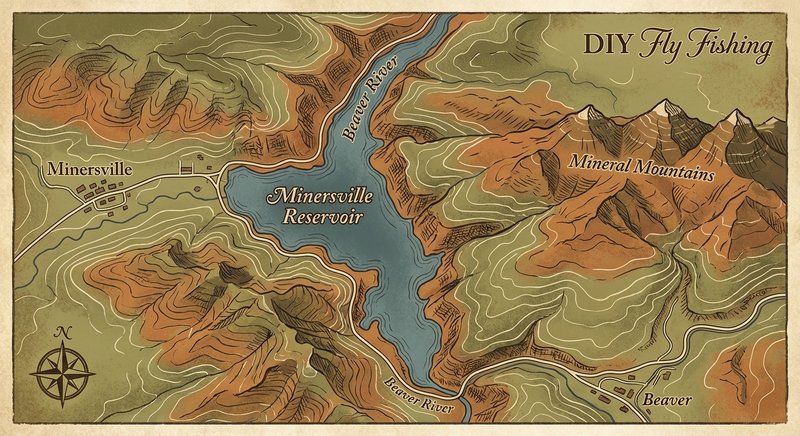
Minersville Reservoir
Fly fishing in Utah · Beginner · Best seasons: Spring, Fall, Winter
Target Species
Rainbow Trout, Brown Trout
About This Water
Central Utah reservoir with excellent trout fishing. Good winter fishery.
Fishing Recommendations
Welcome to the high desert of Southern Utah. As your guide, I can tell you that Minersville Reservoir is one of the premier trophy trout stillwaters in the Western United States. It isn’t a "numbers" lake where you’ll catch 30 small fish a day; instead, it is a "quality" fishery where any hookup could be the rainbow of a lifetime.
Here is your comprehensive guide to fly fishing Minersville Reservoir.
🎣 Location Overview
Located just west of the town of Beaver, Utah, Minersville Reservoir is a man-made impoundment set in a stark, beautiful high-desert landscape. What makes this water special is its alkaline chemistry and high productivity. The water is rich in nutrients, leading to massive populations of scuds, midges, and damselflies.
The reservoir is relatively shallow with extensive weed beds and submerged rock structures. Because of the nutrient-dense water, the fish here grow at an incredible rate, often appearing "football-shaped"—short, deep, and incredibly powerful. For the fly angler, it offers a true stillwater challenge that rewards patience and technical proficiency.
🐟 Target Species & Behavior
- Rainbow Trout: These are the primary residents. They are frequently stocked as fingerlings and grow rapidly on a diet of protein-rich scuds. They are known for their aerial acrobatics and blistering runs. They cruise the weed edges and drop-offs in "pods."
- Brown Trout: While less numerous than the rainbows, the browns in Minersville can reach massive proportions. They are more nocturnal and predatory, often holding tighter to rocky structure or the dam face, feeding on smaller fish and large leeches.
Behavior: These fish are "cruisers." They move along the edges of weed beds in 5 to 15 feet of water. They are highly sensitive to surface vibration and shadows, making stealth and long casts essential.
📅 Best Times to Fish
- Spring (March – May): This is arguably the prime window. As the ice melts (Ice-off), the fish are hungry and congregate in the shallows. Midge hatches are prolific in April.
- Fall (September – November): As water temperatures drop, fish move from the deep central channels back to the shoreline. This is the best time to target large Browns as they become aggressive prior to their spawning window.
- Winter (December – February): Minersville often freezes over, but during mild winters or early/late season, the open water near the dam can be productive. Midges are the only game in town during the winter.
- Optimal Conditions: Overcast days with a "light chop" on the water are perfect. The wind breaks the surface tension, making the fish less spooky and masking your leader.
🪰 Recommended Flies & Techniques
Top Fly Patterns
- Midges/Chironomids: Zebra Midges (size 16–20) in black/silver, red/silver, or olive.
- Scuds: The "bread and butter" of Minersville. Use Flashback Scuds or Ray Charles patterns in orange, olive, or pink (size 14–18).
- Leeches: Balanced Leeches are a game-changer here. Black, olive, or "Bruised" (purple/black) are top producers.
- Damselflies: During late spring, olive Marabou Damsels with gold beads are deadly.
- Streamers: Woolly Buggers or thin-mints fished on a sinking line.
Effective Techniques
- Static Indicator Nymphing: This is the most effective method. Use a long leader (12–15 feet) to suspend a midge or scud 1–2 feet off the bottom or just above the weed line.
- The "Slow Crawl": Use a camolux or intermediate sinking line with a damselfly or leech pattern. Retrieve it with agonizingly slow "figure-eight" hand twists.
- The Hang: When stripping flies, always pause for 5–10 seconds when the fly is right near the boat/shore. Fish often follow the fly and strike when it stops or starts to rise.
💡 Pro Tips & Local Knowledge
- Master the Wind: The wind usually kicks up in the afternoon. If you are in a float tube or pontoon, use the wind to drift your flies over the submerged points near the North end of the lake.
- Focus on the "Drop": Use a fish finder or topographic map to locate the old river channel. Fish will hold in the deep cool water of the channel and move onto the flats to feed. The transition zone (the drop-off) is where you should focus your efforts.
- Long Leaders are Key: Because the water is often clear, use fluorocarbon tippets (4X or 5X) and leaders at least 12 feet long to prevent spooking these wary "trophy" fish.
- Float Tubes Rule: While you can fish from the shore near the dam or the boat ramp, a float tube or kick-boat allows you to stay stealthy and reach the weed lines that are just out of casting distance from the bank.
⚠️ Important Information
- Special Regulations: Minersville is managed as a Trophy Water.
- Artificial Flies and Lures Only: No bait allowed (no PowerBait, worms, or scented gels).
- Limit: Check the current Utah Big Game/Fishing guidebook, but typically it is a 1-fish limit, and that fish must be over 22 inches. Most anglers here practice 100% Catch and Release.
- Access: The main access is via the Minersville State Park (State Route 21). There is a fee for day use.
- Safety: The wind can come up fast and be dangerous for small watercraft. Always wear a PFD and keep an eye on the clouds over the mountains to the west.
- Supplies: The town of Beaver is your last stop for gas, ice, and food. There are no fly shops directly at the lake, so stock up on midges and scuds before you arrive.
Guide’s Final Word: Minersville is a thinking man’s lake. Don't be discouraged if the first few hours are slow. When the bite turns on, you aren't just catching fish—you're catching some of the heaviest trout in the Great Basin. Tight lines!
Bug Hatches & Matching Flies
| Hatch | Type | Peak months | Time of day | Hook sizes | Matching flies |
|---|---|---|---|---|---|
| Chironomids Chironomidae | midge | March, April, May, September, October | All Day | #10-22 | Zebra Midge #16-20, Ice Bud Midge #12-16, Chanter's Chironomid #12-14 |
| Callibaetis (Speckled Duns) Callibaetis | mayfly | May, June, July, August | Morning/Early Afternoon | #12-16 | Parachute Adams #14-16, Callibaetis Spinner #14-16, Hare's Ear Nymph #14-16 |
| Damselflies Enallagma | terrestrial | June, July | Late Morning/Afternoon | #10-14 | Marabou Damsel #10-12, Braided Butt Damsel #12-14, Adult Damsel #12 |
| Scuds (Freshwater Shrimp) Gammarus | terrestrial | April, May, October, November | All Day | #12-18 | Ray Charles #14-18, Flashback Scud #12-16, Orange Scud #14-16 |
| Traveling Sedge Hesperophylax | caddis | June, July, August | Evening | #8-12 | Godzilla Caddis #8-10, Mikulak Sedge #10-12, Caddis Pupa #10-12 |
| Water Boatmen Corixidae | terrestrial | September, October | Afternoon | #14-18 | Water Boatman #14-16, Prince Nymph #14-18 |
| Dragonflies Anisoptera | terrestrial | June, July, August | Daytime | #4-10 | Dragon Slayer #6-10, Woolly Bugger (Olive) #4-8 |
| Terrestrials (Hoppers/Ants) Formicidae / Orthoptera | terrestrial | July, August, September | Afternoon | #8-16 | Parachute Hopper #8-12, Cinnamon Ant #14-16, Chernobyl Ant #8-12 |