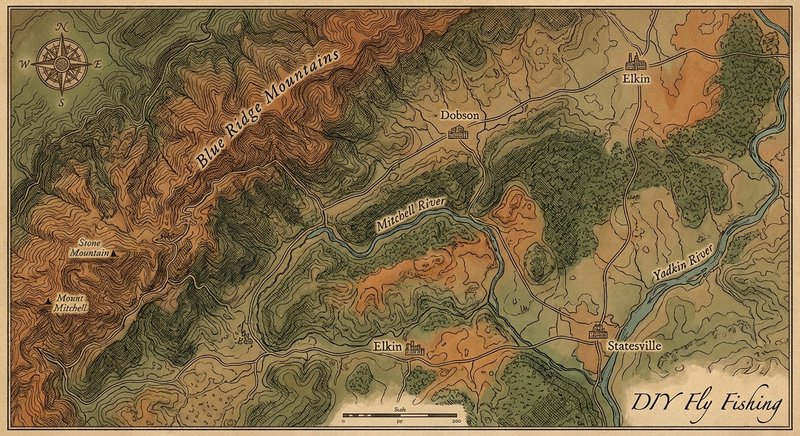
Mitchell River
Fly fishing in North Carolina · Beginner · Best seasons: Spring, Fall, Winter
Target Species
Brown Trout, Rainbow Trout
About This Water
Piedmont trout stream with delayed harvest section. Wild brown trout present.
Fishing Recommendations
The Mitchell River, located in Surry County near Dobson, North Carolina, is a gem of the Blue Ridge foothills. Unlike the high-gradient mountain streams to the west, the Mitchell flows through rolling farmland and woodlots, offering a classic "pastoral" fly fishing experience. It is widely considered one of the finest Delayed Harvest (DH) waters in the state due to its exceptional water quality and scenic beauty.
🎣 Location Overview
The Mitchell River is unique because it is designated as Outstanding Resource Waters (ORW), a testament to its clarity and purity. The river is a mid-sized freestone stream characterized by a mix of long, glassy pools, shallow riffles, and occasional deep runs.
What makes it special is the substrate—a mix of granite boulders and fine gravel—which provides excellent habitat for aquatic insects. It is less rugged than the streams in the Smoky Mountains, making it accessible for anglers of all fitness levels. The river has a "small-town" feel, winding through private agricultural land where the state has secured public fishing easements.
🐟 Target Species & Behavior
The Mitchell is primarily a Rainbow and Brown Trout fishery. While there are some wild fish in the upper reaches, the main section is heavily stocked as part of the North Carolina Wildlife Resources Commission’s (NCWRC) Delayed Harvest program.
- Rainbow Trout: These are the "socialites" of the river. They tend to congregate in the faster water at the heads of pools and in the riffles. They are opportunistic and flashy, often the first to hit an attractor pattern.
- Brown Trout: The "ambush predators" of the Mitchell. They hold in deeper, darker water under overhanging banks or near submerged timber. In the late fall and early winter, they become more aggressive as they move toward spawning season.
- Behavior: Because it is a DH stream, the fish can be "naive" immediately after stocking in October. However, by mid-winter, they become highly educated and "leader shy" due to heavy fishing pressure.
📅 Best Times to Fish
The Mitchell is a seasonal powerhouse, best fished from October through early June.
- Spring (March – May): This is the "Golden Era." As water temperatures rise into the 50s, the bugs start moving. This is your best chance for dry fly action.
- Fall (October – November): The start of the DH season. The river is freshly stocked, and the autumn foliage makes for a spectacular backdrop.
- Winter (December – February): This is for the technical angler. The water is cold and clear. Fish move into the deep, slow pools to conserve energy.
- Prime Window: On the Mitchell, the 10:00 AM to 3:00 PM window is crucial during winter and early spring to take advantage of the warmest water temperatures and sporadic hatches.
🪰 Recommended Flies & Techniques
Top Fly Patterns
- Nymphs:
- Sexy Walt’s Worm (Size 14-18) - A local staple.
- Pheasant Tail (Size 16-20) - Mimics the prolific Blue Winged Olives.
- Zebra Midge (Red or Black, Size 18-22) - Essential for winter.
- Attractors:
- Squirmy Wormies and Egg Patterns - Deadly in the fall and after a rain when the water has some color.
- Frenchie (Size 14-16) - Great for high-visibility targeting.
- Dry Flies:
- Blue Winged Olive (BWO) (Size 18-22) - The primary winter/spring hatch.
- Elk Hair Caddis (Size 14-16) - Effective in the late spring.
- Streamers:
- Woolly Bugger (Black or Olive) - Work these slowly through deep holes for bigger Browns.
Techniques
- Euro Nymphing: This is arguably the most effective way to fish the Mitchell. Because the river isn't overly deep, a tight-line setup allows you to feel the subtle takes of pressured fish.
- Dry-Dropper: In the riffles, a size 14 Parachute Adams with a small Zebra Midge dropped 18 inches below is a "search and destroy" tactic.
- Slow-Swing Streamers: In the winter, don't strip aggressively. Cast across and let the streamer swing slowly into the "bucket" of the pool.
💡 Pro Tips & Local Knowledge
- The Kapps Mill Section: This is the most famous stretch. It features a historic mill dam. The water below the dam is highly oxygenated and holds fish year-round.
- Go Small and Long: During the mid-winter months, the water becomes gin-clear. Drop your tippet size to 6X or even 7X Fluorocarbon and use a 9-foot to 12-foot leader to avoid spooking fish.
- Watch the Gauge: The Mitchell can blow out after heavy rains. Check the USGS gauge (Mitchell River near State Road, NC). You want to see a flow between 60 and 120 cfs for ideal wading. If it's over 200 cfs, it’s getting dangerous.
- The "Secret" Upper Reaches: Most people crowd the bridge crossings. If you are willing to walk half a mile upstream or downstream from the access points, you’ll find pods of fish that haven't seen a fly all day.
⚠️ Important Information
Access Information
Public access is primarily through the Mitchell River Game Land and specific easements on Kapps Mill Road and River Road. Look for the diamond-shaped NCWRC "Public Fishing Access" signs.
Regulations
- Delayed Harvest (Oct 1 – first Saturday in June): During this time, it is Catch and Release ONLY and Single-Hook Artificial Lures ONLY. No bait is allowed.
- June – September: The river reverts to "Hatchery Supported" rules, where harvesting is allowed and bait can be used. (Note: The water often gets too warm for trout in the peak of summer; please check water temps before fishing to ensure fish survival).
Permits
A valid North Carolina Fishing License with a Trout Signoff is required for all anglers 16 and older. You can purchase these online via the NCWRC website or at local fly shops in nearby Elkin or Dobson.
Guide’s Parting Words: Respect the private landowners. The Mitchell exists because farmers allow us on their property. Stay within the banks, pack out your trash, and enjoy one of the most peaceful rivers in the South.
Bug Hatches & Matching Flies
| Hatch | Type | Peak months | Time of day | Hook sizes | Matching flies |
|---|---|---|---|---|---|
| Blue Winged Olive Baetis | mayfly | March, April, October, November | Mid-day/Afternoon | #18-22 | RS2 #18-22, Parachute Adams #18-22, Pheasant Tail #18-20 |
| Quill Gordon Epeorus pleuralis | mayfly | March, April | Afternoon | #12-14 | Quill Gordon #12-14, Hare's Ear #12-14 |
| Hendrickson Ephemerella subvaria | mayfly | April | Afternoon | #12-14 | Red Quill #12-14, Hendrickson Cripple #14 |
| Sulfur Ephemerella dorothea | mayfly | May, June | Evening | #14-18 | Sulfur Parachute #14-16, Sulfur Sparkle Dun #16-18 |
| Tan Caddis Hydropsyche | caddis | April, May, June, September | Morning/Evening | #14-18 | Elk Hair Caddis #14-16, Holy Grail #14-16, Frenchie #14-18 |
| Yellow Sally Isoperla | stonefly | May, June, July | Afternoon/Evening | #14-16 | Yellow Sally #14-16, Iron Lotus #16 |
| Light Cahill Stenacron / Stenonema | mayfly | June, July, August | Evening | #12-14 | Light Cahill #12-14, Cream Mid-Dun #14 |
| Terrestrials Formicidae / Coleoptera | terrestrial | July, August, September | All Day | #10-18 | Cinnamon Ant #16-18, Black Foam Beetle #14-16 |
| Zebra Midge Chironomidae | midge | January, February, December | Morning/Afternoon | #18-24 | Zebra Midge #18-22, Griffith's Gnat #20-22 |
| Little Black Stonefly Allocapnia | stonefly | February, March | Mid-day | #16-18 | Little Black Stonefly #16-18, Prince Nymph #14-18 |