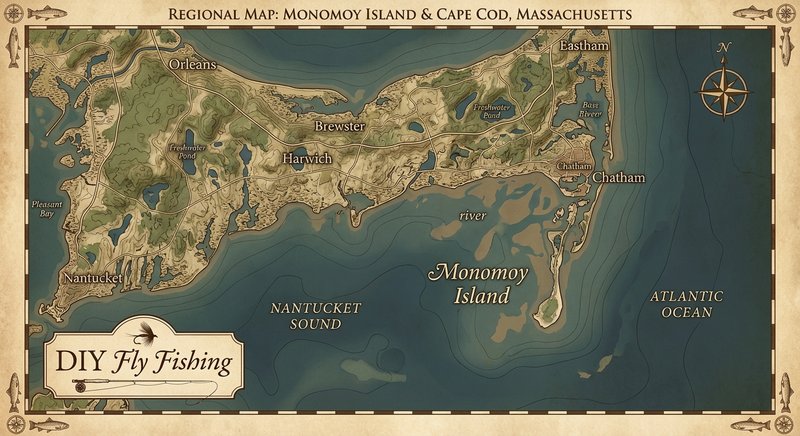
Monomoy Island
Fly fishing in Massachusetts · Advanced · Best seasons: Summer, Fall
Target Species
Striped Bass, Bluefish, False Albacore
About This Water
Cape Cod National Wildlife Refuge with trophy striped bass. Remote flats fishing.
Fishing Recommendations
Welcome to one of the most storied and visual fly fishing destinations on the Atlantic coast. Monomoy Island, extending south from Chatham, Massachusetts, is a dynamic wilderness of shifting sands, extreme tides, and crystalline water. Often referred to as the "Bermuda of the North," its white sand flats offer sight-fishing opportunities that rival the Caribbean—but for hard-fighting, cold-water predators.
🎣 Location Overview
Monomoy is a federal wildlife refuge consisting of a 12nd-mile barrier beach divided into "North Monomoy" and "South Monomoy." What makes it legendary is the clarity of the water and the dynamic geography.
The area is defined by "The Rip"—where the Atlantic Ocean meets the calmer waters of Nantucket Sound. This creates massive sandbars, deep channels, and vast shallow flats. Anglers love Monomoy because it is one of the few places in New England where you can sight-cast to a 30-plus inch Striped Bass in knee-deep water. It is a true wilderness experience; once you are dropped off by a boat, you are at the mercy of the tides and the wind.
🐟 Target Species & Behavior
Striped Bass (Stripers)
The main attraction. In the early season, they push onto the flats to warm up and forage. On the Monomoy flats, they behave like Bonefish, cruising the edges of drop-offs or "moping" in the heat of the day. They feed on sand eels, crabs, and shrimp.
Bluefish
Known as "yellow-eyed devils," they often patrol the deeper edges of the rips and the "Pollock Rip." They are aggressive, fast, and will destroy flies. They feed primarily on larger baitfish like menhaden (pogy) and squid.
False Albacore (Albies)
A fall specialty. These "hardtails" are pure muscle. They don't linger; they slash through schools of rain bait (anchovies) at high speeds. You’ll see them "busting" on the surface, often near the southern tip of the island.
📅 Best Times to Fish
Optimal Seasons
- June (The Peak): This is the prime time for sight-fishing the flats. The water is clear, the bass are hungry after their migration, and the sun is high enough for good visibility.
- September – October: The "Fall Run." This is when the False Albacore arrive and the big "cows" (large female bass) begin their migration south.
Prime Conditions
- Sun: High sun (10:00 AM – 2:00 PM) is critical for sight-fishing the flats so you can see through the water column.
- Tide: The outgoing tide is generally preferred. As the water drains off the flats, it pulls baitfish into the deeper "scours" and channels where the bass wait in ambush.
- Wind: A light southwest wind is manageable, but a strong "Noreaster" will churn up the sand and ruin the visibility (making sight-fishing impossible).
🪰 Recommended Flies & Techniques
Top Fly Patterns
- Sand Eel Clouser Minnow: (Size 2 to 2/0) - The "bread and butter" of Monomoy. Olive/White or Chartreuse/White.
- Mushmouth / EP Fiber Minnow: Perfect for imitating the translucent look of local baitfish.
- The Mushy / Gurgler: For topwater action, especially in the early morning or when Bluefish are active.
- Crab & Shrimp Patterns: Use these on the flats when bass are "tailing" or rooting in the sand.
Effective Techniques
- Sight Casting: Walk the flats slowly. Look for "shadows" or "nervous water." When you spot a fish, lead them by 3-5 feet.
- The "Strip-Strike": Never trout-set (lifting the rod). When a Striper hits, pull the line hard with your stripping hand to set the hook.
- Fishing the Rips: From a boat, cast across the current into the standing waves and let your fly "swing" through the turbulence where the fish are holding.
💡 Pro Tips & Local Knowledge
- The "Monomoy Shuffle": When wading, shuffle your feet. This area is home to many Stingrays and Skates. Shuffling prevents you from stepping directly on one.
- Gear Up: An 8-weight or 9-weight fast-action rod is the standard. Use a saltwater floating line for the flats and a fast-sink tip line (250-350 grain) if you are fishing the deep rips.
- Long Leaders: Because the water is so clear, use long fluorocarbon leaders (9–12 feet) tapered to 16lb or 20lb test to avoid spooking fish.
- The Great White Factor: Be aware—Chatham is the epicenter for Great White Sharks in the North Atlantic. Avoid wading waist-deep in "greasy" or dark water near the outer beaches, and never wade where seals are present.
⚠️ Important Information
Access
- Boat Access Only: Monomoy is an island. Most anglers use the Monomoy Island Ferry (a "rip runner" taxi service) out of Chatham Fish Pier to get dropped off for a day of wading.
- Walking: Be prepared to walk miles. The sand is soft, and the terrain is taxing. Good wading boots with gravel guards are essential.
Regulations & Permits
- Saltwater License: You must have a Massachusetts Recreational Saltwater Fishing Permit.
- Refuge Rules: As a National Wildlife Refuge, certain areas (especially the dunes) may be closed to protect nesting shorebirds (Piping Plovers). Stay below the high-tide line.
- Striped Bass Limits: Regulations change annually. Currently, there is a very narrow "slot limit" for harvesting. Most fly anglers practice 100% catch and release to protect the fishery.
Safety
- Fog: Chatham is famous for sudden, thick fog. If you are DIY-ing, carry a GPS/InReach.
- Tides: The tide moves fast. It is easy to get "cut off" on a sandbar as the water rises behind you. Always keep an eye on your exit path to the main beach.
Bug Hatches & Matching Flies
| Hatch | Type | Peak months | Time of day | Hook sizes | Matching flies |
|---|---|---|---|---|---|
| Salt Marsh Midge Chironomus salinarius | midge | May, June, September | Evening | #18-24 | Zebra Midge #18-20, Griffith's Gnat #20-22 |
| Greenhead Fly Tabanus nigrovittatus | terrestrial | July, August | Afternoon | #10-14 | Deer Hair Greenhead #12, Black Foam Beetle #14 |
| Maritime Grasshopper Trimerotropis maritima | terrestrial | August, September | Afternoon | #8-12 | Joe's Hopper #10-12, Dave's Hopper #8-10 |
| Flying Ant Lasius neoniger | terrestrial | September | Afternoon | #16-20 | Cinnamon Ant #16-18, Black Foam Ant #18-20 |
| Northeastern Beach Tiger Beetle Cicindela dorsalis dorsalis | terrestrial | July | Morning/Afternoon | #12-14 | Tan Foam Beetle #14 |
| Brine Fly Ephydra subopaca | midge | June, July | Morning | #18-22 | RS2 #20, Brassie #18-22 |
| Fall Field Cricket Gryllus pennsylvanicus | terrestrial | September, October | Evening | #8-12 | Black Cricket #10-12 |
| Salt Marsh Mosquito Aedes sollicitans | midge | July, August, September | Evening/Night | #18-22 | Mosquito #18-20, Blood Worm #14-18 |