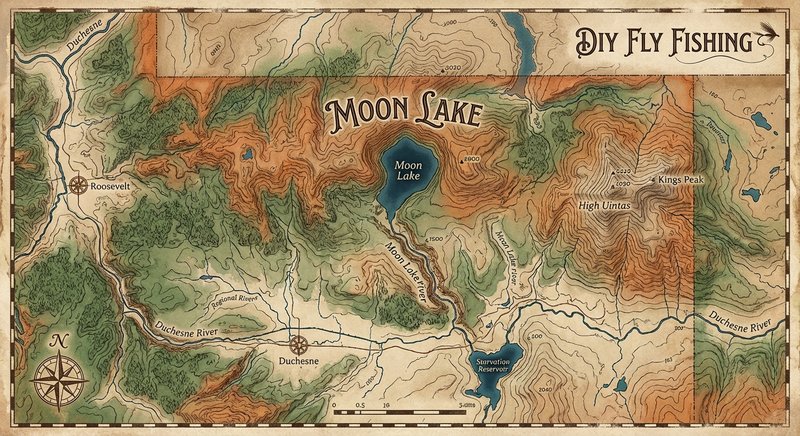
Moon Lake
Fly fishing in Utah · Beginner · Best seasons: Summer, Fall
Target Species
Rainbow Trout, Brown Trout, Splake
About This Water
High Uinta reservoir with excellent trout fishing. Scenic campground access.
Fishing Recommendations
Welcome to the High Uintas. As your guide, I can tell you that Moon Lake is one of the most scenic and rewarding stillwater fisheries in Utah. Tucked into a deep glacial trough at roughly 8,100 feet, it serves as the gateway to the southern Uinta Wilderness.
Here is your comprehensive guide to fly fishing Moon Lake.
🎣 Location Overview
Moon Lake is a high-altitude reservoir characterized by crystal-clear, cold water and dramatic surroundings. What makes it special is its "end-of-the-road" feel—it’s remote enough to avoid the heavy crowds of the Wasatch Front but accessible enough for a day trip from Duchesne.
The lake is unique because it offers a mix of deep-water habitat and productive shoreline shelves. The North end, where Lake Fork River enters, creates a classic inlet fishery, while the steep eastern and western banks provide rocky drop-offs where predatory trout lurk. It is a place where you can find solitude, jagged granite backdrops, and fish that are often more aggressive than their pressured cousins in lower-elevation lakes.
🐟 Target Species & Behavior
- Rainbow Trout: These are the most common and active fish. They cruise the shorelines in the morning and evening, feeding on midges and small crustaceans. They are often found in the top 10 feet of the water column.
- Brown Trout: Moon Lake holds some truly large, "hook-jawed" Browns. They are piscivorous (fish-eaters) here. They hold tight to the submerged rocky ledges and become most active during low-light conditions or when the wind puts a "chop" on the water.
- Splake (Lake Trout x Brook Trout hybrid): This is the "trophy" draw of Moon Lake. Splake love the cold, deep water. They behave similarly to Lake Trout, often holding near the bottom or patrolling the transition zones where the shallow shelf drops into the abyss. In the fall, they move shallower to "spawn" (though they are sterile), making them highly accessible to fly anglers.
📅 Best Times to Fish
- Optimal Seasons:
- Summer (Late June – August): Best for consistent dry fly action and "numbers" of fish. The water is warmest, and insect activity is at its peak.
- Fall (September – October): This is the prime window for Splake and Large Browns. As water temperatures drop, these deep-dwellers move into the shallows. The crowds disappear, and the fish get aggressive before winter.
- Best Times of Day:
- Dawn and Dusk: Essential for Brown trout.
- 10:00 AM – 2:00 PM: Best for sight-fishing the shallows for cruising Rainbows when the sun is high enough to penetrate the water.
- Prime Conditions: A "Uinta Breeze" (light chop) is actually your friend; it breaks up the surface tension, making the fish less spooky and more willing to hit a dry fly or streamer.
🪰 Recommended Flies & Techniques
Top Fly Patterns
- Streamers:
- Olive or Black Woolly Bugger (Size 6-10): The gold standard here.
- Sculpzilla or Complex Twist Bugger: To mimic the small sculpins and baitfish the Browns and Splake crave.
- Nymphs:
- Balanced Leech (Peacock or Maroon): Deadly under an indicator.
- Chironomids (Size 14-18): Zebra Midges in black/silver or red.
- Hare’s Ear or Pheasant Tail: Classic generalist patterns for the inlet.
- Dry Flies:
- Parachute Adams (Size 14-18): Covers most hatches.
- Chernobyl Ant or Foam Cicada: In late summer, terrestrials blown off the trees are a major food source.
Techniques
- The "Slow Strip" Streamer: Use a sink-tip line. Cast toward the rocky banks, let it sink for 5-10 seconds, and use a slow, erratic strip to mimic a wounded minnow.
- Indicator Rigging: Hang a Balanced Leech 4–6 feet below an indicator along the drop-offs. Let the wave action provide the movement.
- The Inlet Approach: At the north end where the river enters, fish it like a slow-moving stream. Swing soft hackles or dead-drift nymphs through the current seams.
💡 Pro Tips & Local Knowledge
- Focus on the Drop-offs: Moon Lake has a distinct "shelf." Fish will cruise the shallow flat, but they feel safest right on the edge of the deep blue water. Position your boat or stand on the shore so you can cast across that transition line.
- The North End Secret: If you have a float tube or kayak, head to the North end where the Lake Fork River flows in. The moving water brings constant food and oxygen. This is a hotspot for Rainbows and the occasional Brook Trout that wanders down from the high country.
- The "Fall Splake" Strategy: In October, look for the Splake over sandy or gravelly bottoms in 5–15 feet of water. Use a bright orange or white streamer to trigger an aggression strike.
- Wind Safety: The wind can howl down the canyon in the afternoon. If you are in a float tube, stay mindful of your distance from the launch point; it’s a tough paddle back against a headwind.
⚠️ Important Information
- Access: Follow Highway 87 to Mountain Home, then head north on Moon Lake Road. The road is paved most of the way but can be washboarded near the end.
- Boating: There is a boat ramp. Small motors are allowed, but it is a "no-wake" lake, making it a paradise for human-powered craft (canoes, kayaks, float tubes).
- Regulations: Check the current Utah Fishing Guidebook. Generally, the limit is 4 trout in the aggregate, but I always recommend Catch and Release for the large Browns and Splake to preserve the trophy quality.
- Facilities: There is a Forest Service campground (Moon Lake Campground) and a small resort/store that operates seasonally.
- Environment: You are in bear country (Black Bears). If you are camping or keeping fish, practice proper food storage.
Guide’s Final Word: Moon Lake rewards the patient angler. If the bite is slow, change your depth before you change your fly. Most people fish too shallow—get that fly down to where the Splake live, and you'll have a day to remember.
Bug Hatches & Matching Flies
| Hatch | Type | Peak months | Time of day | Hook sizes | Matching flies |
|---|---|---|---|---|---|
| Callibaetis (Speckled Duns) Callibaetis spp. | mayfly | July, August | Late Morning to Mid-Afternoon | #14-16 | Parachute Adams #14-16, Callibaetis Spinner #16, Hare's Ear Nymph #14-16 |
| Chironomids (Midges) Chironomidae | midge | May, June, September | All Day | #12-22 | Zebra Midge #16-20, Ice Cream Cone #12-16, Griffith's Gnat #18-22 |
| Traveling Sedge Hesperophylax | caddis | July, August | Evening | #10-12 | Goddard Caddis #10-12, Elk Hair Caddis #12-14, LaFontaine's Deep Sparkle Pupa #12-14 |
| Damselfly Enallagma | terrestrial | June, July | Late Morning/Afternoon | #10-14 | Marabou Damsel Nymph #10-12, Adult Damsel #12-14 |
| Pale Morning Dun (PMD) Ephemerella excrucians | mayfly | June, July | Late Morning/Early Afternoon | #16-18 | PMD Sparkle Dun #16-18, Pheasant Tail Nymph #16-18 |
| Terrestrials (Ants and Beetles) Formicidae / Coleoptera | terrestrial | August, September | Afternoon | #12-18 | Cinnamon Ant #14-16, Black Foam Beetle #12-16 |
| Scuds (Freshwater Shrimp) Gammarus | midge | May, June, September | All Day | #12-16 | Ray Charles #14-16, UV Scud (Olive/Orange) #12-16 |
| Little Black Caddis Brachycentrus | caddis | May, June | Morning/Afternoon | #16-18 | Z-Caddis #16-18, Peacock Caddis #16-18 |