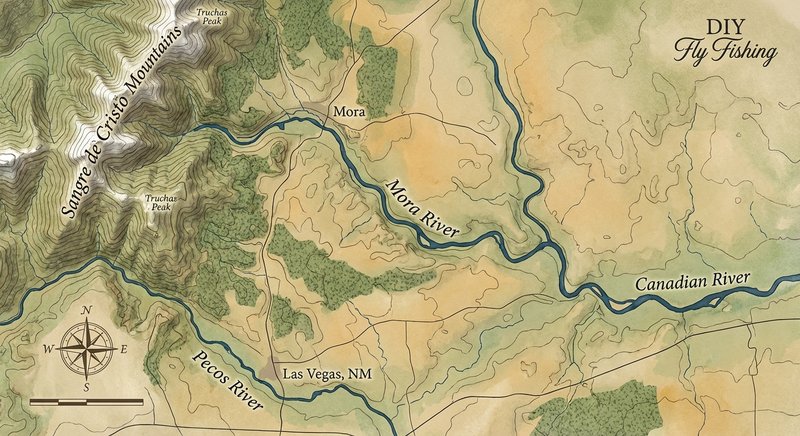
Mora River
Fly fishing in New Mexico · Intermediate · Best seasons: Summer, Fall
Target Species
Brown Trout, Rainbow Trout
About This Water
Mountain stream with wild browns. Less pressured fishing near Mora Valley.
Fishing Recommendations
The Mora River is one of Northern New Mexico’s hidden gems. While often overshadowed by the nearby Pecos or the Cimarron, the Mora offers a classic, intimate "small water" experience. Flowing through the eastern slopes of the Sangre de Cristo Mountains, it transitions from a high-alpine creek into a meandering meadow stream, providing a technical but rewarding challenge for the dedicated fly angler.
🎣 Location Overview
The Mora River is characterized by its diversity. In its upper reaches within the Pecos Wilderness, it is a tumbling, high-gradient stream filled with plunge pools and pocket water. As it moves lower, particularly around the town of Mora and through the Coyote Creek State Park area, it flattens out into lush meadows.
What makes the Mora special is its solitude. Unlike the crowded banks of the San Juan, you can often spend a whole day here without seeing another soul. The water is typically crystal clear but very cold, fed by snowmelt and mountain springs. It is a "skinny water" fishery, meaning stealth and precise presentations are more important than long-distance casting.
🐟 Target Species & Behavior
- Brown Trout: The stars of the Mora. These are wild, wary, and exceptionally beautiful. They dominate the undercut banks and deep holes. They are opportunistic but get "spooky" quickly in the clear, shallow runs.
- Rainbow Trout: Found primarily in the stocked sections near public access points and bridge crossings. They tend to hold in the faster riffles and at the heads of pools where oxygen levels are higher.
- Behavior: These fish are highly sensitive to vibration and shadows. Because the river is narrow, they often hold tight against "structure"—submerged logs, overhanging willows, and deep undercut sod banks. During hatches, they will move into the shallow tail-outs of pools to intercept emergers.
📅 Best Times to Fish
Optimal Seasons
- Summer (Late June – August): This is the prime window for dry fly action. Terrestrials become a major food source as the meadow grasses grow tall.
- Fall (September – October): This is arguably the best time for big Browns. As they prepare for the spawn, they become aggressive. The changing Aspen leaves provide a stunning backdrop, and the water temperatures are perfect.
Best Times of Day
- Summer: Early morning (6 AM – 10 AM) before the sun hits the water, and late evening "power hours" during the caddis hatches.
- Fall: Mid-day becomes more productive as the water needs time to warm up. 10 AM to 4 PM is the sweet spot.
🪰 Recommended Flies & Techniques
Top Fly Patterns
- Dry Flies:
- Stimulators (Orange or Yellow, size 12-16) – Great for prospecting.
- Elk Hair Caddis (Tan, size 14-18) – A staple for evening hatches.
- Parachute Adams (size 16-20) – The ultimate "match-all" fly for the Mora.
- Terrestrials: Dave’s Hopper, Amy’s Ant, or a simple Black Foam Beetle (size 12-16).
- Nymphs:
- Bead-head Pheasant Tail (size 16-20) – Mimics the natural mayflies.
- Prince Nymph (size 14-18) – Works well in the faster pocket water.
- Pats Rubber Legs (Small, size 12) – Effective in the deeper holes during higher flows.
- Streamers:
- Woolly Buggers (Black or Olive, size 10-12) – Dead-drifted or slowly twitched through deep undercut banks.
Techniques
- Dry-Dropper: This is the "bread and butter" technique here. Use a buoyant Hopper or Stimulator as your indicator and hang a small Pheasant Tail 18-24 inches below it.
- High-Sticking: In the upper canyon sections, use short-line nymphing techniques to keep your line off the complex currents.
- Stealth Approach: Kneel when approaching pools. If you can see the fish, they have likely already seen you.
💡 Pro Tips & Local Knowledge
- The "Willow Flick": The Mora is lined with thick willows. Practice your side-arm and roll casts. Being able to "flick" a fly under an overhanging branch is the difference between a 2-fish day and a 20-fish day.
- Focus on the Under-Cuts: Some of the largest Browns in the river live in holes you can't even see—tucked 2 feet back under the grassy bank. Cast your fly inches from the bank and let it drift naturally.
- Check the Flows: The Mora is small; a heavy monsoon rain can turn it chocolate milk in an hour. Always check local USGS gauges or weather reports before making the drive.
- The "Coyote Creek" Connection: If the main stem of the Mora is running high, head up to Coyote Creek State Park (a major tributary). It offers excellent public access and is frequently stocked with Rainbows.
⚠️ Important Information
Access
- Public vs. Private: This is the most critical factor on the Mora. Much of the river runs through private land/ranches. Always look for "Posted" signs.
- Public Spots: Focus on the Pecos Wilderness sections (requires hiking), Coyote Creek State Park, and designated Bureau of Land Management (BLM) or State Game and Fish access points near Cleveland and Holman.
Regulations & Permits
- License: A valid New Mexico Fishing License is required. You also need a "Habitat Management & Access Validation" (HMAV).
- Bag Limits: Check the current New Mexico Fishing Ribbons (regulations) as specific stretches may have "Catch and Release" or tackle restrictions (barbless hooks).
Special Considerations
- Wildlife: This is Black Bear and Mountain Lion country. Carry bear spray if you are hiking into the wilderness sections.
- Monsoon Safety: In July and August, afternoon thunderstorms are common. Get off the water if you see lightning, as flash floods in these narrow canyons are a real danger.
Bug Hatches & Matching Flies
| Hatch | Type | Peak months | Time of day | Hook sizes | Matching flies |
|---|---|---|---|---|---|
| Midges Chironomidae | midge | January, February, March, December | Late Morning/Afternoon | #18-24 | Zebra Midge #18-22, Griffith's Gnat #20-22, Top Secret Midge #20-24 |
| Blue Winged Olive Baetis | mayfly | March, April, September, October | Midday | #18-22 | RS2 #18-22, Parachute Adams #18-22, Pheasant Tail #18-20 |
| Mother's Day Caddis Brachycentrus | caddis | May | Morning/Afternoon | #14-16 | Peacock Caddis #14-16, Deep Sparkle Pupa #14-16, Elk Hair Caddis (Black) #14-16 |
| Pale Morning Dun Ephemerella | mayfly | June, July | Late Morning | #16-18 | PMD Sparkle Dun #16-18, Split Case PMD #16-18, Mercer's Poxy Back PMD #16-18 |
| Golden Stonefly Hesperoperla pacifica | stonefly | June, July | Morning/Evening | #8-12 | Pat's Rubber Leg #8-12, Chubby Chernobyl #10-12, 20 Incher #10-14 |
| Little Yellow Sally Isoperla | stonefly | June, July, August | Afternoon/Evening | #14-16 | Yellow Sally Dry #14-16, Iron Lotus #16, Stimulator (Yellow) #14-16 |
| Cinnamon Caddis Hydropsyche | caddis | July, August, September | Evening | #14-18 | Elk Hair Caddis (Tan) #14-18, LaFontaine's Emergent Pupa #16-18, Hare's Ear #14-18 |
| Grasshoppers Orthoptera | terrestrial | August, September | All Day | #8-12 | Hopper Juan #10-12, Morrish Hopper #8-12, Dave's Hopper #10-12 |